Female Networks under Coverture
October 6, 2014
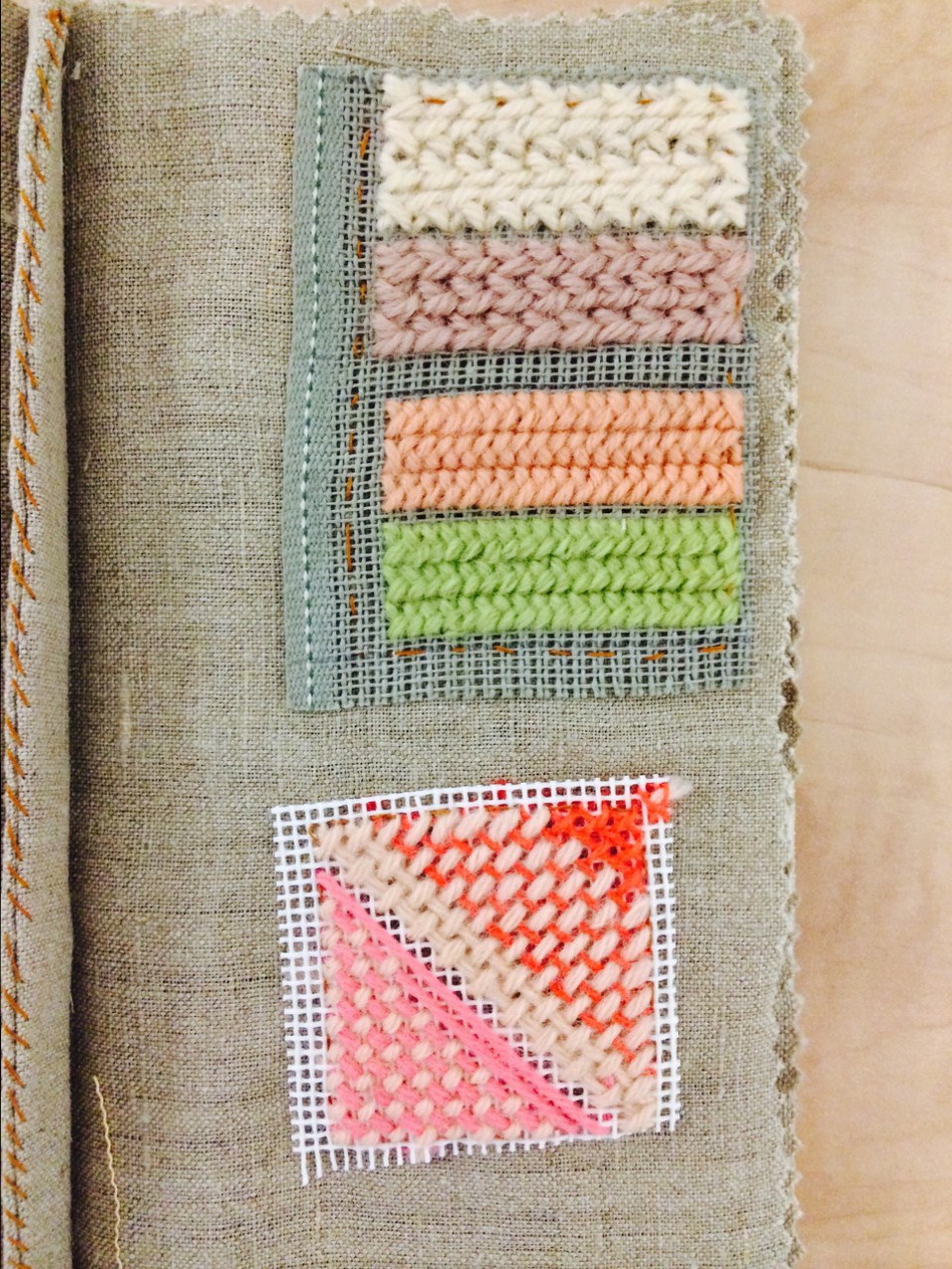
Detail of twentieth century stitching from Happy Hands Studio (Pendelton, Oregon) from unique artist book by Roberta Lavadour called “Happy Hands”
During the Era of Enlightenment men pressed women to place their whole affections upon family, relegating mothers to rule the “gentle empire” of the home. The sensibilities of common law versus civil law dictated how marriage became a woman’s primary social network. Under Anglo-American common law a wife had no rights in regards to making contracts or holding real property. The status as feme covert (married) or feme sole (single) often determined a woman’s ability to network with other women and with men. Under coverture, wives and children were both treated dependents. Female subordination within the family, men argued, reflected their subordination under common law and divine government that asserted, “Influence by reason when you can, by authority when you must.”
Cloth and clothing production became another area supported by female social networking. Adam Smith described the social networks needed to produce a common woolen coat for a laborer in his The Wealth of Nations: “The shepherd, the sorter of wool, the wool-comber or corder, the dyer, the scribbler, the spinner, the weaver, the fuller, the dresser, with many others, must all join their different arts in order to complete even this homely production.” Feme sole, a never-married woman, has remained an anomaly within women’s networking. The woman who remained unmarried was referred to with the derisive term of “spinster.” When it was first used, to define a woman with the occupation of spinning it was a term of respect. However, a woman without a male protector were obliged to live modest and discrete lives of service to family, church, or a respectable occupation like a teacher, or risk being the target of brutal rumors and speculation. Single women were sometimes stigmatized if they resided in boardinghouses located outside of respectable residential neighborhoods, since “boardinghouse” also euphemistically referred to “bordello.” Widows, also considered to be feme sole, sometimes financed other female enterprises utilizing their “dower” income.
In the United States, many single women moved to the frontiers to pursue careers as schoolteachers or missionaries. During the California Gold Rush, the state legislature enacted laws to enable married women to establish businesses as sole traders, rather than to expose single women to the dangers of dealing with volatile males. An important but subtle shift of power occurred when married women and widows kept controlled their real property – women could establish benevolent relief societies in the formal business or public sector for women who found themselves in bad situations. During the 1870s women doctors in San Francisco established the Pacific Dispensary Hospital for Women and Children where only female physicians cared for patients, but as the organization moved to affiliate with medical colleges they were forced to allow male physicians to administer this teaching hospital.
Little girls were socialized as they learned domestic arts throughout. Girls would assist adult women in their households with spinning thread, weaving cloth, making candles, and needlework including sewing, knitting, dressmaking, quilting, embroidery – decorative sewing done with colored thread. They learned how to sew when they were very young, often stitching their first quilt square by the age of four years, and demonstrated skills learned in samplers.
Women and Historic Social Networking
October 3, 2014
Today the Internet offers women infinite ways of networking socially. Women’s demographic numbers and resources get exploited without equitable representation. Charities advertised the chance to walk for this or run for that cause in order to raise money (or “awareness), but these efforts are also supporting fundraising infrastructures. Women have historically fought to have their voices individually and collectively heard, women have collectively built institutions only to have those institutions usurped by men who asserted that women should to heed collective male expertise. Themes of dependency, poverty, gender, and ultimately mortality delineated how women traditionally networked until the late-nineteenth century. During wartime, women’s social networks sustained their broader communities. Women left to support families when men fathers, brothers and husbands were killed or disabled utilized female skills and artistry to support families, and to hold and maintain family property. However, after the conflicts ended, women were relegated to more dependent roles. Prior to women suffrage, women did not have government representation and were treated as dependents. Excluded from political and economic responsibilities, women collectively focused on their reproductive duties.
In some hunter/gatherer societies women were isolated from men during menstruation. This fundamental dichotomy has been manifested in diverse ways throughout time and across cultures. Midwives served integral roles in traditional female networking. During the eighteenth century, up to 45 percent of women did not survive to the age of fifty years, usually due to complications from childbirth. The skilled midwife within a community was essential to the wellbeing of women in that community until male physicians entered the birthing chamber during the late eighteenth century. A woman’s childbearing years, a period lasting about twenty-five years, along with distractions during her child rearing duties, cumulatively weakened her ability to network beyond her neighborhood or immediate community.
Female networks often centered on food cultivating, harvesting, and preparation. Women used raw natural materials to construct practical items for survival. Women were charged throughout the seasons with harvesting, preserving, and cooking food to make the best use of these resources that including working in the dairy, making butter and cheeses; preserving meat from the hunt and fish; preserving fruits and vegetables, and bee keeping. Women gathered and made baskets to store or carry foodstuffs, water, or other items that exhibited design motifs identifying the community in different regions depending upon the availability of local grasses, bark, twigs, and willow.
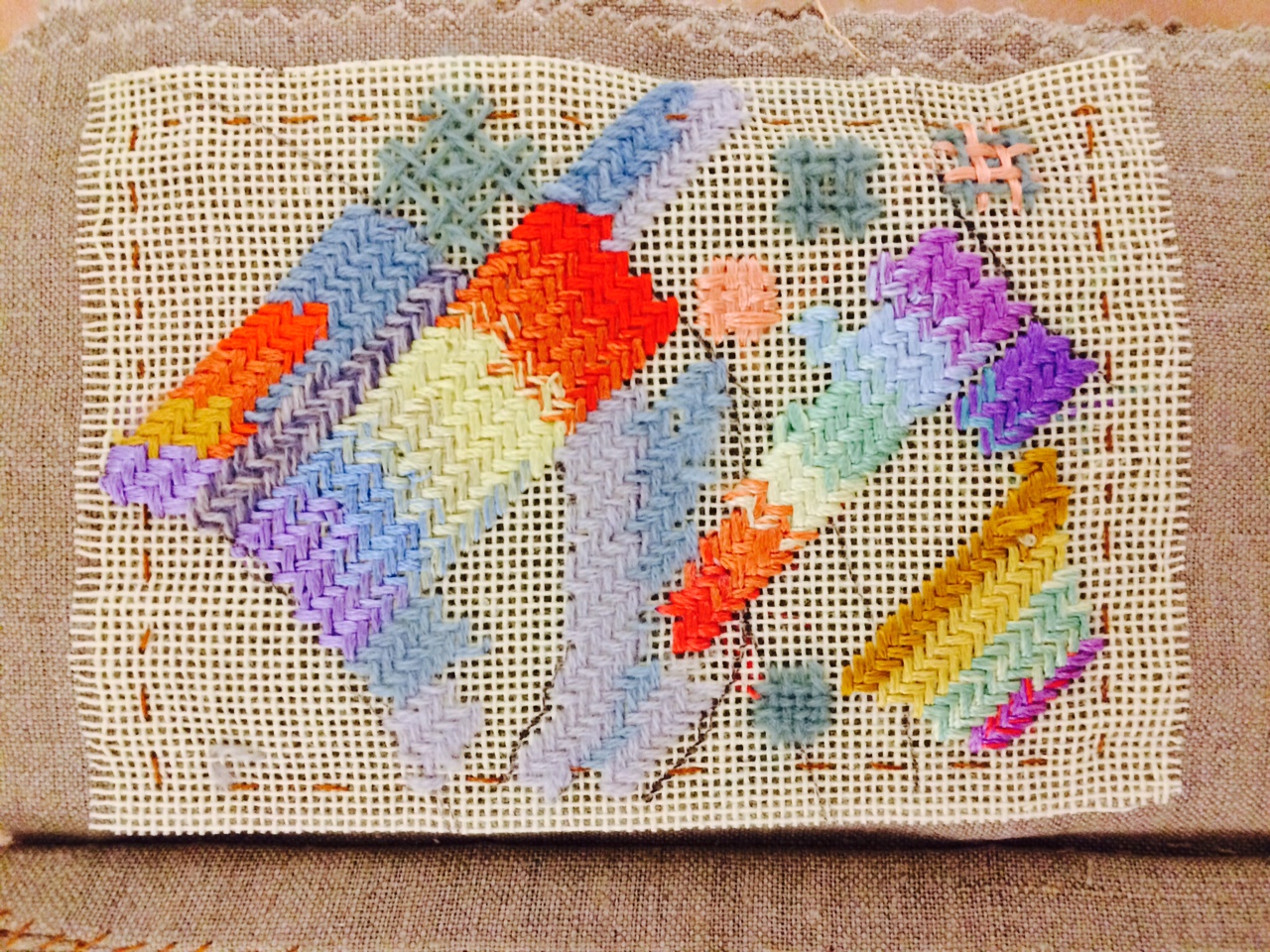
Detail of twentieth century stitching from box of from Happy Hands Studio (Pendelton, Oregon) from unique artist book by Roberta Lavadour called “Happy Hands”
Housewife Guides and the Cult of True Womanhood
October 2, 2014
Housewife guides during the nineteenth century provided women with written scripts to follow in organizing daily household tasks as well as their roles in society. First written by men, housewife guides written by women reveal the intellectual thinking of women over the centuries. Within popular culture, even as changing societal attitudes loosened the some of the restrictions on younger women — virtue, humility, and purity remained prized in American women, and women worked within these parameters to run households as they began to organize grassroots reform.
Barbara Welter wrote about the “cult of true womanhood” a sensibility held between 1820 and 1860 that American women were expected to pursue lives of sheltered passivity and ennobled domesticity. In a separate “private” sphere, women had authority over moral and family issues. Women created an “anti-materialistic” world in the home that balanced the “sordid world of men and public life.” In the cult of true womanhood women were encouraged to be pious, pure, domestic and submissive. Mrs. Hester Chapone (1727-1801) in her epistolary book, Letters on the Improvement of the Mind Addressed to a Young Lady (1797) asserted, “A worthy woman is never destitute of valuable friends, who in a great measure supply to her the want of nearer connections.”
Lydia Maria Child (1802-1880) wrote from experience when The American Frugal Housewife (1829) offered practical knowledge for women with husbands who could not provide for families. Child had a prescient mind seeing that one of the great challenges within the American home was the economic and emotional consequences of slavery. Child’s popular compendium, The Little Girl’s Own Book (1833) included maxims for a girl’s health and gracefulness suggesting that girls wake up early and wash frequently in pure cold water and that girls get a lot of outdoor exercise. Beyond offering household advice, she was instrumental in the publication of Harriet Jacobs’ account Incidents in the Life of a Slave Girl (1861) and An Appeal for the Indians (1868), and her views were seen as radical by the mainstream press.
The efficiency with which women ran their households enabled them to organize and network and accomplish substantive reforms. Catherine Beecher (1800-1896) who organized women’s schools and colleges intellectually reconciled, through her writing, how existing patterns of female subordination attributed to the “cult of true womanhood” was necessary to sustain American democratic sensibilities in antebellum America. In her Treatise on Domestic Economy (1841), she illustrated the consistency of Christian ideals of democracy to American social hierarchies. Beecher proposed a new schema for professionalizing domestic work and schooling. She utilized Lockean theory to substantiate her argument that women’s activities required the same autonomous and practical critical thinking skills for domestic tasks in the private sector as were required of men in experiencing success in careers in the public sector. In the wake of the post-Civil War boom, Beecher and sister Harriet Beecher Stowe (1811-1896) in their American Woman’s Home (1869), attempted to direct women to prudently acquire and use the plethora of new consumer products available. The sisters advised, “The chief cause of woman’s disabilities and sufferings, that women are not trained, as men are, for their peculiar duties – the aim of this volume to the honor and remuneration of domestic employment.”
With coverture, the legal sensibility was that wives and children needed to be treated in the same way, and therefore needed to be malleable. Reverend Daniel Smith in his book The Parent’s Friend, or Letters on the Government and Education of Children and Youth (1845) taught that female subordination within the family led to subordination to civil law and divine government: “Let your child understand that your commands must be obeyed. Parental government does not consist in so many whippings, or corrections of this or the other kind, but in fixing in the mind of the child this impression, ‘I must and ought to obey.’” Smith supported the patriarchal hierarchy of coverture that asserted, “Influence by reason when you can, by authority when you must.”
Julia McNair Wright (1840-1903), the wife of a clergyman, was a prolific writer of women’s novels, didactic literature, poems, cookbooks, and scientific works on botany. She carried on in the tradition of Rev. Smith, and was published by the Presbyterian Board of Publication as well as the National Temperance Society. Wright’s 584-page tome The Complete Home: An Encyclopedia of Domestic Life and Affairs (1879) was a text on domestic economy that reflected her influence and popularity with American female readers throughout her forty-year career.
Moving into the twentieth century, women’s voices in regards to domestic work shifted radically as they fought for and obtained the vote. Elizabeth Cady Stanton (1815-1902) was seventy-seven years old when she wrote The Solitude of Self (1892) after stepping down from the presidency of the National American Woman Suffrage Association. Stanton recognized the political ramifications and psychological resources of “self” or of a woman having an individual life, ”Whatever theories may be on woman’s dependence on man, in the supreme moments of her life, he cannot bear her burdens.” Later, Betty Friedan (1921-2006), a journalist writing for popular women’s magazines, in The Feminine Mystique (1963) called on women to seek satisfying and intellectually stimulating careers in public life without renouncing their roles within the home.
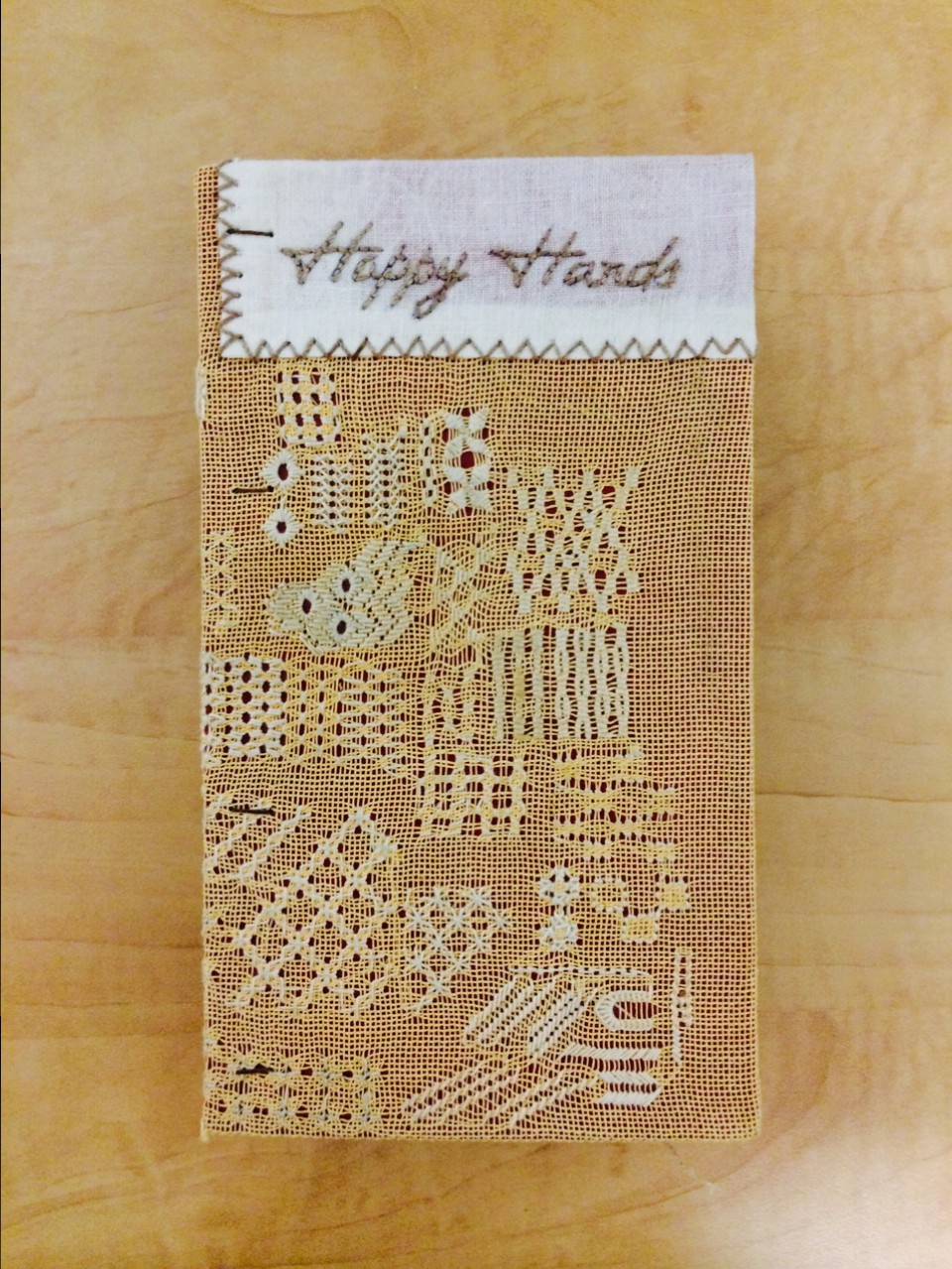
Detail of twentieth century stitching from Happy Hands Studio (Pendelton, Oregon) from unique artist book by Roberta Lavadour called “Happy Hands”
Further Reading
Hemphill, C. Dollett. Bowing to Necessities: A History of Manners in America, 1620-1860. New York: Oxford University Press, 1999.
Where did American Women Writers Lurk?
October 1, 2014
Austen eventually eclipsed her American counterparts, partially because of her great talent, partially because dialogues and epistolary fiction were diminishing in popularity, and partially because Columbia underwent a far more radical transformation than Britannia between the 1790s and 1820s. Women gained greater access to subjects for study that had formerly been off limits. British writer Jane Marcet, née Haldimand, (1769-1858) began to write “conversations” on chemistry, botany, religion, and economics in 1806 and they remained popular textbooks in the United States until the 1850s. American-born proponent for women’s education Emma Willard (1787-1870) began writing books about American history and geography in the 1820s that would greatly expand feminine consciousness relative to national and world conversations for generations. Austen would have related to Willard’s educational philosophy in which mothers taught children to think about current events, geography and history personal own knowledge: Each individual is to himself the centre of his own world; and the more
Intimately he connects his knowledge to himself, the better will it be remembered, the more effectual can it be rendered in after life subservient to his purposes. Hence in geography, he should begin with his own place extending from thence to his country, and to the world (Willard 1828, xiv).
The American Sunday-School Union (A.S.S.U.) was established in Carey’s hometown of Philadelphia in 1817 as a coalition of local Protestant Sunday-school groups. Denominational Sunday schools familiar today superseded the ecumenical A.S.S.U. (Reinier 1996: 121). The A.S.S.U.’s goal beyond establishing Sunday-schools was to provide communities with libraries and reading materials for moral instruction. This non-sectarian organization was a pioneering powerhouse in developing book distribution networks throughout America. Indeed, the A.S.S.U. provided the educational materials and training to children and adults on the frontier – carrying on Carey and Weems’ mission to transmit a shared national identity and values into the rural South (Reinier 1996: 178).
The A.S.S.U. deliberately set out to create indigenous popular literature in America. Writers from many denominations in a single generation produced quality literature so widely read that it caused a complete revolution in the reading habits and tastes of Americans. Authors including women contributing to the Union’s publications but were seldom credited unless the work was of a scientific nature. American in spirit and content, millions of books on health, history, travel, biography, science and fiction lessened the need for dialogues in America. Books were modestly priced to be affordable to most families and remained influential until the 1860s when public libraries began to provide easy access to more attractive literature.
Mathew Carey retired in 1824. His son Henry C. Carey (1793-1879) later served as Lincoln’s chief economic advisor along with his brother-in-law Isaac Lea continued the business as Carey & Lea. During the 1830s, the firm reintroduced Austen to a broader audience of American readers by publishing her major works as a series: Elizabeth Benet, or, Pride and Prejudice (1st American edition from the 3rd London edition, 1832), Mansfield Park (1832), Persuasion (1832), Sense and Sensibility (1833), Northanger Abbey (including a brief biography of Austen, 1833); and when the firm expanded as Carey, Lea & Blanchard a second American edition of Emma was published in 1833.
Bibliography
Reinier, Jacqueline S. From Virtue to Character: American Childhood, 1775-1850. New York: Twayne Publishers, 1996.
Willard, Emma. History of the United States, or Republic of America. New York: White, Gallaher & White, 1829.
 MME Designs's Weblog