Another dangerous operatic triangle
July 27, 2016
Norma (1831) composed by Vincenzo Belini (1801-1835) and based upon the libretto by Felice Romani (1788-1865) tells the epic story of a Druid priestess who breaks her vows and bears two children of a Roman soldier only to discover he has fallen in love with a younger woman. This quintessential bel canto opera was one of the first to be performed in Gold Rush San Francisco.
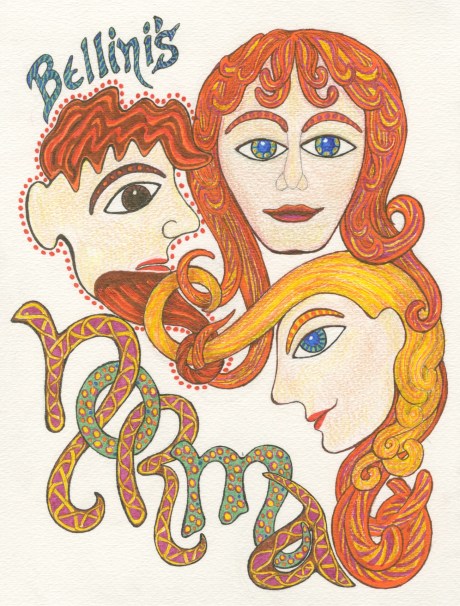
Design featuring Celtic motifs from the “Book of Kells” by Meredith Eliassen, 2016.
What’s Susanna’s secret?
July 26, 2016
The Trade Wind Opera Company has gathered for a short summer run… in the San Francisco fog.
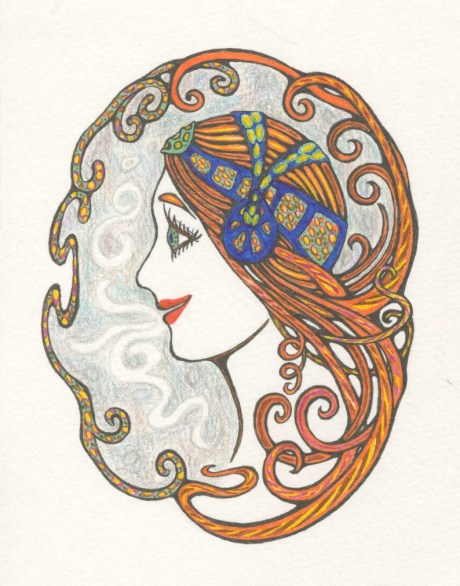
Hint… see the smoke in the fog? Design by Meredith Eliassen, 2016.
Susanna has a secret habit… Il segreto di Susanna is an intermezzo in one act by Ermanno Wolf-Ferrari (1876-1948) with a libretto by Enrico Golisciani (1848-1919) that premiered with a German translation in 1909.
More Shakespeare…
June 28, 2016
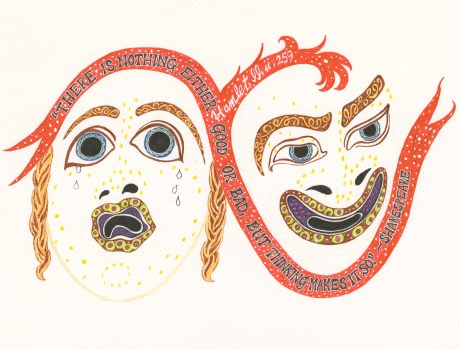
“There is nothing either good or bad, but thinking makes it so.” Words by William Shakespeare in Hamlet, act 2, scene 2, design inspired by the Tragic Comic Masks in the Hadrian’s Villa mosaic drawn by Meredith Eliassen, 2016.
Si: “I’m Just a Girl who can’t say no”
March 9, 2016
So the Trade Wind Opera Company concludes its first season with this singular Mascagni operetta in three acts is based upon Carlo Lombardo’s operetta La duchessa del Bal Tabarin and Felix Dörmann’s libretto for Majestät Mimi.
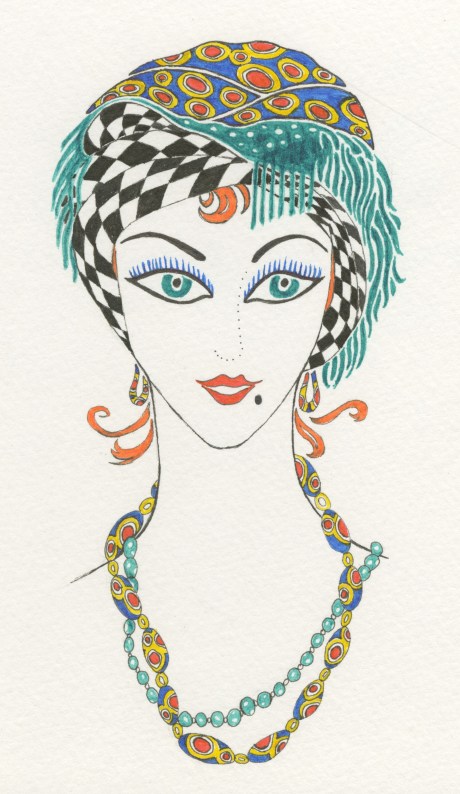
Portrait of Si wearing a strand of millefiore “trade wind” beads from the operetta by Pieto Mascagni (1863-1945) and librettist Carlo Lombardo (1869-1959), design by Meredith Eliassen, 2016
This design depicts, Si, a woman with the romantic spirit of a nomad, someone who is initially carefree in her romantic life. Inspired by the design concept of the “girl head” or “gypsy” tattoo, Si has a colorful, bold, pretty face with detailed adornments. According to tattoo historians, this form of tattoo design is traced to nomadic gypsies, also known as the Romanis that migrated to Europe.
Stay tuned for more operatic designs…
Will Turandot Figure out What True Love Means?
March 6, 2016
Turandot by Giacomo Puccini (1858-1924) is most nearly based upon Turandot by Carlo Gozzi that is in turn based on a story from the 12th-century epic The Seven Beauties by Persian poet Nizami about a princess Turan-Dokht how was the daughter of Turan. Set in China, the Prince Calaf, falls in love with aloof Princess Turandot. In order to obtain permission to marry Turandot, any suitor must solve three riddles correctly, and any wrong answer will result in death. The Calaf passes the test, but Turandot still refuses to marry him. He offers her a way out: if she is able to learn his true identity before the next day dawns, he will sacrifice his own life.

Pictured here are Turandot, the Calaf, and his slave Liù. Design by Meredith Eliassen, 2016.
Turandot, with a libretto by Giuseppe Adami (1878-1946) and Renato Simoni (1875-1952), was unfinished at the time of Puccini’s death in 1924 and was completed by Franco Alfano (1875-1954) two years later. It premiered on April 25, 1926.
The Struggle Between Sacred and Profane Love
March 1, 2016
Richard Wagner (1813-1883) composed and wrote the libretto for Tannhäuser und der Sängerkrieg auf Wartburg = Tannhäuser and the Singers’ Contest at Wartburg Castle (1845), which is based uponon two German legends that once again focuses on redemption through love.

Will our protagonist choose mortal love after being seduced by a goddess? Which face with Tannhäuser show? Design by Meredith Eliassen, 2016.
Will the Bond of Friendship Hold?
February 26, 2016
Les pêcheurs de perles (The Pearl Fishers) is an opera in three acts by the French composer George Bizet (1838-1875) with a libretto by Eugène Cormon (1810-1903) and Michel Carré (1821-1872) that premiered in 1863.

An imaginary seascape for Les pêcheurs de perles set ancient island Ceylon featuring to pearl fishers. Design by Meredith Eliassen, 2016.
Set ancient island Ceylon, The Peal Fishers is the story of two men who vow eternal friendship, which is threatened by their love for the same woman who is conflicted with her emotions related to secular love and her sacred oath as a priestess.
Wagner Tonight
February 24, 2016
Richard Wagner (1813-1883) composed and wrote the libretto for Der fliegende Holländer, which premiered in early 1843. In the story, Senta, the bored daughter of a sea captain spins her own reality about a legendary Dutchman who is cursed.
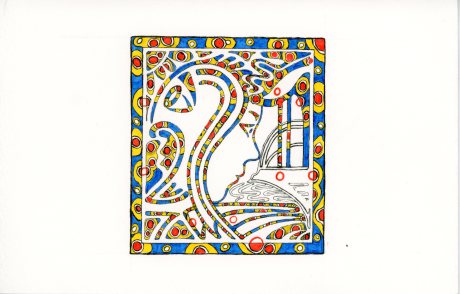
In Wagner’s Der fliegende Holländer, the cursed Dutchman cannot seem to escape Senta’s head. Design by Meredith Eliassen, 2016. Flying Dutchman Notecard
A Little Opera for Mom & Dad
February 17, 2016
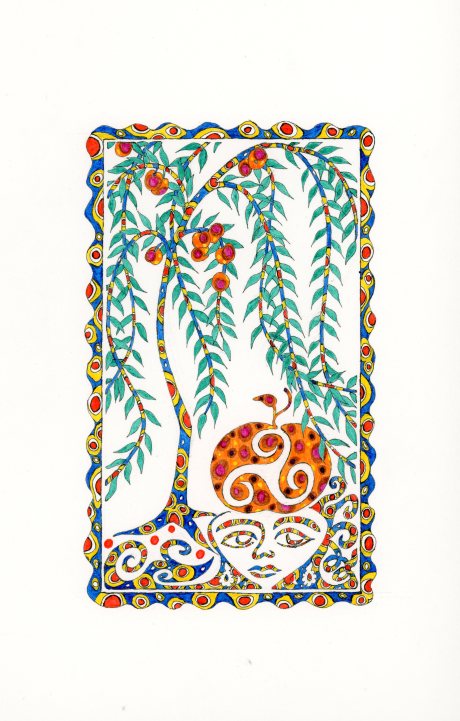
L’arbore di Diana=der Baum der Diana, music by Vicente Martin y Soler (1754-1806), libretto by Lorenzo Da Ponte, (1749-1838), design by Meredith Eliassen, 2015.
Opening night for the Trade Wind Opera Company, where everybody knows your name, they just can’t remember your face…
More popular with contemporary audiences than Mozart’s classic operas with Da Ponte librettos with audiences, this erotic comedy was quickly translated and performed in other counties. Diana, the goddess of chastity has a miraculous tree in her garden that can produce exceptionally large fruit that reveals the goodness or sins of those who pass beneath its branches.
Interesting older Ornament articles on beads
January 13, 2015
Jamey D. Allen traces cane production for millefiori beads to the late 1400s in “Cane Manufacture for Mosaic Glass Beads: Part II,” Ornament 6: 1, pages 13 and 23.
Marie-Francois Deloarodiere describes how Mautauria beadmakers try to imitate millefiori beads to this day in “Mautaurian Beads,” Ornament 8: 3, pages 27-32. This article profiles the work of Lalla Aichia, one of the few remaining beadmakers in Oualata. In the same issue, Robert K. Liu examines how cylindrical millefiori trade beads were broken into smaller pieces and perforated for stringing by Mauritanian women in “African-Made Glass Beads: Survey and Experimental results,” pages 52-57. Koli (cooked) beads were cooked in a pot with vegetable matter and then ground, turning opaque, so that they would be more aesthetically acceptable to Ghanaian consumers.
Peter Francis Jr. offers up a humorous look at the industry of forging beads in “Bead Report XIV: A Collection of ‘Phoenician’ Beads,” Ornament 8: 4, pages 45-48.
“Special Pictorial: Historic Photographs of a Venetian Bead Factory,” Ornament 9:3: pages 50-53.
 MME Designs's Weblog