Color play… trade wine bead motifs
August 8, 2018
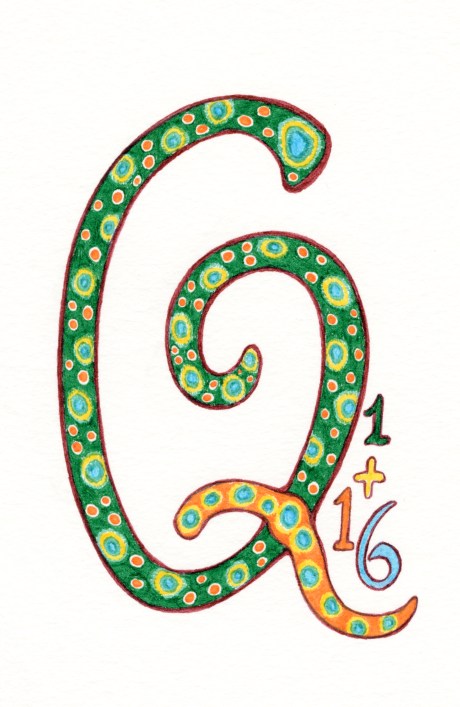
17 features letterform “Q” with eye bead motif, design by Meredith Eliassen, 2018.
Shakespeare’s ability to create linguistic imagery established a symbolic connection between the color of green and the emotion of envy, yet green is also the color of paradise… the garden… growth… and the emergence of spring:
Merchant of Venice (II,ii,108) “How all the other passions fleet to air, As doubtful thoughts, and rash-embraced despair, And shuddering fear, the green-ey’d jealousy.”
Iago in Othello (III,iii,165) “O! beware, my lord, of jealousy; It is the green-et’d monster which doth mock The meat feeds on; that cuckold lives in bliss Who, certain of his fate, loves not his wronger; But, O! what damned minute tells he o’er Who dotes, yet doubts; suspects, yet soundly loves.”
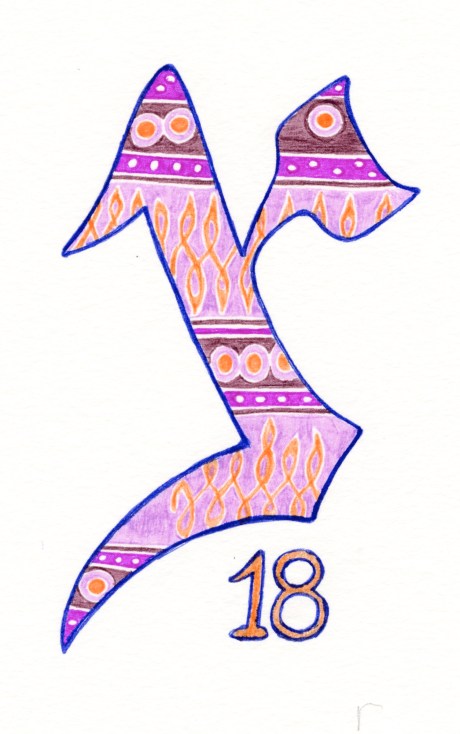
18 features Yerushalmi letterform of “tzadi” with trail bead motif, designed by Meredith Eliassen, 2018.

19 features Sephardi letterform of ‘kopf” with ancient eye bead designed by Meredith Eliassen, 2018.
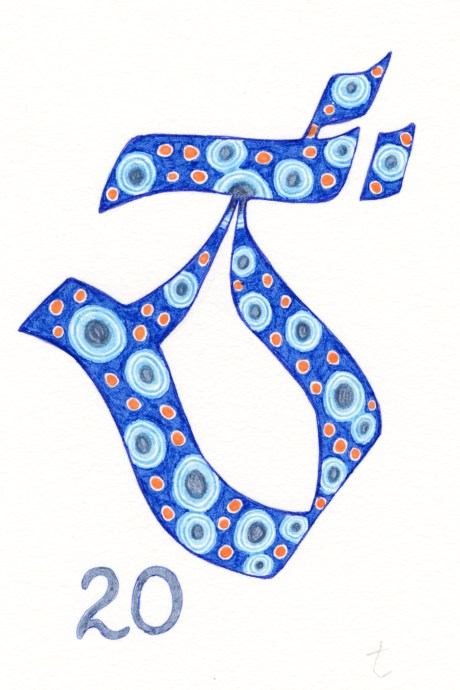
20 features Tibetan letterform of “tsa” with ancient eye bead motif designed by Meredith Eliassen, 2018.
More free studies…
August 7, 2018

21 features Greek letterform of “upsilon” designed by Meredith Eliassen, 2018.

22 features a light green base color, design by Meredith Eliassen, 2018.
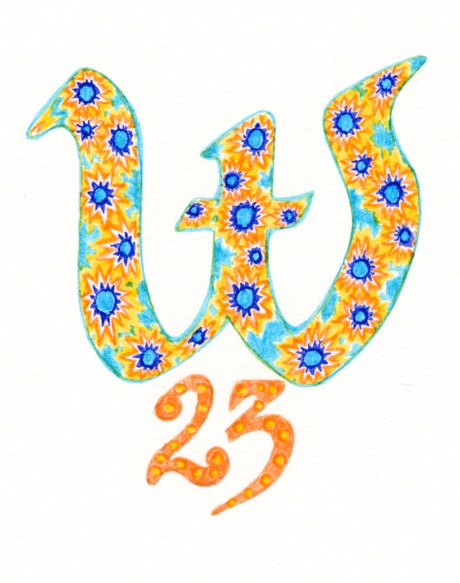
23 features a light blue base color, design by Meredith Eliassen, 2018.
Free studies… X Y Z
August 6, 2018
Mosaic millefiore glass bead motifs from the nineteenth century were made with ancient techniques developed in western Asia where composite case canes of preformed unites were fused together to create colorful complex designs.
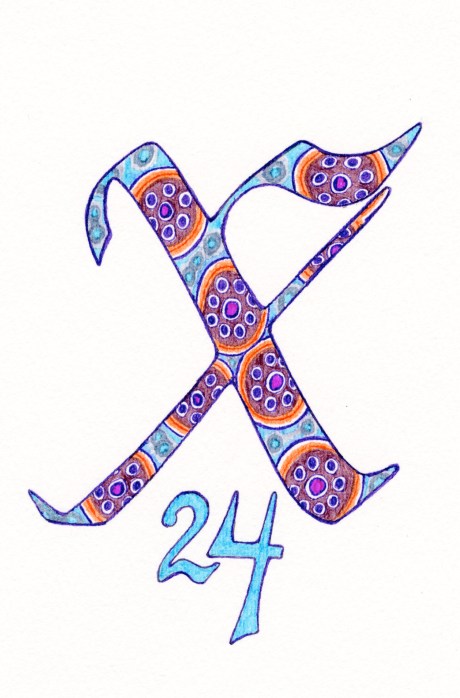
24 features a light blue base color, design by Meredith Eliassen, 2018.
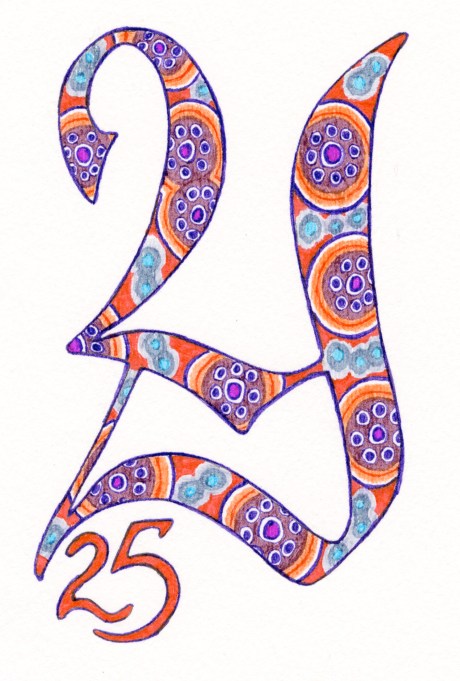
25 features a red base color, design by Meredith Eliassen, 2018.
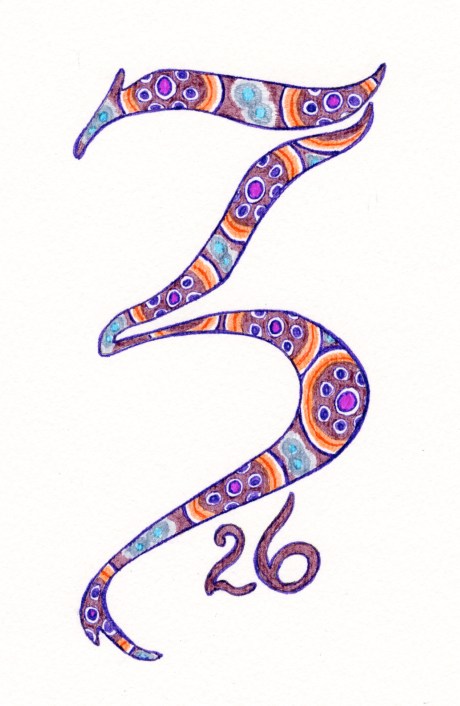
26 features a mauve base color, design by Meredith Eliassen, 2018.
Going in search of Albers…
July 23, 2018
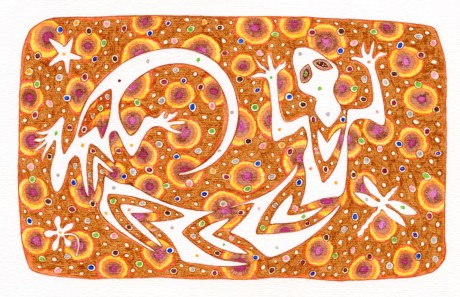
Lucky Spirit design by Meredith Eliassen, 2018. Notecard
This summer I have decided to take a break and play with color using Josef Albers Interaction with Color. Though I am not using colored papers, as he recommended, I am exploring his exercises, and in the coming weeks I will share some results.
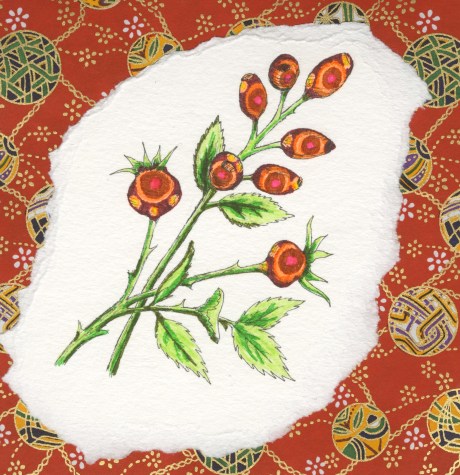
Rosehip design by Meredith Eliassen, 2018.
Even in comparing these to designs employing the same colors, the colors show that they have different interactions.
By Rose for Rose… a dreamcatcher
December 12, 2017
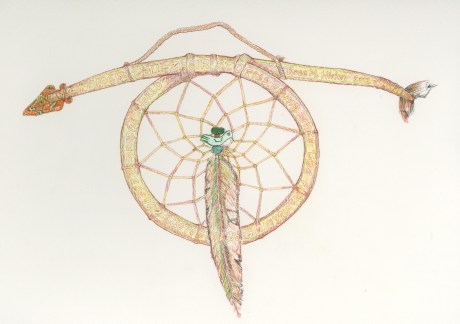
“Women tell their stories rising into the air along the edge of the world.” Rose M. Hickey, 2012.
For Mom and Dad…
February 14, 2017
Happy Valentine’s Day!

Let the love in your heart grow tall like a tree and shine bright like the sun, heart tree design inspired by a medieval design by Meredith Eliassen, 2017.
Art Enables…
January 13, 2017

“Art enables us to find ourselves and loose ourselves at the same time.” Quote by Thomas Merton, butterfly design by Meredith Eliassen, 2016.
Magic eye beads of Tibet are called dZi beads, and they are often etched or treated agate revered for their protective qualities.

One of the stories about dZi beads is that they were originally insects that were petrified.
Happy Halloween!!!
October 31, 2016
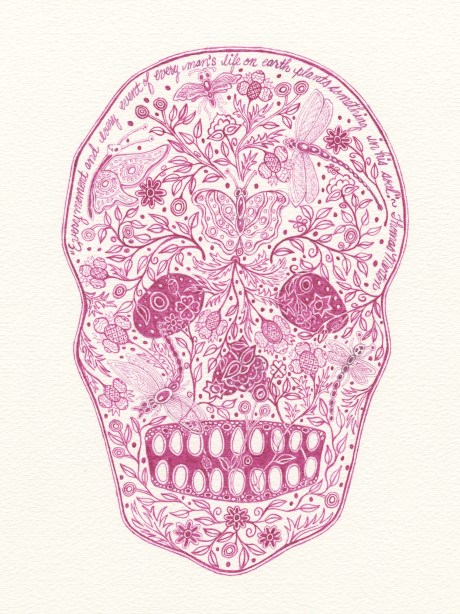
“Every moment and every event of every man’s life on earth plants something in his soul.” Words by Thomas Merton (1915-1968), design by Meredith Eliassen, 2016.
Over the next few days this site will explore the Mexican Day of the Dead that emerged from the ancient pre-Columbian traditions.
Wait… wait… wait… act…
September 14, 2016

“wait * wait * wait * act * wait * — * the * rhythm * of * things * — * make * it * a * song * & * it * will * be * come * one * — * lis * ten * lov * ing * ly * to * the * mu * sic * slow * ly * joy * ous * ly * join * the * dance” inspired by the words of Robert Lax, dancing being designed by Meredith Eliassen, 2016.
Childhood at Risk? A Folklorist Investigates
September 10, 2016
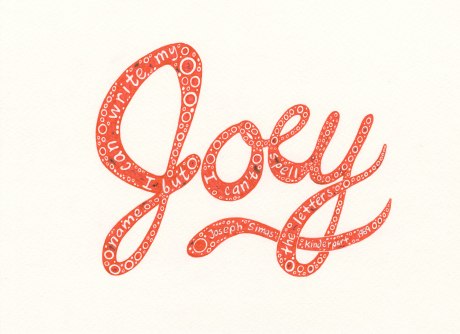
“I can write my name but I can’t spell the letters.” Words by Joseph Simas, “Kinderpart,” 1989, design by Meredith Eliassen, 2016.
If a folkway is defined as a way of thinking or acting shared by members of a group as part of their common culture, then childhood is the means for accessing common culture. Children are vectors of imaginary landscapes within adult societal constructs. Children naturally explore, experiment, and create opportunities to test and expand boundaries within familial and community contexts. Original play allows children to holistically experience events that involve a certain degree of risk and failure to provide opportunities to learn and develop knowledge and skills needed to survive as adults engaged with society. For instance play jumping into and over puddles can test a child’s physical attributes as well as properties of the physical world. Likewise, childhood offers the potential to choose a simple vessel portal for imaginative play in order to explore its possibilities.
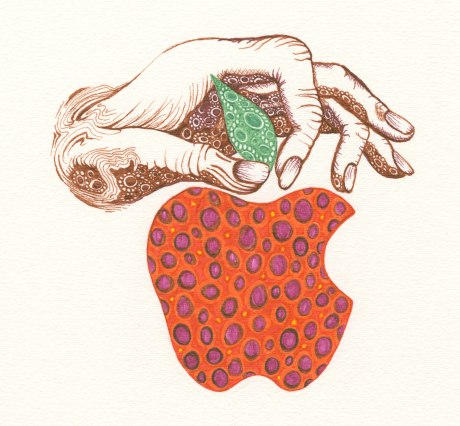
“Media as an extension of the human hand,” conceptual drawing by Meredith Eliassen, 2016
The cell phone can now be an interactive medium for child’s play and entertainment in an increasingly secular world. As folklorist, we can see with the lens of media ecology that this little device (like a play doll or ball of earlier days) has become an extension of the child or teenager’s arm and hand. Therefore, we can ask as with other media:
- Does this device structure what we can see and say and, therefore, do?
- Does this device assign to us roles to play? And then insist upon our playing them?
- Does this “smart” device explicitly specify what we are permitted to do and what we cannot do?
- Does this device offer half-concealed implicit and informal specifications that compel us assumption that what we are dealing with merely a machine and not a highly-corporate media environment?
When mass-produced toys create total-entertainment-experiences, society can loose ecosystems where holistic inner-imaginary landscapes flourish. Although folklorists will adapt to this technologist for studying First World childhood, we may need to head for the Cloud[s] to find our fodder for studying the real or ordinary lives of children. Media ecology surfaces roles that media compel us to play. Media ecology will continue to spotlight how emerging media structures the semantics of what we see and how media informs how we feel and act as we approach the gateway to the future with our eyes, ears, and hands wide open. In the coming weeks, I will explore the transitions of earlier media in this blog to identify areas that might be considered when asking the question: Is childhood at risk?
Here is a recent article from the Washington Post: And everyone saw it… by Jessica Contrera
To learn more about media ecologist go to the Media Ecologist Association.
 MME Designs's Weblog