Beloved friends, be safe…
August 23, 2018
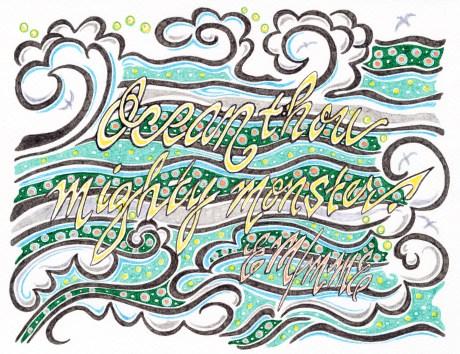
“Ocean thou mighty monster,” designed by Meredith Eliassen, 2018.
Preface to tone poem by Edward MacDowell (1860-1908) called To the Sea, which delineated a tonal oceanscape with its magnitude, mystery, and vast beauty.
Visual Afterthoughts… Lydia Maria Child
July 25, 2018

Lydia Maria Child (1802-1880) began her career almost two centuries ago, and some of her writing is dated, yet some resonates today in odd ways. She address the contradiction in American society as to whether to conserve of consume with her association of ideas. Child also offered this thought: The United States is a warning rather than en example to the world.” This odd group including a bird, bees, a squirrel, a whale, a wax doll, and a horse appeared in “Fanny’s Menagerie,” Rainbows for Children (Boston: Ticknor and Fields, 1847): 119-131. Design by Meredith Eliassen, 2018.
Movements in American reform: Transcendentalism
April 10, 2018

“There are two laws discrete, not reconciled – law for man, and law for thing.” Quote by Ralph Waldo Emerson, bird design by Meredith Eliassen, 2018.
Transcendentalism is, in many respects, was the first notable American intellectual movement; it was a philosophical movement that developed in the late 1820s and 1830s out of a literary circle in Concord, Massachusetts. Inspired by English and German Romanticism and the idealism of Immanuel Kant (1724-1804), it was concerned not with object, but rather with our modes for understanding objects where the human mind became aware of itself.
The transcendentalists longed for a more intense spiritual experience; they believed in the power of the individual and personal freedom. A core belief of transcendentalism is in the inherent goodness of people and nature. Transcendentalism emphasizes subjective intuition of the individual (as opposed to the collective) moral and spiritual sensibilities and the rejection of materialism. Ralph Waldo Emerson wrote in his essay “Self-Reliance” (1841), “Traveling is a fool’s paradise.” Adherents believe that individuals are capable of generating completely original insights with little attention and deference to past masters by turning to nature for spiritual guidance. Writing children’s literature brought Lydia Maria Child a steady income; she also used it to create a consciousness of empathy. Emerson inspired Child in her writing career even as she reacted against the dichotomy in his logic related to men and women’s roles in society.
Lydia Maria Child attended some Emerson lectures during the early 1840s after he set forth the principles of Transcendentalism in his essay called Nature (1936). Emerson delineated two sects of humans by classifying them into materialists (based upon experience) and idealists (based upon consciousness): “The materialist insists on facts, on history, on the force of circumstances and the animal wants of man; the idealist on the power of Thought and of Will, on inspiration, on miracle, on individual culture.” In Lydia Maria Child’s children’s story called “The Magician’s Shadow Box” (1856) the protagonist’s adventure illustrates a transcendental theme where only from such an individual that is at peace with his environment can contribute to the formation of a true community.
Ides of March… a storm brewing… look what it brought!
March 15, 2018
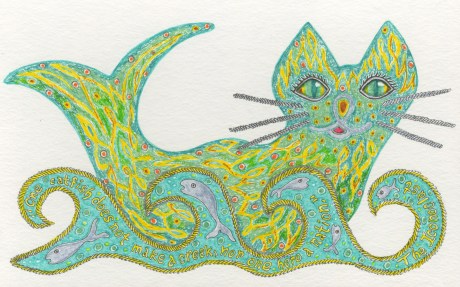
“One catfish does not make a creek make, nor one hero a nation,” words by The Iconoclast, and image by Meredith Eliassen, 2018.
A nature parable… “Active and Passive”
January 23, 2018

The Weathercock was having a rough day… design by Meredith Eliassen, 2018.
“Restless life! Restless life!” moaned the Weathercock on the church tower by the seas as he felt the wind sway his direction suddenly. He creaked with dismay, “restless, toiling life, and everybody complaining of one all the time…”
An old woman hobbling towards the church lamenting: “There goes that tiresome weathercock pointing east… now I know why my rheumatism has returned!”
Then a farmer warned the old gravedigger: “Watch out Tomkins! If that rascally weathercock is to be trusted, the wind’s going to bring us rain.”
The steadfast weathercock was horrified that he was always to blame for the weather, and muttered to himself: “Am I to blame? Did I choose my lot? Do you think I would swing every which way if I had a choice?”
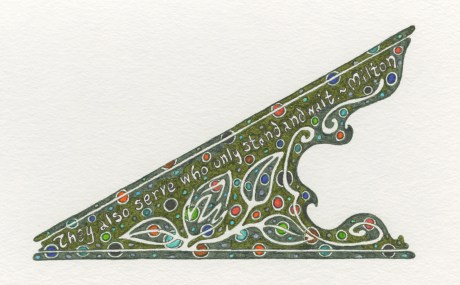
Gatty’s motto for this story: “They also serve who only stand and wait,” is from Milton, 1673 Poems, design by Meredith Eliassen, 2018.
From below, the sundial grumbled under his breath: “Oh, how he chatters away up there… he almost makes me smile.” Reflecting upon his day, “Not a ray of sunshine has fallen upon me today. I wonder what Ol’ Weathercock finds to interesting to talk about. His life is so active, no doubt. Oh, what I would not give to be like him.”
The weathercock looked down at his longtime companion the sundial with envy: “Ah, that’s the life!”
Dial heard his name whispered in the wind: Hello up there! Did you call? Is there anything fresh astir? I get so tired of the long dark useless hours. So come on now, what have you been talking about?”
“Nothing profitable,” replied the weathercock. “I am just grumpy.”
“But why?” Asked the dial. “Your life is so active and bright.”
Weathercock thought Dial was mocking him. “Look at me! Swinging with every peevish blast that crosses the sky. Turn here, turn there, turn everywhere… never a moment’s rest.”
The companions fell silent as humans started passing with their daily routines… pausing a moment to examine the sundial or the weathercock to get a sense of what was coming.
A sailor lingered near the dial and read its weathered motto: “Watch, for ye know not the hour.” He just hankered for a long afternoon to relax, and mentioned this to the gravedigger in passing. Tomkins responded: “You’ll be cured of the wish for idle afternoons when they are forced upon you… wait until you are old like me and then you will understand.” With good-natured goodbyes, the two parted ways leaving the churchyard empty of its living guests.
The sailor went home and warned his sons to keep a lookout for there have been signs of a strong gale arriving and with the high tide, there could be dangerous or even deadly conditions.
Meanwhile, the sundial observed, “Just as I thought, everything is wrong because everybody is so dissatisfied.
Soon the farmer’s wife saw the tracts of white foam, thick like snow fields, on the ocean, followed the breakers as they crashed upon the shore like claps of thunder. That night, a mighty storm – a hurricane – came and stalled over the coastal hamlet causing great fear, but the weathercock and the sundial stayed the course.
The weather eventually cleared and the sun shined brightly over the village and the sea with the brilliancy of spring. Because the villagers recognized the signs and prepared, nobody was hurt and damage was minimal, indeed, the dial and the weathercock were buffeted to the point of shining like new. Villagers look at them renewed gratitude, thinking: “What a mercy!”
Dial heard this and asked his friend: “Are you silent, Weathercock?”
“I was just thinking,” he replied. “I have a new sense of my own responsibility. I have the sensation that everything is useful in its own place and at all times, though humans may not always figure that out.”
The sundial beamed, “that was my impression as well.”
===
Source: Margaret Gatty (1809–1873) wrote about marine biology and was prolific children’s book author and editor who mentored her daughter Juliana Horatia Ewing (1841-1885) in her writing career. While Gatty’s tales were targeted for juvenile audiences, she hoped that they would influence the minds of adults as well. This story is from her Parables from Nature.
Armadillo symbolism…
May 25, 2017
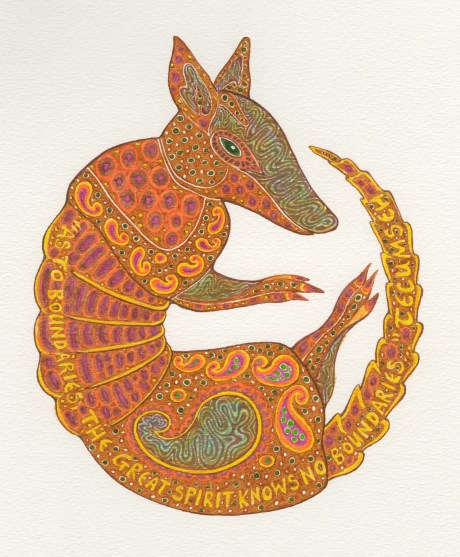
The armadillo’s shell acts as its physical and spiritual boundary protecting the safety of its entire being. Armadillo design with words from Tecumseh: “As to Boundaries, the Great Spirit knows no boundaries,” by Meredith Eliassen, 2017.
Tecumseh was a Shawnee chief who with his brother, “The Prophet,” united Native Americans in the West to resist white expansion. Tecumseh asserted, “These lands are ours: no one has the right to remove us, because we were the first owners; the Great Spirit above has appointed this place for us, on which to light our fires, and here we will remain. As to Boundaries, the Great Spirit knows no boundaries, nor will his red people acknowledge any.”
We all do it… Quote
May 19, 2017
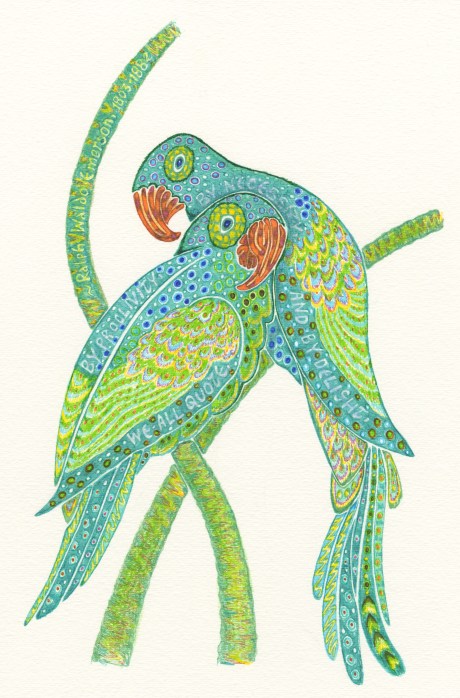
“By necessity, by proclivity, and by delight, we all quote.” Words by Ralph Waldo Emerson, design by Meredith Eliassen, 2017.
Watch out… little hog
May 3, 2017
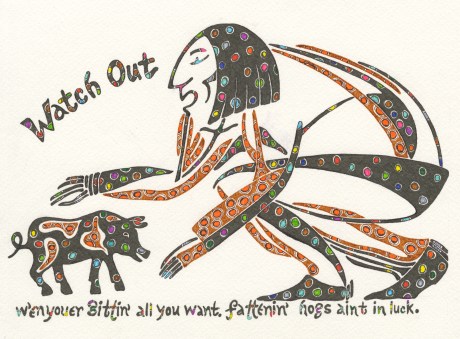
“Watch out w’en youer gittin’ all you want. Fattenin’ hogs ain’t in luck.” Quote by Joel Chandler Harris, design by Meredith Eliassen, 2017.
Joel Chandler Harris (1848-1908) was an American writer and folklorist best known for his collection of “Uncle Remus” stories “Br’er Rabbit” stories written in dialect. Harris worked as an apprentice on a plantation during his teenage years where he gathered stories from the African-American oral tradition.
Pink elephant sighting
January 26, 2017

“Nature’s great masterpiece, an elephant the only harmless great thing, the giant of beasts.” Words from John Donne, design by Meredith Eliassen, 2017.
Paisley Elephant Notecard and Survivors’ Hub Postcard
Happy Halloween!!!
October 31, 2016

“Every moment and every event of every man’s life on earth plants something in his soul.” Words by Thomas Merton (1915-1968), design by Meredith Eliassen, 2016.
Over the next few days this site will explore the Mexican Day of the Dead that emerged from the ancient pre-Columbian traditions.
 MME Designs's Weblog