The breakdown of traditional female networks
October 25, 2014
Prohibition of the manufacture, sale and transporting of alcoholic beverages I the Unites States from 1919 to 1933 was largely due to pressure from women’s social networks. Yet, after World War I flappers, young women living lives of excess, patronizing speakeasies and consuming alcohol, formed a counterculture that subverted tradition women’s networks. Flappers virtually removed corsets from women’s fashions, and visually and behaviorally freed up all women by wearing shorter skirts and short haircuts, and excessive make-up. Flappers redefined the roles of women in society and mocked the traditional female networks that had lobbied for Prohibition.
Television had a tremendous impact on how women gathered socially during the 1950. Nationally and locally produced women’s programs soon followed throughout the United States often premiering within hours of a station signing-on, first to sell televisions as an essential home product, and then to build loyal female audiences. Local broadcasters produced cooking shows to entertain and instruct housewives on the latest trends in cooking, nutrition, and kitchenware that carried the message that women should purchase the latest products that would enable them to get out of the house. Women’s programs usually lasted thirty minutes and featured food topics, along with other educational content related to home economics including, “textiles and clothing, home furnishings, time management and work simplification, gardening, kitchen planning, childcare, grooming and family relations.” Ironically, television also served to alienate women from traditional face-to-face networking.
The impact of the birth-control pill, simply known as “the Pill” approved for use in the United States in 1960, gave women unprecedented control over their bodies, and therefore provided them with the option to differ marriage. The availability of the Pill opened avenues for social networking that had previously been considered taboo as different social movements and counterculture groups emerged. Betty Friedan (1921-2006), a journalist writing for popular women’s magazines, in The Feminine Mystique (1963) called on women to seek satisfying and intellectually stimulating careers in public life without renouncing their roles within the home. Friedan and other feminists established the National Organization for Women (NOW) focused on the fight for full equality for women in 1966.
Female social networking within counterculture movements still mirrored traditional models of women assisting male leadership. For instance, the Diggers, a psychedelic political movement of the late-1960s was credited with coining the phrase, “Today is the first day of the rest of your life.” This subgroup of San Francisco hippies, utilized traditional female social networks as they worked towards a society where all food and possessions were shared freely. The Diggers provided free clothing in the Free Store and distributed free food in the San Francisco Panhandle during the Summer of Love. The group introduced principals of serving organic foods distributed broadsides and leaflets along Haight Street advertising free food, supplies, and performances to thousands of transient youth. Dedicated volunteers, consisting of mostly young women, ferreted cheap food from produce markets, slaughterhouses, fish markets and bakeries.
The proposed Equal Rights Amendment (ERA) to the U.S. Constitution stating, Congress passed “equality of rights under the law shall not be denied or abridged by the United States or by any state on account of sex,” in 1972. This amendment would have responded to many issues raised by generations of women’s social networks, but its controversy undermined the demographic female majority, because it was ratified by only 35 of the necessary 38 states by its 1982 deadline.
Learning by the Rules
October 8, 2014
Before the establishment of free public schools in 1770, girls learned to read at home or at weekly secular Sunday schools (or first day schools), which met to provide instruction in reading for children as well as illiterate adults beginning in the 1790s. First day schools operated on Sundays because children were expected to work during the rest of the week, and girls were more likely to attend Sunday-schools than boys because it was their only option for public education at the time. Virtue, humility, and purity remained characteristics that were prized in women. While upper-class women gathered discretely in parlors to read aloud dialogues to educate themselves on science or to enjoy Dr. Watts’ Divine Songs, they networked. “Republican womanhood,” a concept of American womanhood coined by historian Linda Kerber, to define how the Republican mother integrated political values into her domestic life.
As families from different classes migrated to urban centers, individuals belonging to the growing middle class sought opportunities for “self elevation” or self-improvement in order to move up socially, but a woman’s destiny was tied to her choice of husband. During the nineteenth century, women’s social networking centered on the issues of women’s rights, the abolition of slavery, temperance, women’s suffrage, and missionary work. These social networks often held up throughout “bust” economic cycles. The impulse for reform in the United States during the first half of the nineteenth century was generally manifested in five distinct phases: moral reform (1810s-1820), the creation of utopian societies (1820s), institutional reform (1830s), the abolition movement (1830s), and the movement for women’s rights (1840s). Once these reforms were addressed institutionally, male organizational structures took over, and professionals once again pushed women back into dependent roles.
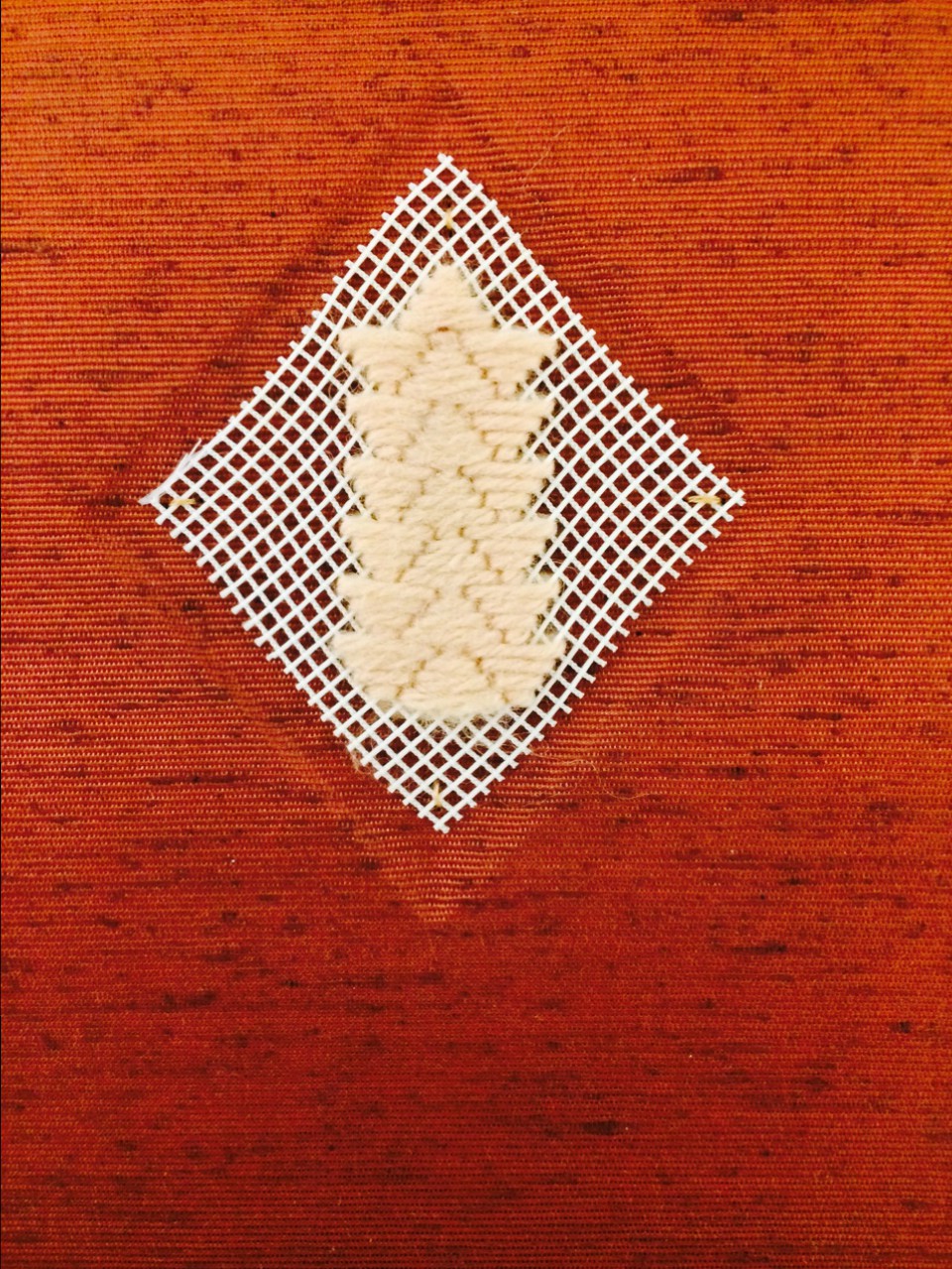
Stitching Swatch Detail
Women provide Transient Housing and Social Networks
October 7, 2014
Women operated boardinghouses from the seventeenth to early-twentieth centuries. Typical boardinghouses, establishments privately operated by families to bring in extra income became popular during the mid-nineteenth century. Some families chose to co-inhabit with other families as boarders, creating two-family households. Thomas Butler Gunn’s satire The Physiology of New York Boarding-Houses (1857), chronicled the variety of female dominated networks found in boardinghouses. Filled with anecdotes about scheming landladies, carousing bachelors, slovenly housemaids, and an odd cast of fellow boarders, boardinghouse life emerged as an aspect of cosmopolitan American culture. Indeed, individuals who chose to live solitary lives during the nineteenth century were considered to be odd loners or hermits.
Taking in boarders, was a crucial economic factor in the financial success of both urban and rural families during the early nineteenth century. Operating a boardinghouse was a rigorous weekly cycle of washing laundry, baking, and mending, and daily cycles of cooking, cleaning and serving. While husbands could leave the boardinghouse to work and run errands, wives and children kept the operation going even when they got sick, injured, or pregnant. Women recognized the economic value of their labor produced by taking in boarders was a means for women to bring cash into the household. Compared to taking in sewing, running a grocery, catering from their kitchens, or working as unpaid labor in their husband’s trades, operating a boardinghouse brought good income that could be reinvested into businesses or supply family needs.
Boardinghouse living could supply a surrogate family along with room and board. Immigrants clustered in boardinghouse communities or “quarters.” These groups generally included young men or women of similar professions, who assimilated to the new climate together. Mealtime became an opportunity to socialize and network for boarders who enjoyed similar foods and spoke the same language. Accustomed to living in urban areas, immigrants set up their own grocery and dry goods stores, liquor stores, boardinghouses, and restaurants. Boardinghouse culture was ephemeral and transient in nature. Boardinghouse living waned during the early twentieth century as urban planners focused on creating apartment communities to accommodate the American sensibility that the single lifestyle was acceptable.
Female Networks under Coverture
October 6, 2014
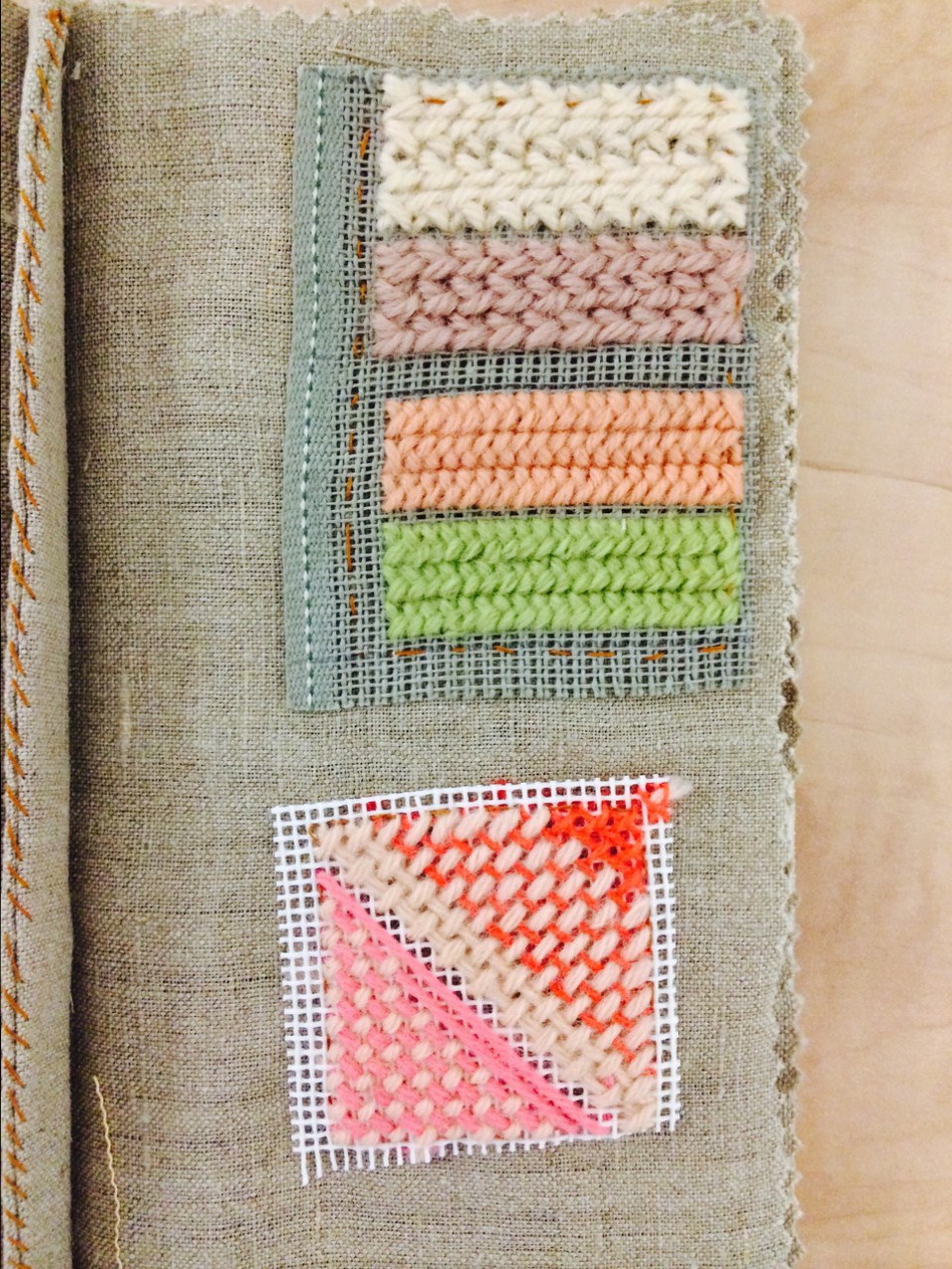
Detail of twentieth century stitching from Happy Hands Studio (Pendelton, Oregon) from unique artist book by Roberta Lavadour called “Happy Hands”
During the Era of Enlightenment men pressed women to place their whole affections upon family, relegating mothers to rule the “gentle empire” of the home. The sensibilities of common law versus civil law dictated how marriage became a woman’s primary social network. Under Anglo-American common law a wife had no rights in regards to making contracts or holding real property. The status as feme covert (married) or feme sole (single) often determined a woman’s ability to network with other women and with men. Under coverture, wives and children were both treated dependents. Female subordination within the family, men argued, reflected their subordination under common law and divine government that asserted, “Influence by reason when you can, by authority when you must.”
Cloth and clothing production became another area supported by female social networking. Adam Smith described the social networks needed to produce a common woolen coat for a laborer in his The Wealth of Nations: “The shepherd, the sorter of wool, the wool-comber or corder, the dyer, the scribbler, the spinner, the weaver, the fuller, the dresser, with many others, must all join their different arts in order to complete even this homely production.” Feme sole, a never-married woman, has remained an anomaly within women’s networking. The woman who remained unmarried was referred to with the derisive term of “spinster.” When it was first used, to define a woman with the occupation of spinning it was a term of respect. However, a woman without a male protector were obliged to live modest and discrete lives of service to family, church, or a respectable occupation like a teacher, or risk being the target of brutal rumors and speculation. Single women were sometimes stigmatized if they resided in boardinghouses located outside of respectable residential neighborhoods, since “boardinghouse” also euphemistically referred to “bordello.” Widows, also considered to be feme sole, sometimes financed other female enterprises utilizing their “dower” income.
In the United States, many single women moved to the frontiers to pursue careers as schoolteachers or missionaries. During the California Gold Rush, the state legislature enacted laws to enable married women to establish businesses as sole traders, rather than to expose single women to the dangers of dealing with volatile males. An important but subtle shift of power occurred when married women and widows kept controlled their real property – women could establish benevolent relief societies in the formal business or public sector for women who found themselves in bad situations. During the 1870s women doctors in San Francisco established the Pacific Dispensary Hospital for Women and Children where only female physicians cared for patients, but as the organization moved to affiliate with medical colleges they were forced to allow male physicians to administer this teaching hospital.
Little girls were socialized as they learned domestic arts throughout. Girls would assist adult women in their households with spinning thread, weaving cloth, making candles, and needlework including sewing, knitting, dressmaking, quilting, embroidery – decorative sewing done with colored thread. They learned how to sew when they were very young, often stitching their first quilt square by the age of four years, and demonstrated skills learned in samplers.
Women and Historic Social Networking
October 3, 2014
Today the Internet offers women infinite ways of networking socially. Women’s demographic numbers and resources get exploited without equitable representation. Charities advertised the chance to walk for this or run for that cause in order to raise money (or “awareness), but these efforts are also supporting fundraising infrastructures. Women have historically fought to have their voices individually and collectively heard, women have collectively built institutions only to have those institutions usurped by men who asserted that women should to heed collective male expertise. Themes of dependency, poverty, gender, and ultimately mortality delineated how women traditionally networked until the late-nineteenth century. During wartime, women’s social networks sustained their broader communities. Women left to support families when men fathers, brothers and husbands were killed or disabled utilized female skills and artistry to support families, and to hold and maintain family property. However, after the conflicts ended, women were relegated to more dependent roles. Prior to women suffrage, women did not have government representation and were treated as dependents. Excluded from political and economic responsibilities, women collectively focused on their reproductive duties.
In some hunter/gatherer societies women were isolated from men during menstruation. This fundamental dichotomy has been manifested in diverse ways throughout time and across cultures. Midwives served integral roles in traditional female networking. During the eighteenth century, up to 45 percent of women did not survive to the age of fifty years, usually due to complications from childbirth. The skilled midwife within a community was essential to the wellbeing of women in that community until male physicians entered the birthing chamber during the late eighteenth century. A woman’s childbearing years, a period lasting about twenty-five years, along with distractions during her child rearing duties, cumulatively weakened her ability to network beyond her neighborhood or immediate community.
Female networks often centered on food cultivating, harvesting, and preparation. Women used raw natural materials to construct practical items for survival. Women were charged throughout the seasons with harvesting, preserving, and cooking food to make the best use of these resources that including working in the dairy, making butter and cheeses; preserving meat from the hunt and fish; preserving fruits and vegetables, and bee keeping. Women gathered and made baskets to store or carry foodstuffs, water, or other items that exhibited design motifs identifying the community in different regions depending upon the availability of local grasses, bark, twigs, and willow.
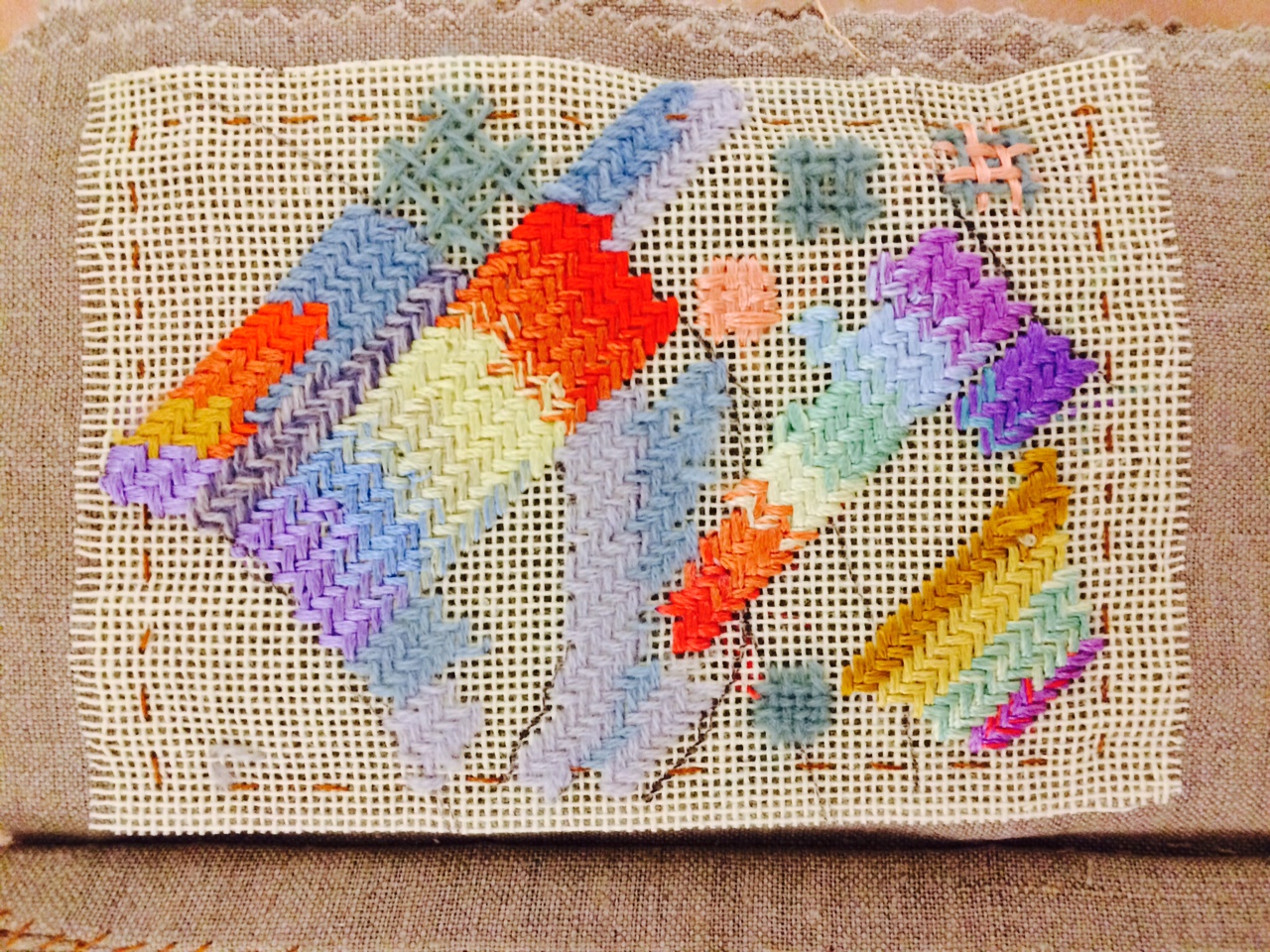
Detail of twentieth century stitching from box of from Happy Hands Studio (Pendelton, Oregon) from unique artist book by Roberta Lavadour called “Happy Hands”
Re-searching Shunk, continued
September 16, 2014
Issachar Bates (1758-1837) lamented the hypocrisy of elected leaders who in the name of God, raved about freedom yet allowed slavery to continue, and wicked priests who allowed denominational pride to get in the way of fighting for right. Bates walked several thousand miles through the Midwest preaching his concept of the Rights of Consciousness:
RIGHTS of conscience in these days,
Now demand our solemn praise;
Here we see what God has done
By his servant Washington,
Who with wisdom was endow’d
By and angel, through the cloud,
And led forth, in Wisdom’s plan
To secure the rights of man.
Fortuna introduces each nation to her own ethos. The British, outraged by American attacks upon Canadian forces in border towns deemed to be outside civilized laws of warfare issued orders to destroy and lay waste to vulnerable targets. Baltimore, Washington, and Philadelphia looked to be the most promising. The British capture of Washington, D.C. in the autumn of 1814 was the only occasion since the Revolutionary War when a foreign power captured and occupied the young nation’s capital. British forces, though inferior in numbers, in a spectacular ten-day campaign won victory over inexperienced and undisciplined American forces. Federal government leaders who made the most of Washington’s legacy after his death made the decision not to defend the Capital – his namesake. At dawn on August 24, the British marched via the Bladensburg Road towards Washington. American forces proved insufficient as Ross’s forces easily broke trough their positions before the British approached Washington. The British could find no American official to negotiate surrender of the city. Officers dined at the abandoned presidential mansion before ransacking and burning it.
Francis Rawn Shunk (1788-1848), a humble and benevolent fortune hunter saw the United States as a land abounding in inexhaustible resources. He began to study law with Thomas Elder in Harrisburg, Pennsylvania and soon hired Francis to write practical documents before volunteering to serve at the Battle for Baltimore. Shunk scribbled this poem (excerpted from page 50 of his journal):
It sheds upon my soul a melancholy hue
Its short-lived influence shall my bosom fill
And teach the lesson of departing time
When fine delights fill my soul with
Thoughts serene on things above
Where time & chance & misery all shall yield
To heavenly peace & everlasting love.
This must fond inducements like pure zest
Yield up their joy to cruel unrelenting fate
Thus kink endearments mild celestial brand
That in its wove in covers of peace & live by love
So rudely torn fate’s rough iron hand
Is torn asunder by fate’s unrelenting hand.
And kindred spirits doomed – apart to rove.
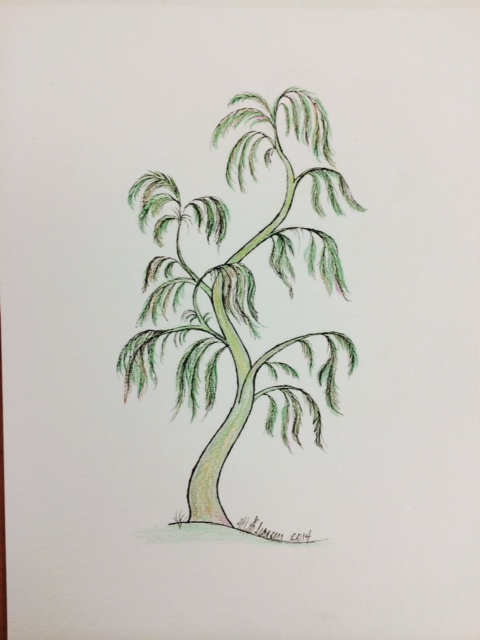
The Weeping Willow
Shunk borrowed a copy of William Wirt’s The Old Bachelor to read on his off-duty hours. Still green to the ways of the world, he quipped: “The knowledge of men is an important acquisition yet it is not always a source of Satisfaction.” He scribed thoughts on the dichotomy of dependence: “Dependence is that relation which subsists between master and servant, and in which, the wile of the latter is absorbed in the former and is subject to his commands – without resistance – he is a mere machine.” Shunk concluded, “The degrees of this relation are various and extensive; its existence is almost universal, it is not confined to Slaves, properly speaking, that finds its way into all ranks and Conditions of life.”
Shunk felt that worldly knowledge of men causes regret and mortification that outweighs the virtues discovered. He leveraged his self-education to rise in rank. He, a poor schoolteacher, garnered surveying experience. Francis felt that if Americans did not confront the countries that bullied them, their newfound independence would have little meaning. However his view of the conflict evolved as he experienced the hardship of war. He wrote in his journal, “Did kings & conquerors in the hours of serious affliction weigh their glory and their fame against the wretchedness they have produced?”
Re-searching Shunk
September 15, 2014
I am transcribing an old journal from the Battle for Baltimore written by an young Francis R. Shunk. In 2001, a small manuscript containing the writing of Francis Rawn Shunk (1788-1848) was found along with various ephemera in the Marguerite Archer Collection housed in San Francisco State University’s J. Paul Leonard Library. This seventy-page manuscript contains Shunk’s observations from September 5 to November 3, 1814. And my work will likely follow that time frame two hundred years later. Born in the rural village of Trappe, in Montgomery County Pennsylvania, he was the son of a poor farmer and his wife. Shunk struggled to educate himself. His parents, although unable to spare his time contributed to farm work, provided him with a loving home. Shunk’s childhood and youth were mostly devoted to manual farm labor.
Shunk was kind, industrious, and devoted to self-improvement. He recognized the need to cultivate an advantageous patron in order to climb out of grinding poverty. He attended a common school in Trappe. When he was fifteen years old, Shunk was hired as an instructor at that common school. He worked as a teacher during the few months of the year that the school was in session, and the rest of the time he worked as a farm laborer. Books were rare. Francis read each book that his hands reached with deep interest, not lounging on a sofa or around a marble center-table brightly illumined with an astral lamp, but often in a chimney corner, by the light, which a wood-fire or its embers reflected. What he read he pondered until it became part of his mental being.
California Indian Baskets – part 4
September 8, 2014
Specific geographic locations fostered the development of distinct stylistic basket motifs. Generic baskets were not produced; names were assigned to baskets classified by function. Working mothers safely carried infants in tule shade cradles. Tightly woven storage baskets about 2’ x 3’ constructed of hazel with straight sides were traditionally hung in structures. Acorn baskets featured an open stitch to allow air to move through the seeds in a coastal climate where fog supported mold growth. Parching trays were round and flat; close woven water-resistant conical burden basket held seeds; course woven conical burden baskets were constructed of hazel were used to gather foodstuffs; and coiled basket hoppers for grinding acorns. Men made large non-water resistant burden baskets with a handle on each side to store dried acorns. One man on each side using handles carried the basket that was placed on sticks or grass inside the granary.
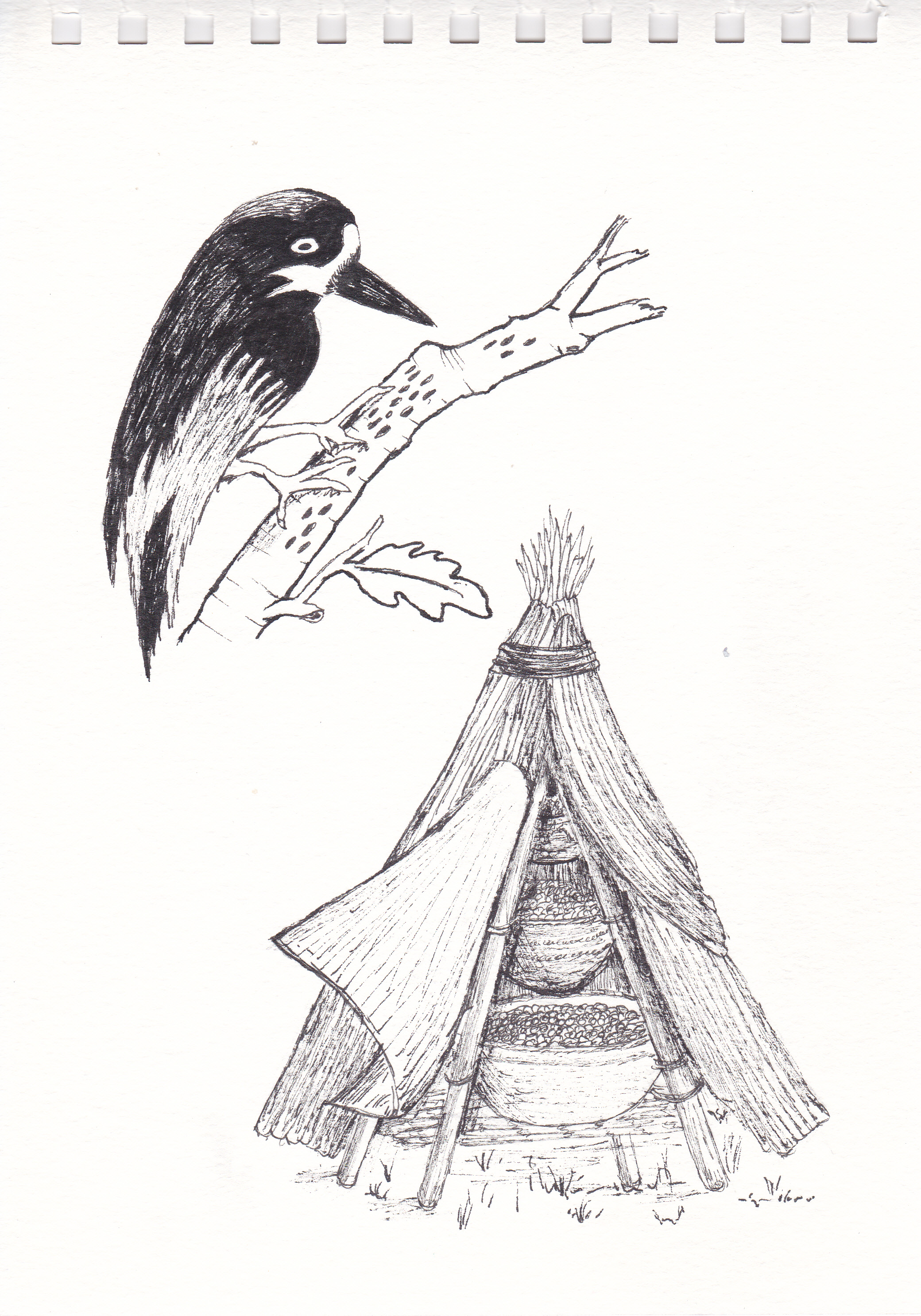
The acorn woodpecker stores in trees while California Indians traditionally stockpiled acorns over a couple of years in baskets secured in small bark-covered structures that allowed for good air circulation in the foggy coastal climate.
Coyote Gathers Feathers
September 4, 2014
Native Californians incorporated the notion of controlled burns as part of their creation stories. In a Pomo creation story collected during the summer of 1904, a trickster coyote employed fire in a world-burn that burns mountaintops and then supplies water (specifically Clear Lake) by throwing native tule roots and non-native grapevine roots into the mountain tops to create streams. As in many creation stories from other regions, the trickster creator does not achieve the respect that he feels is deserved, his people are soon looking for ways to destroy him.
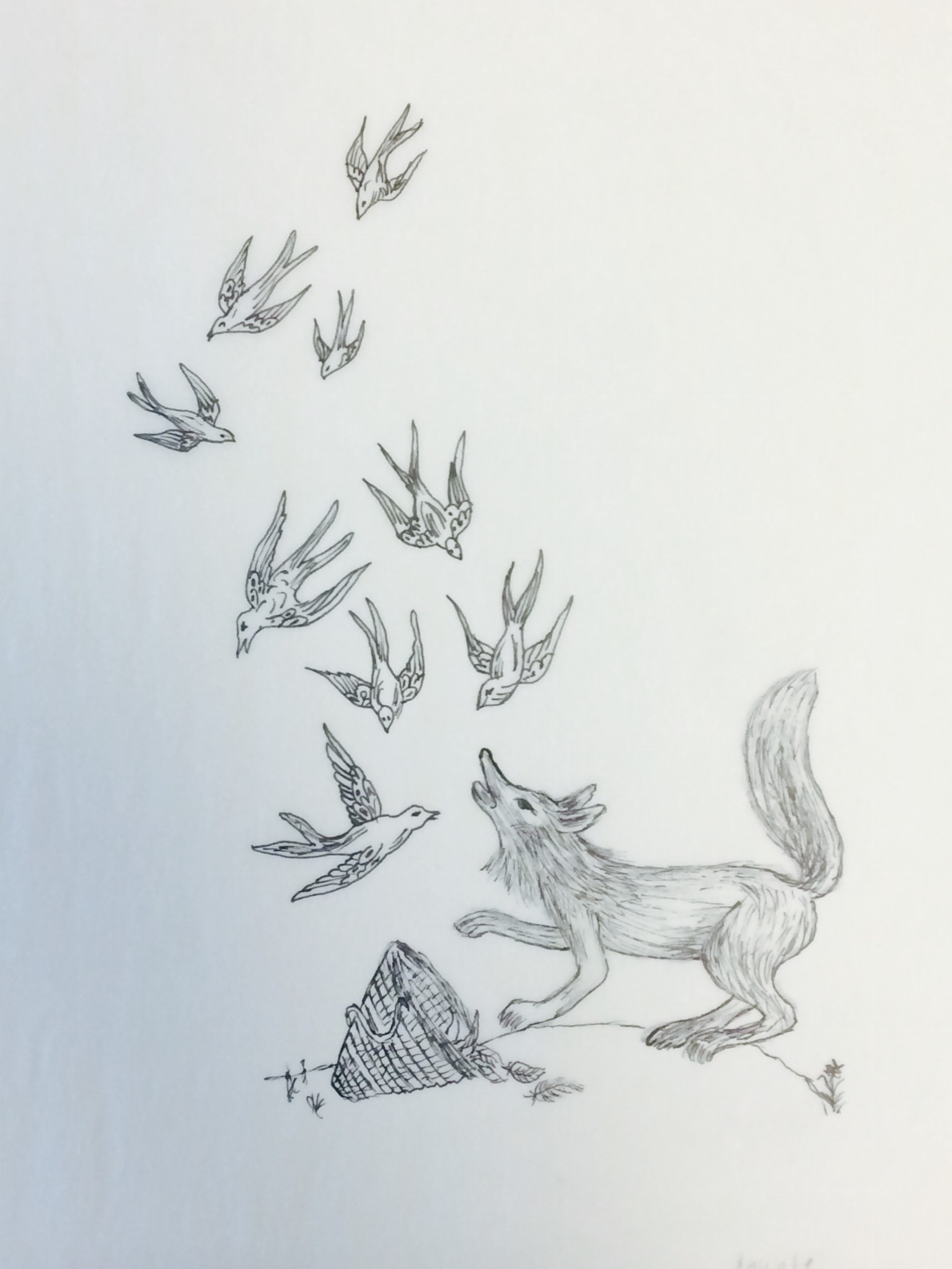
Coyote enticed the birds to giving him their feathers so that he could create humans.
Source for Further Reading: S.A. Barnett, “A Composite Myth of the Pomo Indians,” Journal of American Folklore 19: 72 (Jan.-Mar. 1906), 37-51.
Laure Albin-Guillot (1879-1962) was married to a physician/scientist and she tapped into her husband’s lifelong interest in micrography to create a stunning series of photomicrographs of crystals printed on colored and metallic papers. Her Micrographie decorative (Paris: Draeger Freres, 1931) is a shining example of natural pattern that can be seen elementally.
 MME Designs's Weblog