Introducing dragged trail bead design…
January 17, 2017
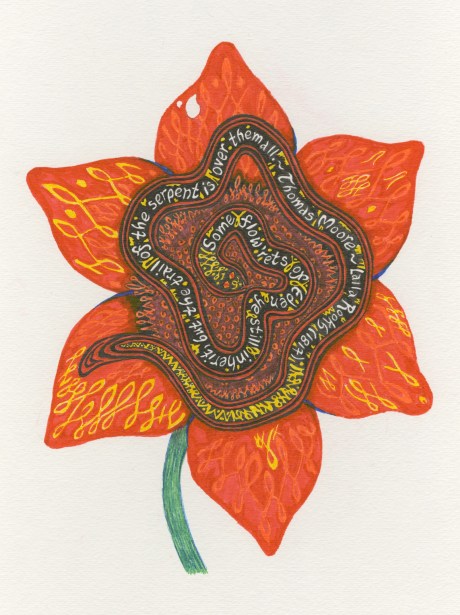
Some flow’rets of Eden ye still inherit, but the trail of the serpent is over them all.” Words by Thomas Moore from Lalla-Rookh (1817). The name Lalla Rookh or Lala-Rukh means “tulip cheeked” and is an endearment frequently used in Persian poetry. Tulip design by Meredith Eliassen, 2016.
The dragged trail bead motif is a pattern on glass that is created when a contrasting color is trailed onto a base color in parallel lines then an instrument is used to drag the trail in a perpendicular direction with a combing motion. This is a feather design where the dragging alternates up and down.

Photograph of dragged trail bead.
A Prayer for Unity
November 9, 2016
Peace, joy, and love design with two doves form a heart by Meredith Eliassen, 2015.
For the Clinton Family, thank you.
Imagine a better world… then act.
November 8, 2016
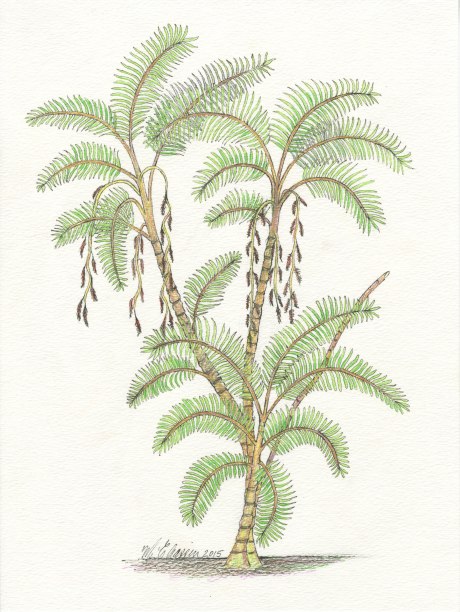
Drawing of a palm tree by Meredith Eliassen. Notecard
A Toddler named Alma, on the sky…
August 29, 2016
British politician and orator William Gladstone (1809-1898) studied The Iliad and The Odyssey by the Greek writer Homer who was active during the eighth century BC, and came to the conclusion that Homer must have been colorblind. However more recently, scholars have come to believe that color perception must be evolving and that perhaps, the world saw in black and white until a human consciousness reached for the perception of additional colors over many generations; that our ancestors could see first black and white, followed by red, yellow, green and then blue.
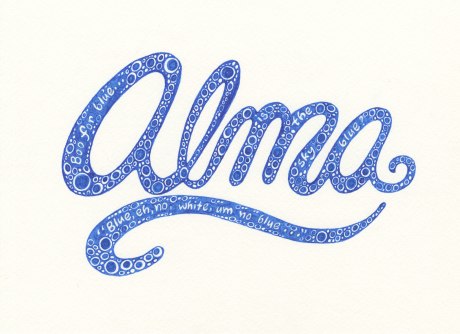
Consider “boo” for blue… is the sky blue? Alma responds, “Blue, eh no, white, um no blue…” Design by Meredith, 2016.
My friend Ella turned me on to this program by Radio Lab…
Radio Lab: Why Isn’t the Sky Blue? http://www.radiolab.org/story/211213-sky-isnt-blue/ Radiolab is a show about curiosity. Where sound illuminates ideas, and the boundaries blur between science, philosophy, and human experience.
The program asserted that colors entered the human consciousness as they were manufactured, and the earliest manufactured blue pigment was created in ancient Egypt.

Some ancient beads from Egypt.
On the road again…
August 16, 2016
Well summer is winding down, and my childhood buddy “Little Bear” has decided that he needs some adventure, so he is traveling to the Southwest with some of my designs. If you see him, give him a hug, he’s a real sweetheart.
“Little Bear” for MME Designs by Meredith Eliassen, copyright 2016.
The beginning of summer…
June 20, 2016
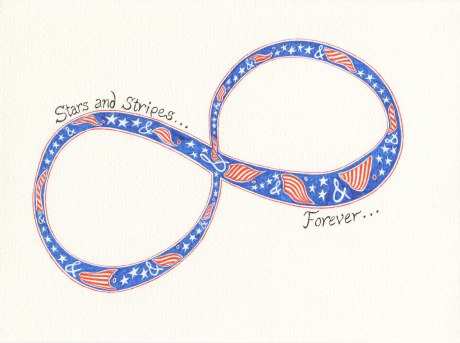
Already thinking about the 4th of July, Stars and Stripes… Forever, design by Meredith Eliassen, 2016.
In Unity
June 17, 2016
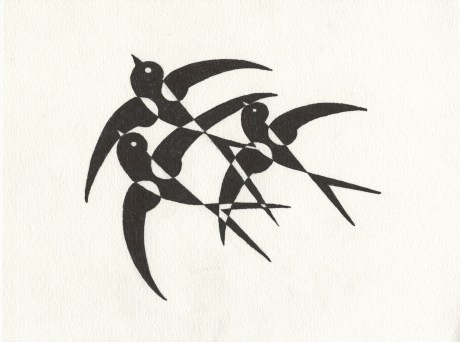
Three birds fly in formation, Art Deco design by Meredith Eliassen.
Si: “I’m Just a Girl who can’t say no”
March 9, 2016
So the Trade Wind Opera Company concludes its first season with this singular Mascagni operetta in three acts is based upon Carlo Lombardo’s operetta La duchessa del Bal Tabarin and Felix Dörmann’s libretto for Majestät Mimi.
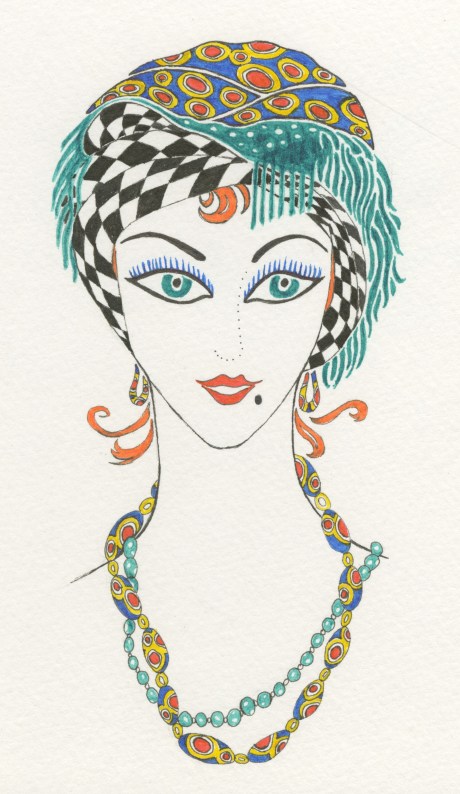
Portrait of Si wearing a strand of millefiore “trade wind” beads from the operetta by Pieto Mascagni (1863-1945) and librettist Carlo Lombardo (1869-1959), design by Meredith Eliassen, 2016
This design depicts, Si, a woman with the romantic spirit of a nomad, someone who is initially carefree in her romantic life. Inspired by the design concept of the “girl head” or “gypsy” tattoo, Si has a colorful, bold, pretty face with detailed adornments. According to tattoo historians, this form of tattoo design is traced to nomadic gypsies, also known as the Romanis that migrated to Europe.
Stay tuned for more operatic designs…
Will Turandot Figure out What True Love Means?
March 6, 2016
Turandot by Giacomo Puccini (1858-1924) is most nearly based upon Turandot by Carlo Gozzi that is in turn based on a story from the 12th-century epic The Seven Beauties by Persian poet Nizami about a princess Turan-Dokht how was the daughter of Turan. Set in China, the Prince Calaf, falls in love with aloof Princess Turandot. In order to obtain permission to marry Turandot, any suitor must solve three riddles correctly, and any wrong answer will result in death. The Calaf passes the test, but Turandot still refuses to marry him. He offers her a way out: if she is able to learn his true identity before the next day dawns, he will sacrifice his own life.

Pictured here are Turandot, the Calaf, and his slave Liù. Design by Meredith Eliassen, 2016.
Turandot, with a libretto by Giuseppe Adami (1878-1946) and Renato Simoni (1875-1952), was unfinished at the time of Puccini’s death in 1924 and was completed by Franco Alfano (1875-1954) two years later. It premiered on April 25, 1926.
Wagner Tonight
February 24, 2016
Richard Wagner (1813-1883) composed and wrote the libretto for Der fliegende Holländer, which premiered in early 1843. In the story, Senta, the bored daughter of a sea captain spins her own reality about a legendary Dutchman who is cursed.
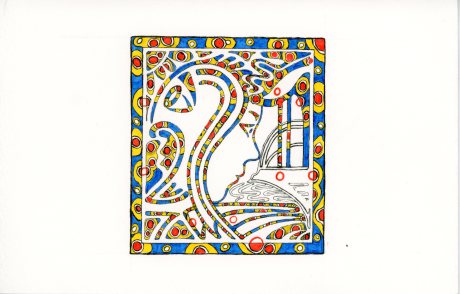
In Wagner’s Der fliegende Holländer, the cursed Dutchman cannot seem to escape Senta’s head. Design by Meredith Eliassen, 2016. Flying Dutchman Notecard
 MME Designs's Weblog