Purpose and “Use”
May 10, 2015
Paulann Petersen, Oregon’s sixth Poet Laureate (2010-2014) penned the wonderful poem called “Use,” which appears on this peregrine falcon.
To see “Use” as it meant to be read, online: http://www.paulann.net/poems/use.php
To learn more about Petersen and her work, go to:
http://www.poetryfoundation.org/bio/paulann-petersen

Peregrine falcon, drawn by Meredith Eliassen, 2015.
Thanks Paulann! These words perfectly reflect how I feel about life at this time of life. As I reflect upon the meaning of your words, I see how this blog has served its purpose for me, giving me insights to my creative processes and to the people around me. I see this as a natural place to pause and put what I have learned to use on other projects, so I am going to let the bird and the poet have the last words for now… and return in autumn with new drawings and stories from the field.
Many Thanks!
May 7, 2015
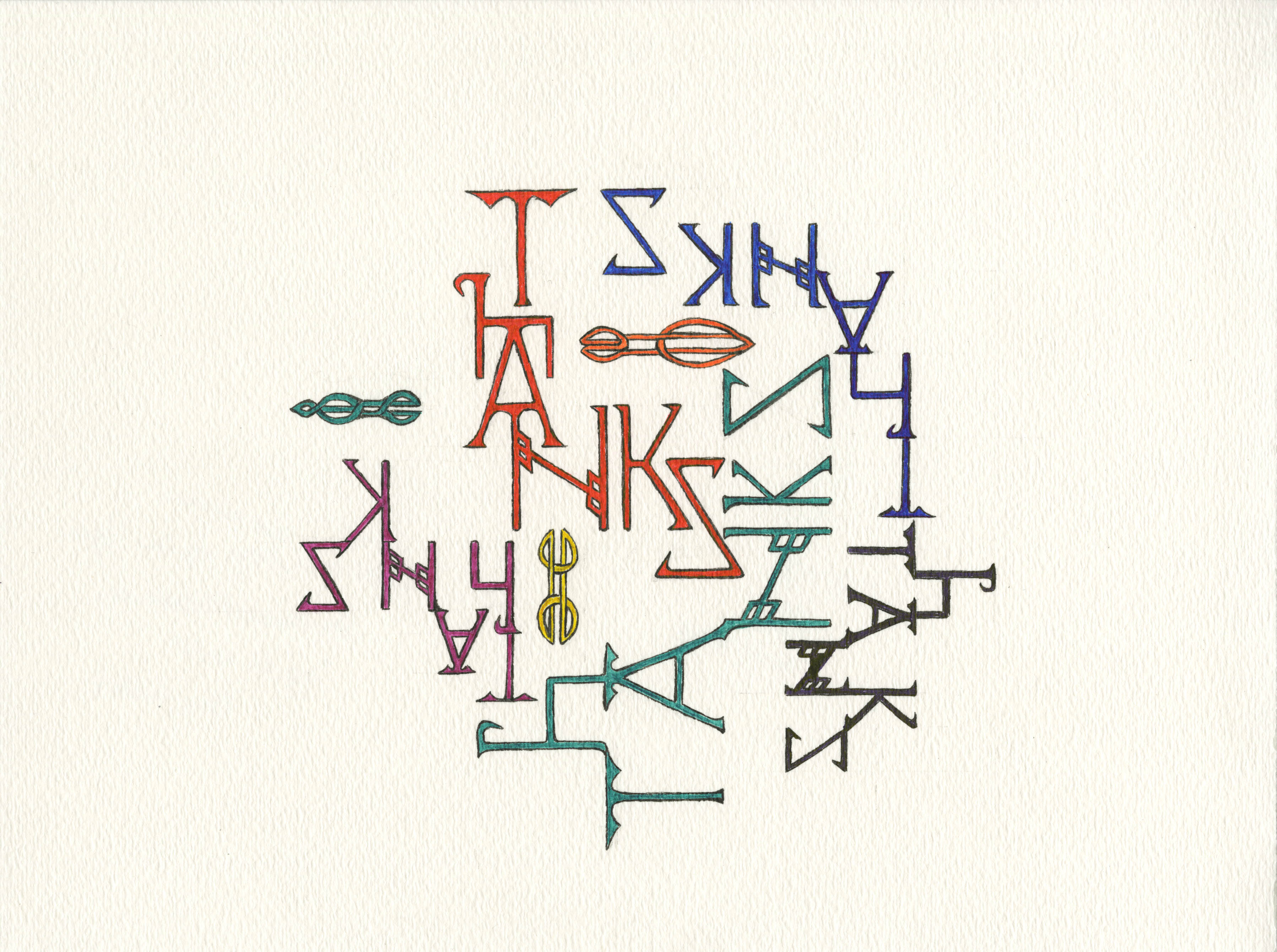
Many THANKS, using script interpreted from the “Book of Kells” drawn by Meredith Eliassen, 2015.
For Oliver
April 28, 2015
Meet Oli Octopus, the gentlest octopus in the whole ocean blue, he wants to say hello to you…
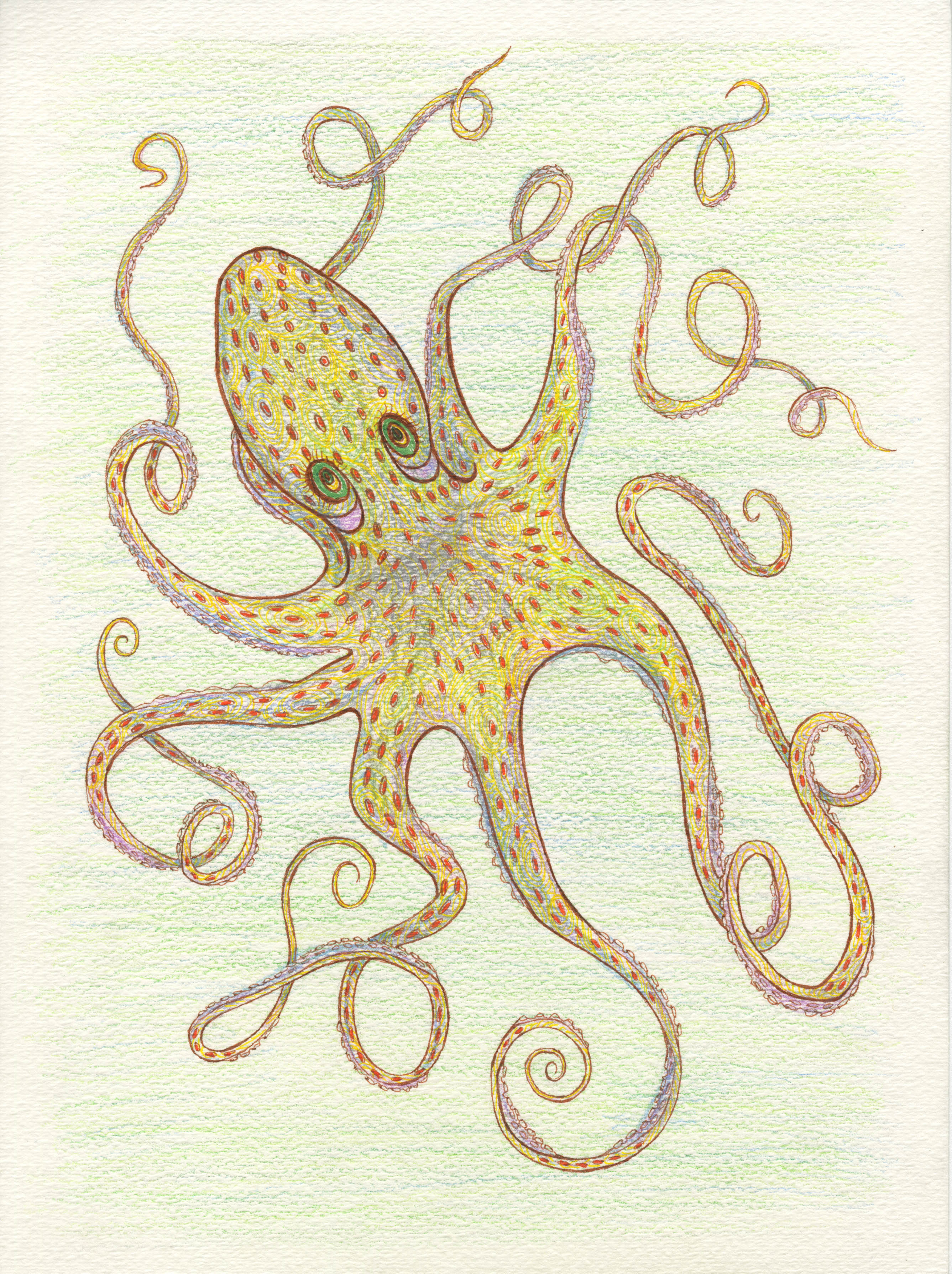
“Oli Octopus,” designed by Meredith Eliassen, 2015.
Happy birthday!
Someone I know is writing a biography of Arthur Rackham, so the Edwardian artist has been in my thoughts. I have to admit that Rackham’s work was a big influence on me as a teenager. Rackham had a delicate constitution that led him to leave high school as a teenager. He traveled to Australia with family friends where he recovered his health. His illustrations resonated with me as a teenager because I believed that he really saw the spirits; he clearly had an affinity for fairy tales and an eye for fantasy.
Roughly contemporary to Siméon Pelénc (1873-1935) but working in very different design ecosystems; both were responding to realism (or verismo) in art; Rackham’s market niche was established in the expensive gift book market (popular in America) that waned in the Interwar years in England. He enjoyed a huge adult following, but the war had brought such a deep level of disillusionment that fairies and fantastical were beyond the realm of verismo that carried art into a guttery lurid place.
During World War I, his wife Edyth (often described as his opposite: beautiful and daring) was struck down by pneumonia and subsequently had a heart attack that substantively weakened her. Their small family moved to a farmhouse with few amenities in the Sussex area. Though he looked wizened, Rackham was physically active, walking and cycling daily. To spend time in the natural world without luxuries, we take for granted the imaginary landscapes that can appear when the material senses are silenced.

“Rackham-esque Tree,” design by Meredith Eliassen, 2015.
Over the weekend I drew the above image that was definitely inspired by an illustration by Arthur Rackham in The Legend of Sleepy Hollow by Washington Irving (Philadelphia: David McKay Company, 1928), and the quote describing Rackham’s fantastic tree appears on pages 82-83.
“In the centre of the road stood an enormous tulip tree which towered like a giant above all the other trees of the neighborhood and formed a kind of landmark. Its limbs were gnarled and fantastic, large enough to form trunks for ordinary trees, twisting down almost to the earth and rising again into the air.”
Article Published on French Artist Siméon Pelénc (1873-1935)
April 24, 2015
I recently had an article published in the California State Library Foundation Bulletin about Siméon Pelénc (1873-1935):
Click to access Bulletin111.pdf
Siméon Pélenc was born and raised in Cannes, France. He hoped to become an architect and was an accomplished draftsman, but perhaps was best known for his murals and opera set designs. He settled in San Francisco, California in 1916. A study of San Francisco city directories indicates that Pélenc did not advertise as an artist for several years while he taught French to journalists in the Chronicle Building. By 1925, he occupied a studio located at 728 Montgomery Street and resided with his second wife Helen at various locations adjacent to the French Quarter.
Pelénc was a scenic painter who worked in oils and temperas. Some of his early work employed pointillism, a technique of painting in regular dots or small dashes of pure color, which from a distance created a vibrant effect. However, he was best remembered for introducing Italian sgraffiti techniques of mural painting to California. The Northern California Chapter of the American Institute of Architects invited Pelénc (who was a member) to participate in Exhibit and Honor Awards for Craftsmanship in efforts to revive “the splendor of fresco and sgraffito” in the region in 1927, 1928, and 1929.
“The word, “fresco” comes from an Italian word meaning “wet” or “damp” and the fresco painter does not paint his picture on the wall it is meant to adorn; he makes it become part of the wall, in the same manner in which nature makes marble — by adding mineral pigments to the plaster while it is still wet.
Pelénc’s credo was “Every effort in life teaches us something and this accumulated gain is what makes the big man out of the little man.”
I have found that researching Pelénc has made me want to draw with less realism. The following picture was inspired by a German example of ceramic sgraffiti with light/dark reversed.
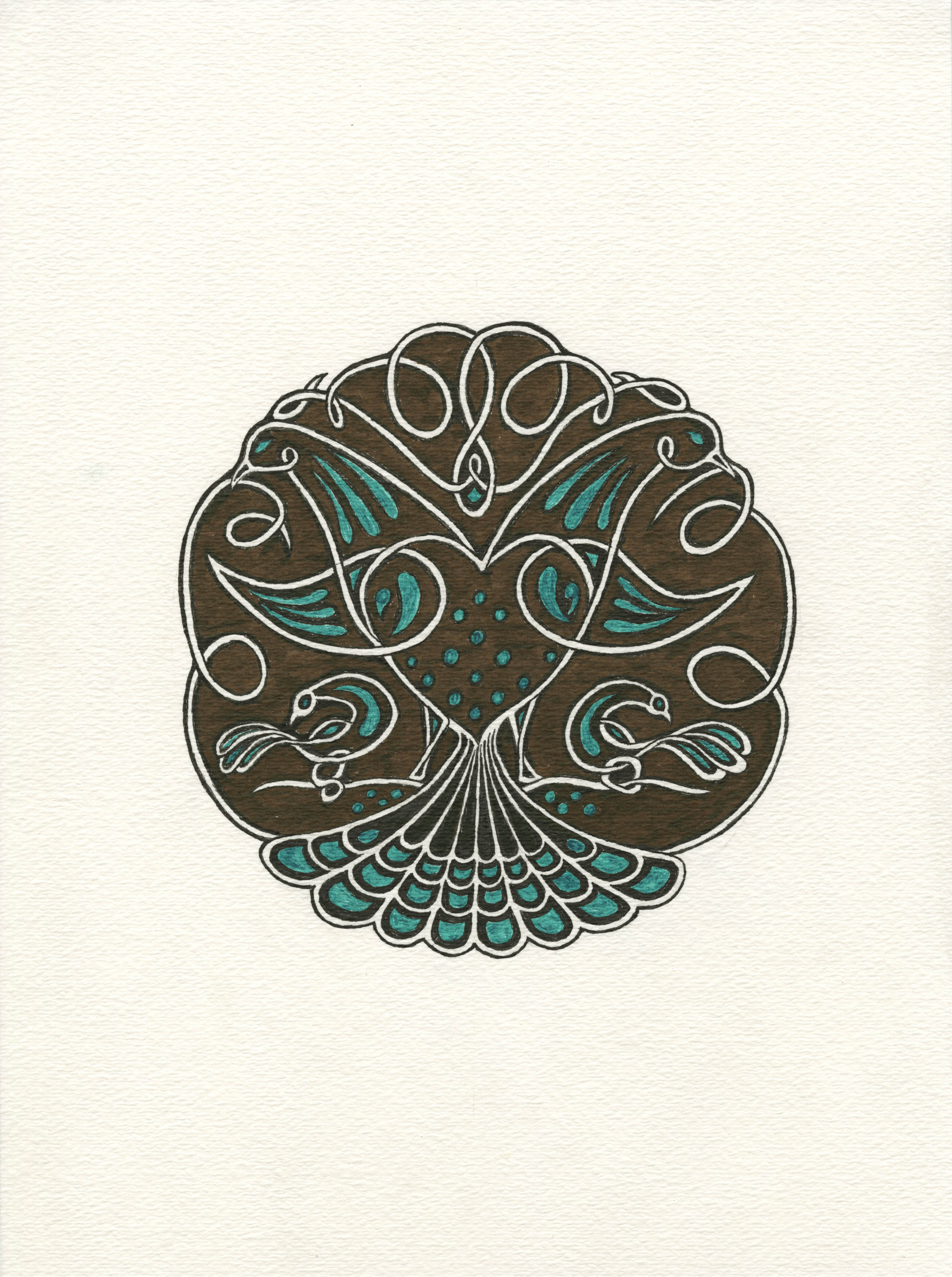
Four birds in a stylized design by Meredith Eliassen, 2012.
On Earthday: Let’s also consider “The Celestials”
April 22, 2015
As we broaden our view to celebrate Earthday today, let’s also consider ourselves within a more universal context. Happy Earthday, Everyone!!!

“The Celestials” all together: Sun, Moon, and Stars. Design by Meredith Eliassen, 2015.
Butterflies #1
April 3, 2015
I have been playing with butterfly designs, and this is the first collection to land on paper. I draw them on cheap paper and cut them out. When the paper is cut, it curls so that the butterflies look like they will take flight. I hope to do more as time permits.
Happy April Fools Day!
April 1, 2015
“The Chase” came to me after a walk around Lake Merced. No, there is not some evolutionary happenings at the lake that I know of, but I saw a cormorant dive into the water a had a mind picture of primordial times when a bird dove in to the water and chased a fish, who sensing danger, had it fins turn into wings just in time to take flight.

A bird chases a fish underwater and looking back the fish’s fins morph into wings so he can take flight. Design by Meredith Eliassen
This image captures an imagined moment of transformation.
Convergence…
March 23, 2015
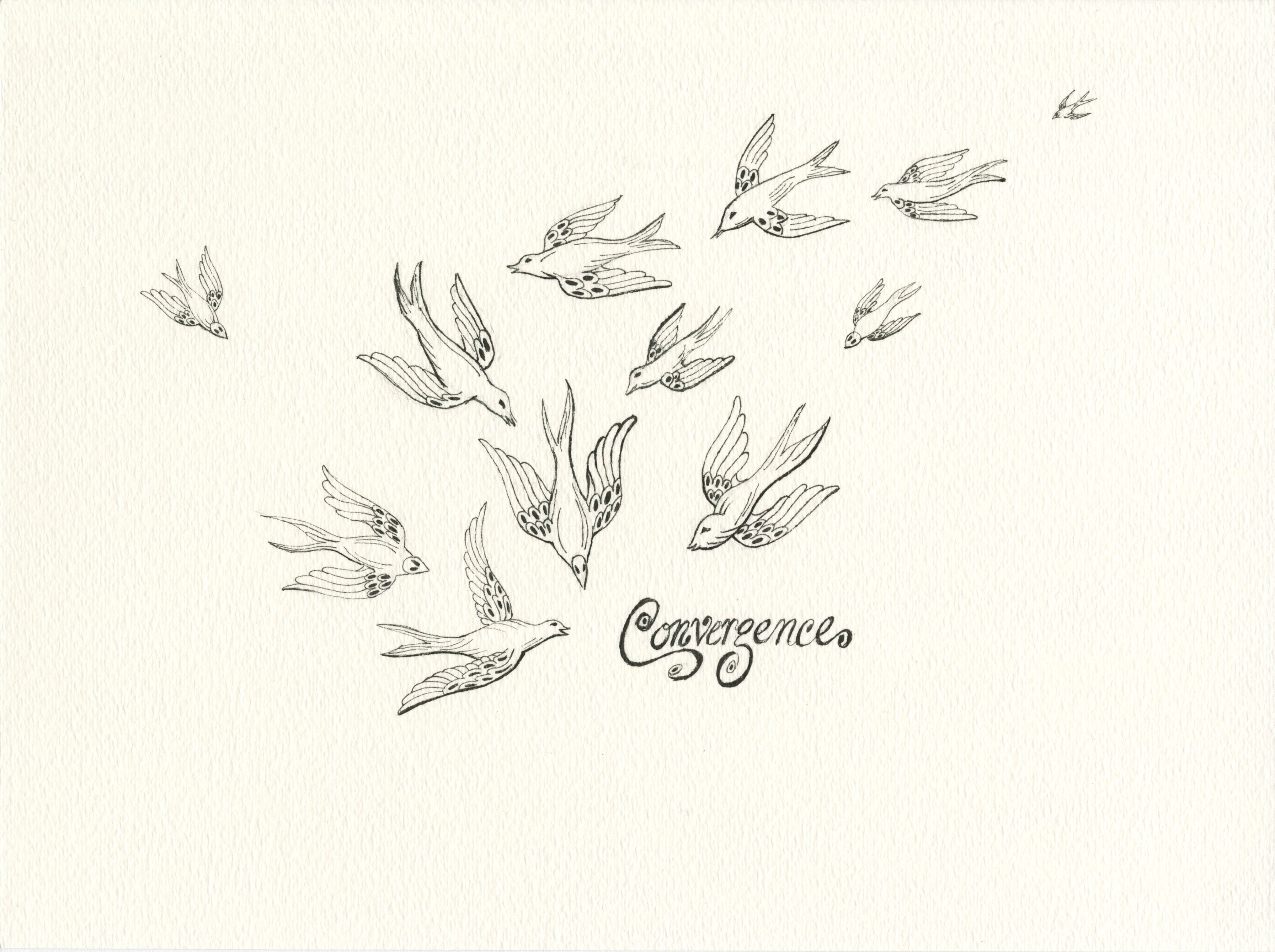
I was so busy with my day job that I have not had a chance to do artwork, so this was my way a easing back to the drawing board. The basic bird design was inspired by an embroidery design in a Victorian crazy quilt by Helen Penniman (Pardee) who would marry a future California governor, that was stitched on camping trips to the Redwoods. To learn more about this quilt and its maker, check out my article from over a decade ago, called “Adventurers in Nature: The Merry Tramps of Oakland,” California History 82:2 (2004): 6-19. The quilt is still housed at the Historic Pardee Home in Oakland, California.
Water Turtle Visits
March 12, 2015
Here is the companion to the Water Yin Yang in the form of a turtle, I did them one after the other. For you, Mr. Turtle… you can see the hints of a primordial language on his shell.
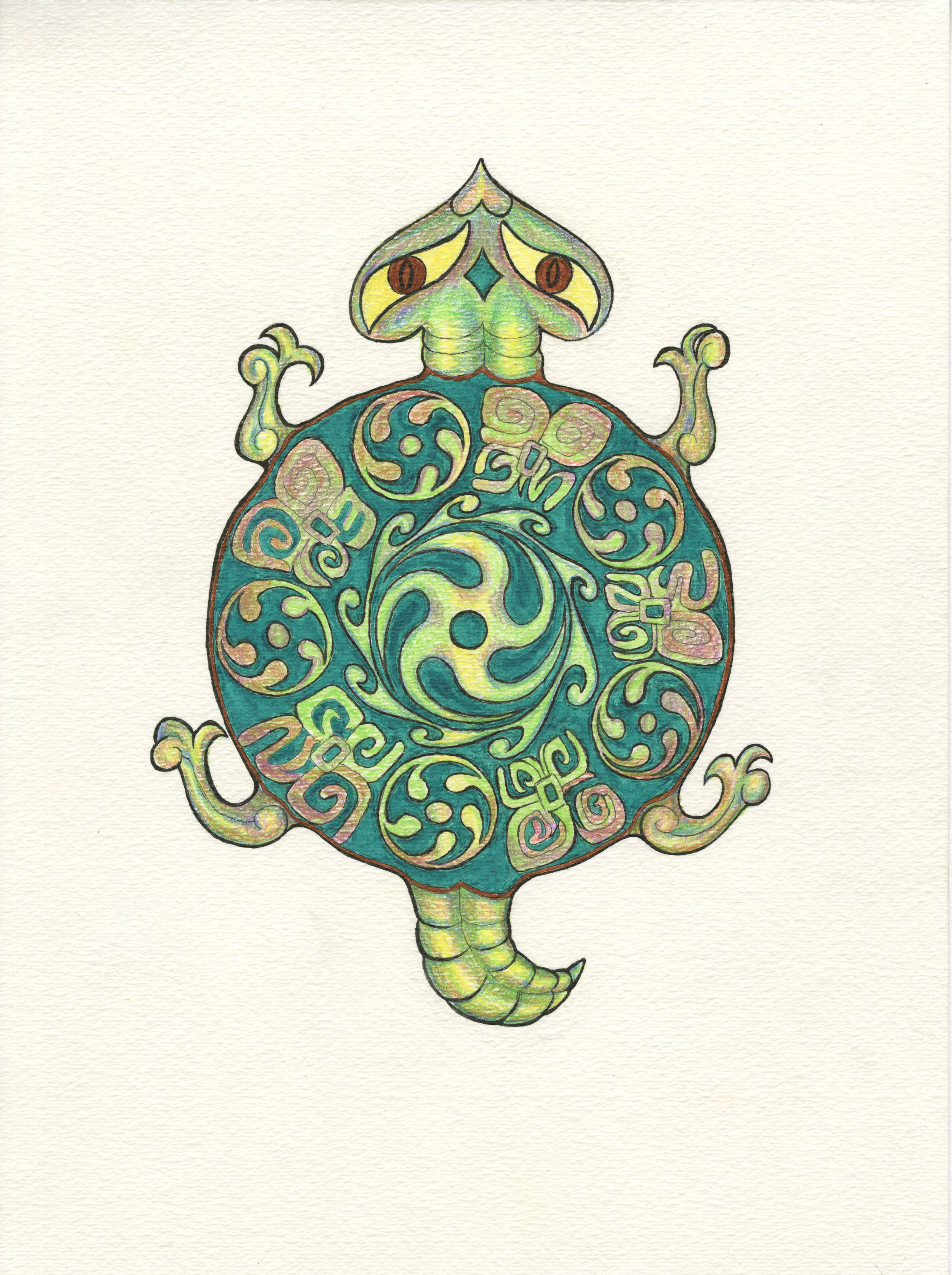
Turtle design by Meredith Eliassen.
 MME Designs's Weblog