Enter the chess King…
March 7, 2015
Yes, in chess, without her King, there is no game. Still playing with shape.

Drawing of chess Queen and King pieces side by side featuring continuous landscape, by Meredith Eliassen, 2015.
Is She Isolated or Self-Contained
March 6, 2015
Several months ago I read Marilyn Yalom’s engaging book Birth of the Chess Queen (New York: HarperCollins, 2004) and was intrigued by the image of the earliest Spanish chess queen from the medieval period to reside in the United States (pictured on page 56). I could not figure out the logic of the piece, because to my twentieth century sensibility, she looked trapped or imprisoned within her fortress piece… and Queens are supposed to be free moving on the chess board.
I drew her quickly with my trusty Sharpie for later contemplation and provided her with a different identity (that of Katherine Swynford) by adding heraldic images. Last night I pulled her out again and it seemed to me that she was not isolated, but rather, self-contained.
Though she has kind a deco feel now…
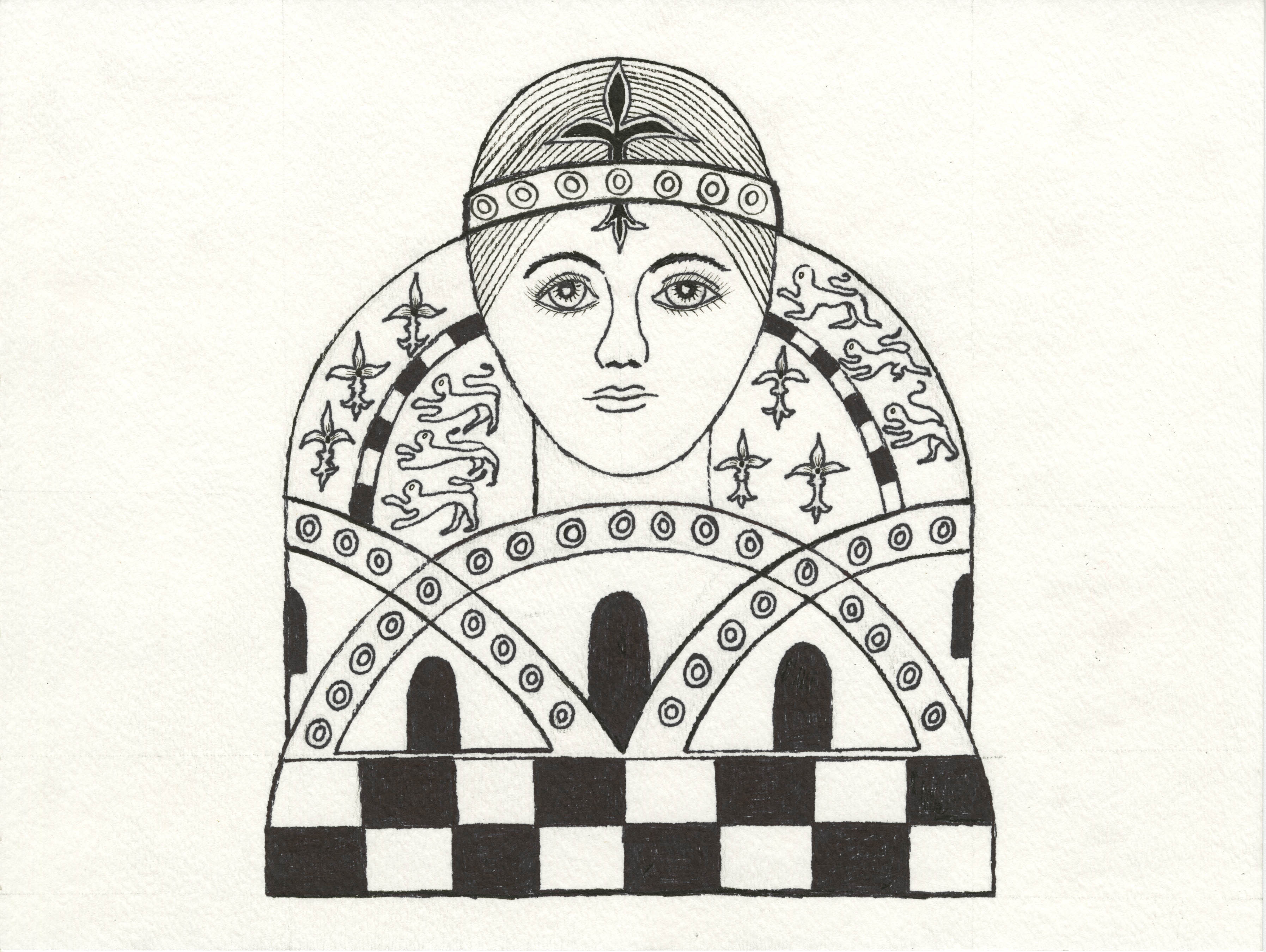
Chess Queen design based upon the earliest known Spanish chess queen with a face dating from medieval times. Drawing done with Sharpie ultra fine point pen by Meredith Eliassen, 2015
Introducing the Queen of Diamonds Gallery…
March 4, 2015
I seem to be seeing diamond designs… perhaps it is a response to Zentangle squares, maybe a subversive sensibility to turn squares on edge. I am going to start a gallery of images where diamonds are featured somehow, but not to alienate any shapes… this is an inclusive website, I will try to expand my repertoire of shapes in the near future.

Adapted from a “Queen of Diamonds” in a deck of playing cards, this design is by Meredith Eliassen, 2015.
Etruscan Dancing Girl
February 17, 2015
Before “Happy Fish,” I drew an Etruscan dancing girl, based upon a design on an Etruscan vase, I was not to sure of her, especially with the odd toes (authentic to the vase drawing), but decided to post her anyway.
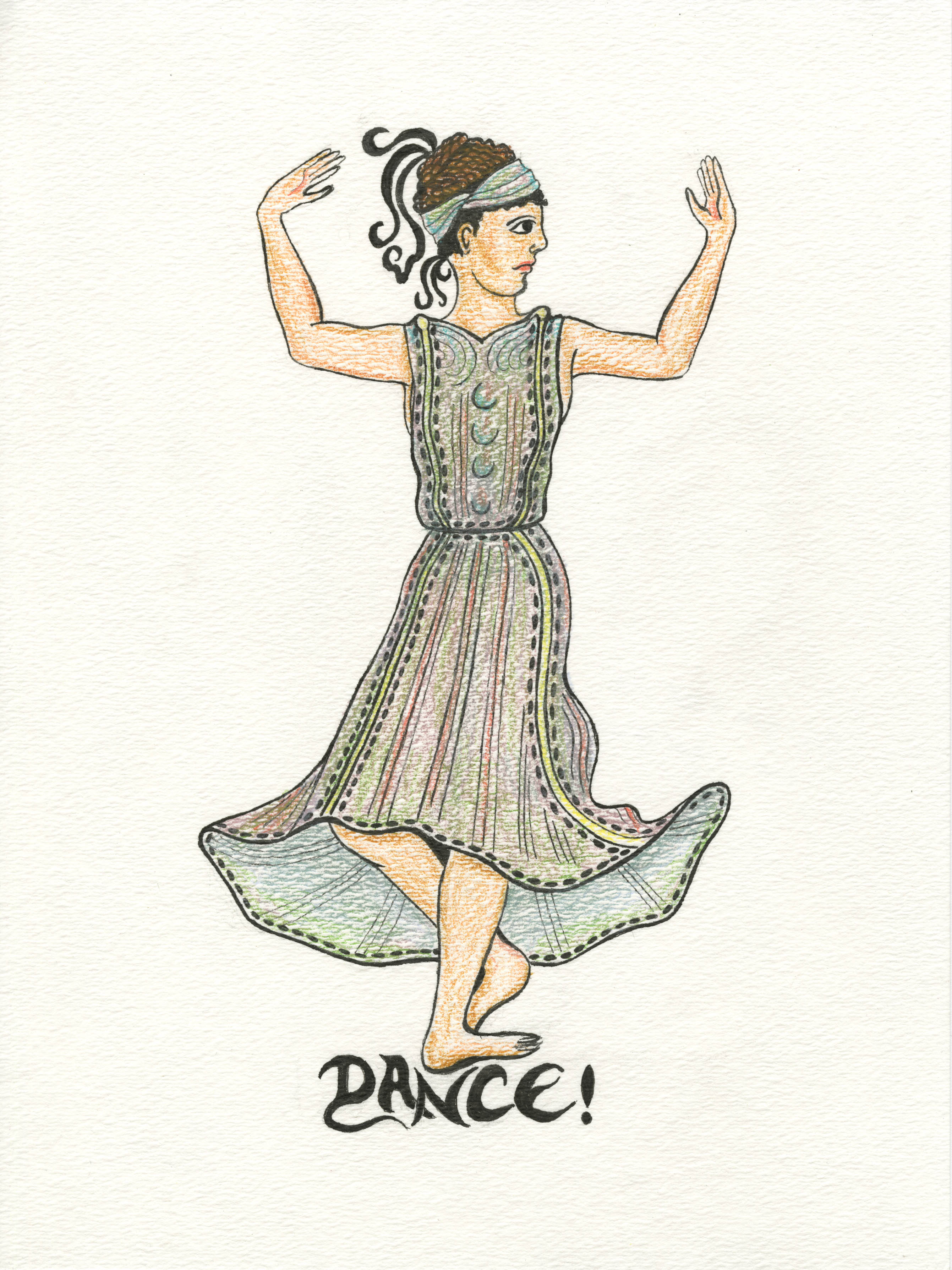
Image of a girl dancing inspired by an Etruscan vase from the 4th century BCE. Drawn by Meredith Eliassen, 2015.
A Fish Picture…
February 11, 2015
I had been practicing drawing working with an image from an Etruscan vase of a female dancer without much luck last week… the drawings worked but they were not worthy of posting. Then a series of rain storms came through the Bay Area and I was stuck indoors for a while. This picture of a jewel-tone fish came into my mind and I started to draw. I have not colored it yet because it has an interesting “woodcut” quality which I am going to share before attacking it with color.
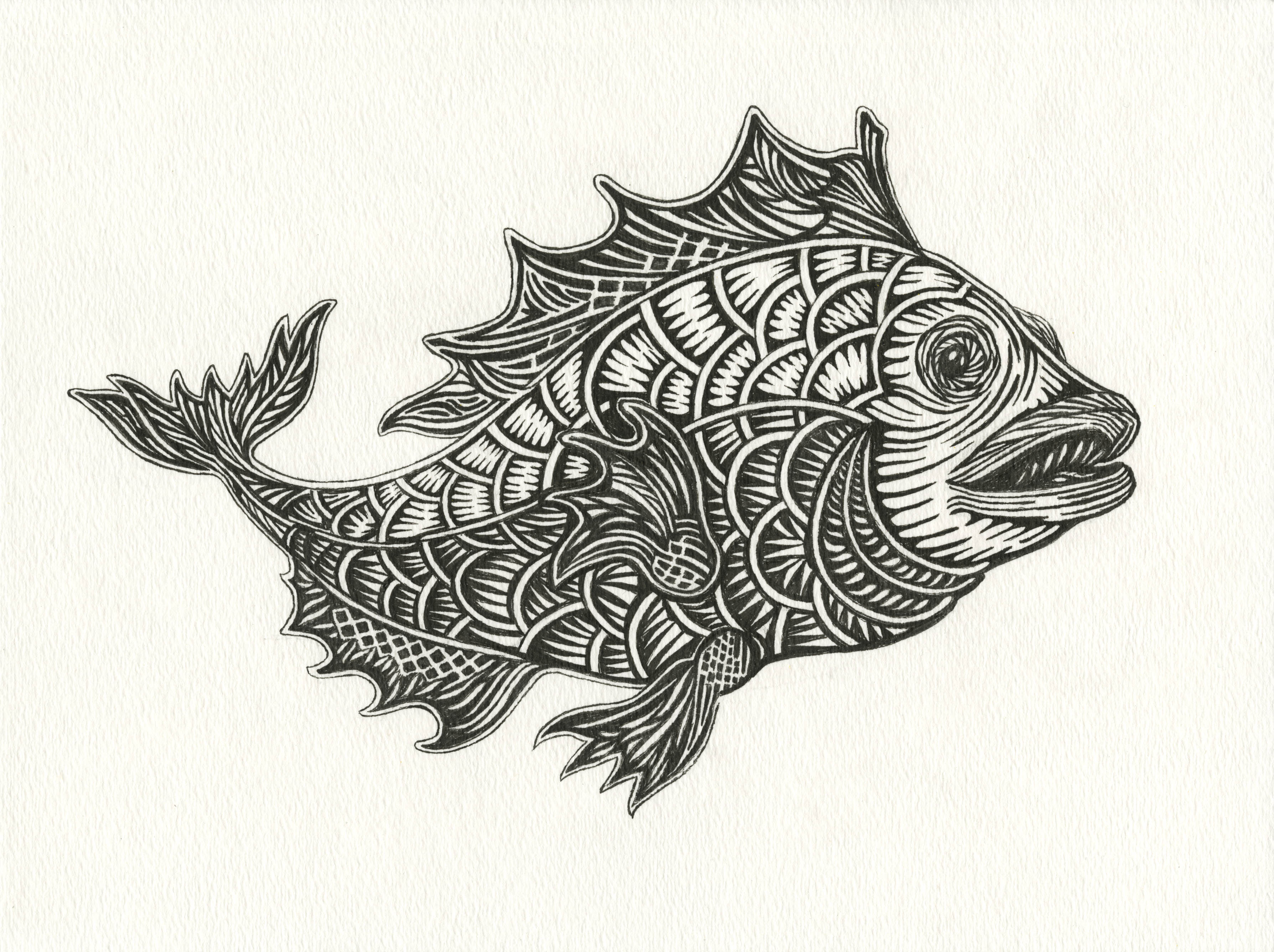
During recent rainstorm this fish came into view in full color, but I wanted to capture it while in black and white. Drawing by Meredith Eliassen
Result from Dad’s [dot] Smackdown Challenge
January 29, 2015
Here is what I first came up by using a dot and then developing an image.

Drawing by Meredith Eliassen
“The Mason Children, David, Joanna and Abigail”
December 19, 2014
This oil painting depicts three children (one boy and two girls) posing with props is one of a small number of paintings from New England showing cultural icons of Puritan society. It is carefully detailed and fascinating to look at. There is an interaction between these figures: gazes that cross each other, the distortion of the girls’ hands make it seem like they are reaching to hold hands, to give each other support, subtly demonstrating a silent bond despite a space between them. The separation of the girls from David is marked by the walking stick, which serves to separate the two sexes.
The composition tells the viewer about the time and society in which the painting was produced. The girls are symmetrically posed with Joanna set slightly forward on the plane creating a one-point linear perspective indicated by the floor pattern. David’s posture further adds distance, as well as indicated the youth’s predestination to be someone of prominence in his community as shown by the enlarged stomach, then a sign of prosperity.
The use of color is subdued but exciting at the same time. The chiaroscuro is dramatic; values are extreme between dark rich browns and greys and the intensely light whites and beiges, with one exception – the red hue – that is used on the girls. This intense red stands out as a strong statement for during this time wearing red symbolized passions not to be shown in public. However, I believe the use of red in this picture reflects the passion of our county’s youth.
The textures in this work are precise and clean from the contour lines to the lovely modeling of the skin, to the softness of the hair. The textures of the delicate lace, fine leather, shiny ribbons, heavy fabrics, and shear stockings demonstrate the skill of the artist. “The Mason Children, David, Joanna and Abigail” could be a symbol of the first American frontier, for it is a group of people who have the garden, and who long to have a society with all of its structure. Society is shown through the cane and fan; religion is shown with a rosary, and the garden is symbolized with the red rose. Even at this point, Colonials needed to be bound by the restrictions of civilizations symbolized by the red ribbons that bind the girls’ neck, arms, and feet. For me the unknown Freake-Gibbs Painter has done a brilliant job in conveying the youth of America.
“The Mason Children, David, Joanna, and Abigail” (circa 1670) at the Fine Arts Museums of San Francisco (online):
http://www.wwnorton.com/college/english/nael/17century/topic_4/illustrations/immason.htm
The Wayfarer’s Song, Installment 4
November 6, 2014
An Experiment in point of view
Wayfarers’ songs are work songs, sea shanties, street cries, military cadence and jody calls, and protest songs. Songs for miners, lumberjacks, cowboys and factory workers get sung in rhythmic a cappella that synchronize group action and relieve the loneliness; they are boasts sung during off- hours in social settings. To while away sleepless hours, pitching voices high or low through the intricacies of song, the watchman over time learns to keep in tune. As for me, there has always been a woman to let me be her tom.
The wayfarer’s song is seminal to historic memory: the means for groups to remember and perpetuate shared values, experiences, and knowledge. For us to remember, they must have four features: they must be repeated over time and through multiple currents; they must be conspicuousness in intensity to remain in the consciousness; they must be recognizable and standard, and embellish-able; and they must be bold and compelling enough to announce that more complex signal will follow.
The Wayfarer’s Song, Installment 3
November 5, 2014
An Experiment in point of view
I admit that I mimic the great poets and embellish their sensibilities; competitors and former friends say I am an imposter still masked. Men learn to mimic with their mouths the trilling notes of birds long before they are able to join together in tuneful song. It was akin to the whistling of the breeze through hollow reeds that taught the Ancients to blow through hollow hemlock stalks. After that the wayfarer, troubadours and jongleurs, and wandering minstrels (or nomads like myself) learned by slow degrees the plaintive melodies that with the touch of a player’s fingers flow from the flute.
Coordinated action throughout evolution, I believe, comes to us today in call and response songs inherited from prehistoric kinfolk. Employed to foster “muscular” bonding, these musical dialogs trigger elemental human emotions: love, hate, and fear. We reflect patterns of human communications with a succession of a call phrases in our provincial tongues, the langue d’oc, followed by a direct comment or response. If the sun smiles upon us, then comes the time for joking, talking, and merry laughter. I speak of the heyday of the rustic muse, when he dances out of step, moving limbs clumsily with feet stamping on mother earth.
The Wayfarer’s Song, Installment 2
November 4, 2014
An Experiment in point of view
Folklorists traditionally capture songs in regions of isolated poverty. Be not deceived, the wayfarer’s song is a phenomenon of cosmopolitanism conceived and incubated in the intense heat of cultural hearths, be they multicultural urban centers or densely packed boomtown camps. Men compelled to wander in search of purpose and utopia carry music from home and hearth. This music imbued with intangible nomadic qualities, hopes, and fears, morphs within shady alleyways and busy bars; it binds wayfarers together even as they compete for opportunity in boom times, but it also shares the sorrow, death, and bust times. Music aligns strangers into kin groups. The fortunes of Liberty get tested with each generation; we must not limit posterity to our limited understanding of freedom, for posterity is born of another time. The wayfarer quickly learns that what does not kill him, will make him stronger.
Anthropologists argue that we inherit music from our male primate ancestors who used it to attract mates. Epic songs, the Ancients believed, were derived from the Muses who ruled over all creative and intellectual endeavors. Evolutionists suggest that music is an action like art and language that changes with social dynamics and cross-cultural nuances through time. They also say that music is practical in ritualized mother-infant exchanges that are shaped by universal common understanding. Song, scientists today argue, is simply various courtship displays akin to those expressed by other complex, varied, and interesting animal sounds found in nature. Music, they agree, is not an object of physical sustenance – like food or water – it provides no protection against attackers. However, they discern, it serves a social function by fostering deeper relationships shaped by both biology and culture. Melodies take shape far from the busy highways, amid groves and thickets in the solitudes where the wayfarer spends his sunlit leisure.
 MME Designs's Weblog