Austen Counters American Captivity Novels
September 23, 2014
Jane Austen’s work was not in sync with the emerging American nationalism that was a new social construct of imagined communities (not naturally expressed in language, race or religion) as Columbia’s citizenry moved toward a single overarching national identity. The frontier challenged any fictional portrayal of women having niceties based solely upon virtue. Ann Eliza Bleecker (1752-1783) spawned a homegrown American genre in the form of the captivity novel. The posthumous publication of her History of Maria Kettle (1797) set during the French and Indian War containing graphic scenes of violence presented epistolary prose in the British style that was exciting to readers. No English woman would have witnessed the brutal murder of her children by Native Americans, or have been stripped of her “habits, already rent to pieces by brier, and attired… with remnants of old blankets (Bleecker 2010: 19).” Bleecker’s exaggerated style created a hauntingly brutal journey into a conversation on the American frontier. It inculcated moral lessons that assured its captive protagonist, married at the age of fifteen years to a farmer and immersed in innocent righteousness, would be returned to the loving arms of loved ones.
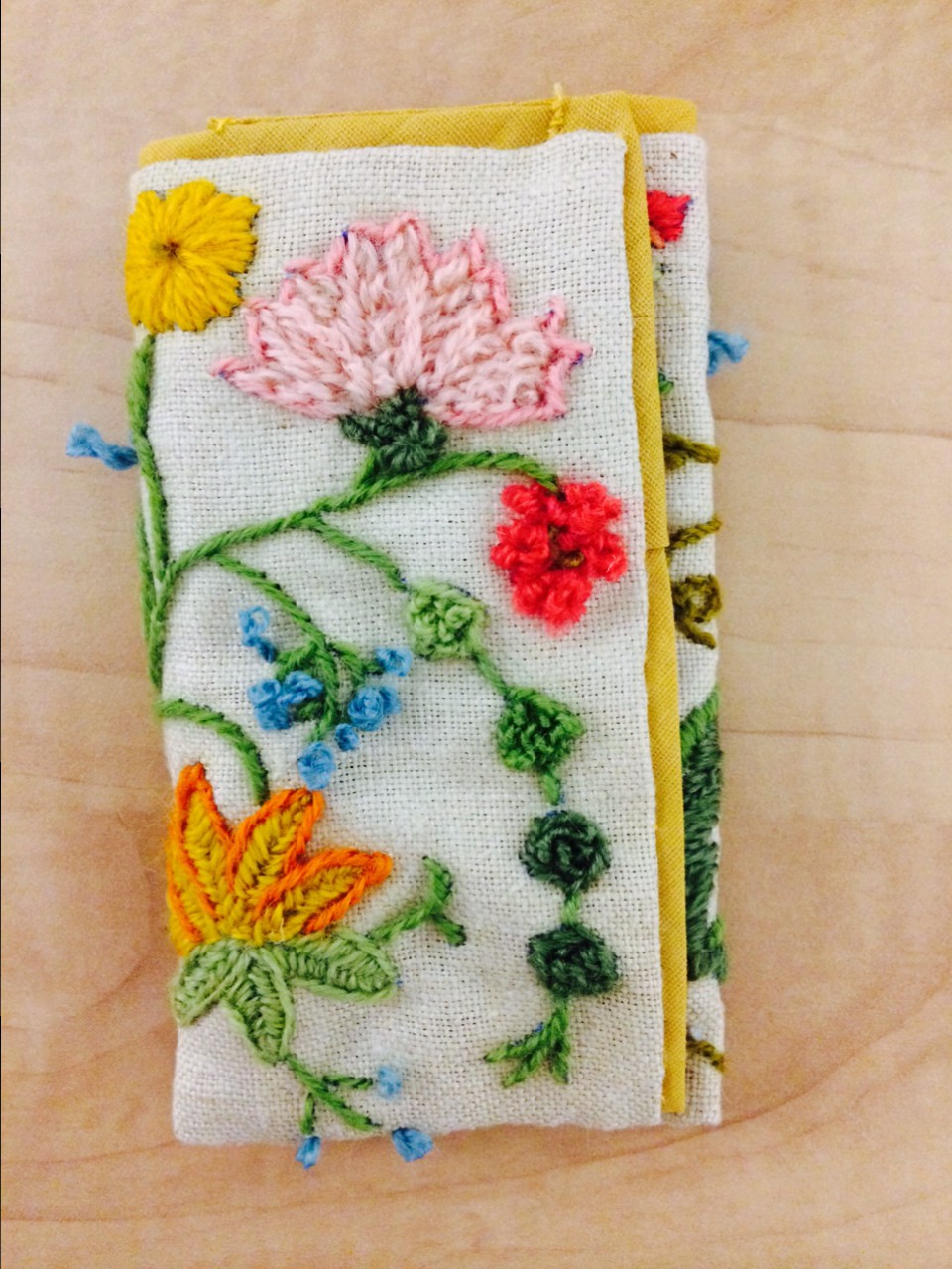
Crewel stitching by Constance Eliassen turned into a pouch by daughter Meredith
In celebration of the first day autumn, a sample of my mother’s stitching:
“Republican womanhood,” a concept of American womanhood described by historian Linda Kerber, to define the notion that the Republican mother integrated political values into her domestic life. She was dedicated to the nurturing of public-spirited male citizens, and infused her sensibilities of virtue into the young country. This reconciled politics and domesticity and justified the status quo of coverture. For instance, P. -J. Boudier de Villemert in his The Ladies’ Friend: Being a Treatise on the Virtues and Qualifications which are the brightest Ornaments of the Fair Sex, and Render Them most Agreeable to Sensible Part of Mankind (1781), asserted that a woman should place her whole affections on her family, which made the mother the ideal parent to rule the “gentle empire” of the home.
However, a woman’s worth on the frontier (without the established class system found in England) was measured by her service to God and neighbor. American women grappled with newly defined gender roles. As in literary fairy tales, ordinary women were tested in daily life and exhibited quiet heroism when their world was economically destabilized; they often employed an unrecognized female-managed “grey” economy dating back to the Revolution when men were on the warfront. This verse of Judith Sargent Murray (1751-1820) in her collection of essays called The Gleaner (1798) reflects a rarely delineated sensibility of American womanhood cultivated in Columbia’s less-structured class system:
I love to trace the independent mind;
Her beamy path, and radiant way to fine:
I love to mark her where disrob’d she stands,
While with new life each faculty expands:
I love the reasoning which new proofs supplies,
That I shall soar to worlds beyond the skies;
The sage who tells me, spirit ever lives,
New motive to a life of virtue gives.
Blest immortality! – enobling thought!
With reason, truth and honour, richly fraught –
Rise to my view – thy sweet incentives bring,
And round my haunts thy deathless perfumes fling;
Glow in my breast – my purposes create,
And to each proper action stimulate (Murray 1992: 493).
In marriage as in fairy tales, the male reflected the active side of the pairing, while the female reflected its passive more receptive side. Traditional parental influence waned in relation to a daughter’s marriage prospects during the 1790s. American women practiced more freedom in choosing marriage partners as romantic love and premarital sex grew. Single women who did not correspond to the status quo were marginalized. Literature of the day justified this conversation by placing women into a model wives as the purveyors of morality. American women were active out of necessity. Where in Sense and Sensibility, a physician is called when Marianne Dashwood becomes dangerously ill to administer the more psychologically dramatic therapy of bleed letting (suggesting a connection to the upper ranks of society), more conservative remedies would be employed by midwifes in rural America.
Marriage was had become a rite into retirement, and not necessarily the enchanted dream of happily-ever-after. Once a woman wed, under coverture she became a mere cipher. The legal doctrine of coverture declared that a husband and wife became but one person in marriage – that person was the husband whether he lived by virtue or vice. A married woman was considered to be sub potestati viri – under the power of her husband – and therefore she was unable to make contracts or establish credit without her husband’s consent. The husband was liable for his wife’s support, but his legal obligations to his wife extended only to necessities – what she needed to survive. In practice, everything beyond the wife’s mere maintenance was dependent upon her husband’s sense of propriety or generosity.
Bibliography
Bleecker, Ann Eliza. The History of Maria Kittle: in a Letter to Miss Ten Eyck. Glouchester, U.K.: Dodo Press, 2010.
Murray, Judith Sargent. The Gleaner. Schenectady, NY.: Union College Press, 1992.
Cousins Britannia and Columbia and the Evils of Novel Reading
September 22, 2014
British essayist and lexicographer Samuel Johnson (1709-1784) first coined the term “Columbia” to represent the symbolic female personification of the American colony in a 1738 issue of Gentlemen’s Magazine. Johnson defined active as “that which acts, opposed to passive, or that which suffers (Johnson 1785: 1: ACT),” and he defined passive as, “receiving impression from some external agent (Johnson 1785: 2: PAS).”
In traditional fairy tales the male represented the active side of human nature, while the female represented human nature’s passive more receptive side (Meyer 1988: 73). American publishers during the early Republic were especially sensitive to the semantics of active and passive in promoting a strong new America, and American publications promoted feminine virtue as a tool for building nationalism. However, they remained in accord with earlier British essayists Joseph Addison and Richard Steele who warned of the deplorable effects of fashionable education on young women: “From this general folly of parents we owe our present numerous race of coquettes (Lasch 1997: 68 and Tise 1998: 362).” They suggested that raising daughters to be “artful” made them fair game for seducers, when parents should rear daughters to make them morally attractive as marriage partners for upwardly mobile young men.

Pouch with stitching by Constance Eliassen
While Jane Austen was in sync with the contemporary Anglo-American sensibility that young women should not have any exaggerated sense of self-worth, the dependency of her heroines upon reputation was too akin to the sense of dependency experienced by men in colonial America. The memory of economic and cultural dependency on the mother country lingered undermining national confidence. American women craved British literature during the 1790s because it did not mirror tumultuous conditions of contemporary life. American publishers in literary hubs including Philadelphia, Baltimore, Boston, Georgetown, and New Haven, drew upon the British female writers to attract new female readers. However, American publishers were slow to cultivate a sophisticated readership.
In England, as well as in the Colonies, an idle “novel reading” woman was seen not only as a burden to her family but also as a risk for becoming immoral. Reading was not a leisure activity for women in the new America. Within communities where there was very little individual privacy, one frivolous woman in a household could create scandal for the family patriarch resulting in hardship to the entire family since patronage more than inheritance influenced credit. Congregational clergyman Reverend Dr. Enos Hitchcock (1745-1803), in his epistolary novel Memoirs of the Bloomgrove Family, composed a series of letters to Martha Washington explaining how European educational systems were not applicable in the United States: “it is now time to become independent in our maxims, principles of education, dress, and manners, and we are in our laws and government (Hitchcock 1790: 15-7).”
Bibliography
Hitchcock, Enos. Memoirs of the Bloomsgrove Family: In a series of letters to a respectable citizen of Philadelphia. Containing sentiments on a mode of domestic education, suited to the present state of society, government, and manners, in the United States of America, and on the dignity and importance of the female character interspersed with a variety of interesting anecdotes. Boston: Thomas and Andrews, 1790.
Johnson, Samuel. A dictionary of the English language in which the words are deduced from their originals and illustrated in their different significations by examples from the best writers. London: J. F. and C. Rivington, l. Davis, T. Payne and Son, T. Longman, B. Law [and 21 others in London], 1785.
Lasch, Christopher, and Elisabeth Lasch-Quinn. Women and the common life: love, marriage, and feminism. New York: W.W. Norton & Company, 1997.
Meyer, Rudolf. The Wisdom of Fairy Tales. Edinburgh: Floris, 1988.
Tise, Larry E. The American Counterrevolution: A Retreat from Liberty, 1783-1800. Mechanicsburg, PA.: Stackpole Books, 1988.
Diolog[ue]s and Conversations
September 18, 2014
Emma (1814) was the only work Jane Austen (1775-1817) to be published in the United States during her lifetime. Austen’s romantic fiction remains more popular in the United States than the work of gritty bestselling American female authors of the same era including Susanna Rowson (1762-1824) and Hannah Webster Foster (1758-1840). Austen merged several female literary genres including the fable, the dialogue, and epistolary fiction to create conversations that women could emulate. The semantics of conversation in the context of Austen’s work refers to “behavior; manner of acting in common life (Johnson 1785, 2: CON).” American publishers did not embrace Austen’s work until the 1830s, and the choice of Emma as her introduction to American readers creates a curious subtext of changing women’s roles that came with the emerging American nationalism between 1790 and 1820. Sensibilities of disenchantment run throughout Austen’s plots creating adult exemplum without fairies. The enduring American fascination with Austen’s character, as well as the authoress herself, has lingered with the excitement of a meeting between two cousins long-separated by a family dispute; it reveals an inclination of American readers to read about domestic conflicts in the private sphere abroad rather than public conflicts mirrored in the familial sphere at home in the United States.
Women were generally self-taught and garnered intellectual access to male-dominated fields through the genre of the dialogue or conversation. The dialogue provided a non-threatening literary mechanism so women could read about science without drawing attention. Austen would have been familiar with Sarah Fielding (1710-1768), the younger sister of novelist Henry Fielding, who wrote the first full-length novel for adolescent girls The Governess, or, The Little Female Academy (1749), which was noted for its innovative adaptation of John Locke’s educational theories. The Governess utilized literary devices innovated by Henry Fielding (1707-1754) but it lacked plot complexities found in novels written for adults. Its frame story centered on the daily activities in a boarding school for adolescent girls – it presented a familiar conversation going on between students and their teacher and among each other.
British editions of The Governess could be found in affluent colonial households and the first American edition was published in Philadelphia in 1791. Its lessons would have been familiar to American girls, but culturally and economically a great divide existed. The vast majority of American girls would have little need to attend to a “female academy” unless their families were affluent enough to pay for finishing schools, they would have been modestly educated at home by mothers using primers that might use fables to inculcate very distinct behavior. Fables and fairy tales in Fielding’s story were repeated as mnemonic devises built upon themes of how passion, lying, and cunning adversely affected a girl’s chances for happiness (Fielding 1968: 280). Fielding employed neither “high-sounding Language, nor the supernatural Contrivances” to tell stories, suggesting to readers that great care be taken not to be “carried away, by these high-flown Things, from that Simplicity of Taste and Manners which is my chief Study to inculcate (Fielding 1968: 166).”
Austen’s characters, like Fielding’s, were seldom elegant, but she resolved plotlines with the moral precision characteristic of didactic fairy tales. Austen’s greatness came from embedding themes utilized by Sarah and Henry Fielding in characters that were placed in conversations familiar to readers in the growing middle-class in an industrializing British society. At a time when every girl had little chance for social advancement beyond her choice in marriage partner, Austen mastered a realistic fairy tale where fantasy was spun into reality transposing ordinary into extraordinary. Austen promoted the notion that a girl’s indigenous goodness in any circumstance would bring goodness into her life, and her success in asserting this logic was that she wrote about conversations that were very familiar to her. Austen would later advise her niece Anna Austen Lefroy, an aspiring novelist; against including desultory conversations in her stories, “You will be in danger of giving false representations. Stick to Bath… there you will be quite at home (Austen 2003: 101).”
Bibliography
Austen, Jane. Jane Austen’s letters. Philadelphia: Pavilion Press, 2003.
Fielding, Sarah. The Governess, or, Little Female Academy. London: Oxford University Press, 1968.
Johnson, Samuel. A dictionary of the English language in which the words are deduced from their originals and illustrated in their different significations by examples from the best writers. London: J. F. and C. Rivington, l. Davis, T. Payne and Son, T. Longman, B. Law [and 21 others in London], 1785.
 MME Designs's Weblog