Hints of spring from Lax
March 9, 2018

“the-light-is-still-up-on-the-wa-ters-the-sun-is-still-up-on-the-sea” inspired by the words of Robert Lax, design by Meredith Eliassen, 2018.
“Siegfried” condensed…
February 27, 2018

Conceived out of the year of failed revolutions – 1848 – Richard Wagner’s Der Ring des Nibelungen (1876) is a fusion of drama and epic narratives forged in a cultural hearth of shifting ideologies. Wotan disguised like an old man, becomes the Wanderer. Mime twists plots to obtain the ring of power created by his brother. Siegfried returns from his wanderings in the forest with a wild bear in tow, and immediately breaks the new sword. Mime has raised Siegfried as a foster child. Similar to The Fool, Siegfried complains to Mime that he has never learned the meaning of fear. Siegfried arrives, and the Wanderer questions the youth. Design by Meredith Eliassen, 2018.

Mime despairs as he imagines the ferocity of the dragon, Fafner. The Wanderer also arrives at the entrance to Fafner’s cave, where Mime’s brother Alberich keeps vigil. A forest bird sings to Siegfried of a woman sleeping on a rock surrounded by magic fire. Siegfried, unaware that intimacy brings vulnerability, wonders if he will learn to comprehend fear from this woman, and follows the bird to the rock. Siegfried, confronted by the Wanderer, does not recognize him as his grandfather, and insolently responds before continuing on the path towards Brünnhilde’s rock. The Wanderer blocks Siegfried, but the youth only mocks him, laughing at his floppy hat and his missing eye. Siegfried breaks the Wanderer’s spear, the symbol of Wotan’s authority, with a blow from his magical blade, Nothung. Wotan calmly gathers up the pieces and vanishes. Siegfried passes through the ring of fire, emerging on Brünnhilde’s rock. At first, he perceives the sleeping armored figure to be a man. However, as he removes the armor, he discovers a woman beneath. She is the first woman he has ever seen, and at last Siegfried understands the power of fear. Design by Meredith Eliassen, 2018.
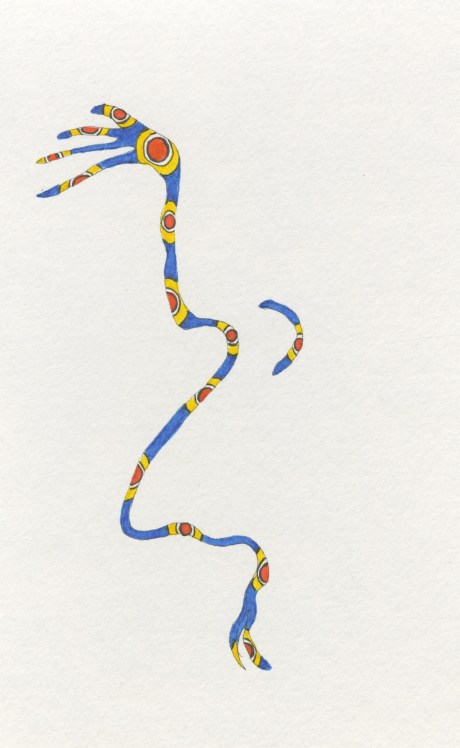
The Rhine River as an old man knows what starts in the River, is fated to return to the River. Design by Meredith Eliassen, 2018.
Another grassroots production of the transient Trade Wind Opera Company, where even the Wanderer looses his hat.
The Rat with a Bell… a fable
February 21, 2018
There was an old country house that was infested with rats and nothing could be secured from their depredations. The vermin scaled the walls to reach the farmer’s bacon hanging from the ceiling and hanging shelves offered no protection for the cheese and pastries. The preserves and sweetmeats were no safer in the pantry, the rats gnawed through cupboard doors, undermined floors, and ran races behind the wainscots.
The cats could not reach them, the vermin were too clever and too well fed to bother with poisoned bait, and traps only caught a few heedless stragglers. However, the farmer caught one of these stragglers and fitted him with a small bell and then let him loose.

Moral: He who is raised so much above his fellow creatures as to be the object of their terror, but suffer for it in loosing all the comforts of society. He is a solitary being in the midst of crowds. He keeps them at a distance and they equally shun him. Dread and affection cannot subsist together. Design by Meredith Eliassen, 2018.
Overjoyed by his freedom, the rat ran into the nearest whole and searched for his companions. They heard the tinkle, tinkle at a distance and assumed it was an enemy in their midst and scattered in every-which way. The bell-bearer pursued, and soon guessing the cause of their flight, he was greatly amused. He chased his friends from hole to hole, and room to room, laughing all the while at their fears, even as he increased it by all means in his power. Soon he had the whole house to himself. He thought, “That’s right, the fewer, the better.” So he rioted alone and stuffed himself with goodies until he could hardly walk.
For two or three days, life was good. He ate and ate, until he grew tired of his lonely condition and longed for his old family and friends. The difficulty now was how to get rid of the bell. He pulled and tugged with his fore-feet until he nearly wore all of the fur from his neck, but all in vain. The bell was now his plague and torment, so the rat wandered from room to room searching for a companion, but they all stayed out of his reach At last, as he moped about in despair, he fill into a puss’s clutches and was devoured in an instant.
Source: John Aikin (1747-1822) and Anna Lætitia Barbauld (1743-1825), Evenings at home, or, The juvenile budget opened (New-York: Harper & Brothers, 82 Cliff-Street, 1839.) Barbauld was unable to publish because of her political stances, and collaborated with her brother to get this book published.
Brrr… where shall we our breakfast take?
February 20, 2018

Nevermore and two companions followed me to work, asking, Where shall we our breakfast take? I thought about it for a moment and recommended the fried rice at our neighborhood take-away in honor of Chinese new year… they agreed and took flight. Design by Meredith Eliassen, 2018.
Happy Chinese New Year!
February 16, 2018

Welcome Earth Dog! Earth Dog humans are communicative, serious, and responsible in the workplace. Design by Meredith Eliassen, 2018.
In memory, for Alice… kindness makes everyday Valentines Day
February 14, 2018

Some California Indian tribes consider moths to be sacred and powerful creatures that are spirit guides into mystery, darkness/light, and transformation. Design by Meredith Eliassen, 2018.
Always wise: “what do ? love…”
February 9, 2018

“what-do-?-love” words by Robert Lax (1915-2000) from “In the Beginning was Love: Contemplative Words of Robert Lax,” edited with an introduction by S. T. Georgiou (2015), design by Meredith Eliassen, 2018.

Maple leafs floating in a stream design by Meredith Eliassen, 2018.
Sumi-e, the dominant style of painting during the Kamakura Era (1185-1333) blended samurai aesthetics of simplicity with Zen, utilizing black inks of varied shades from grey to black… these designs infill the black with a colored pattern so that there is no black. Sumi-e, noted for its purity and simplicity, reflects the eternal nature of the subjects with minimalism that is relevant for the Lax word-picture and the internal pattern evokes the energy of a favorite trade with bead motif.
What does beach weather in February mean? It’s paisley time!!!
February 8, 2018

Border featuring overlapping paisley designs by Meredith Eliassen, January 2015.
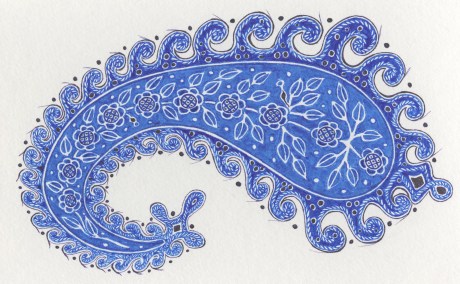
Cool blue paisley design by Meredith Eliassen, January 2018.
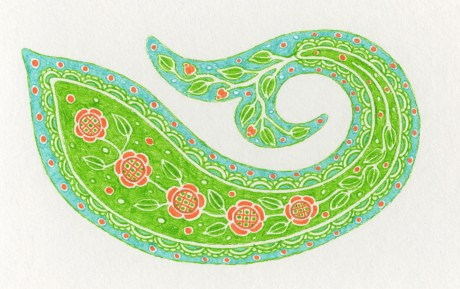
Okay, the sun has come out green paisley design by Meredith Eliassen, February 2018.
The Boys and the Frogs… be nice!
January 30, 2018
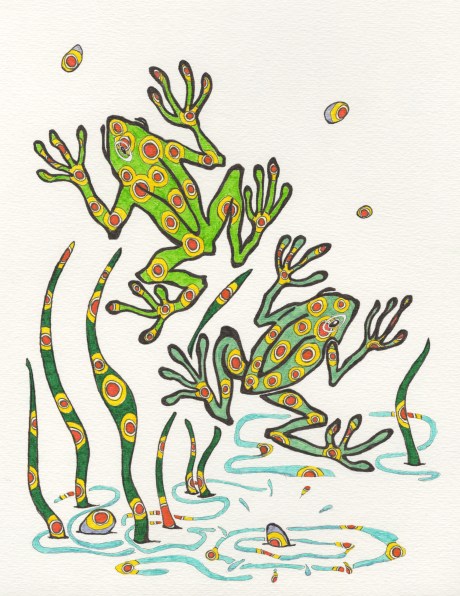
Two frogs dodging rocks… design by Meredith Eliassen, 2018.
Some boys were playing by the edge of a pond. Unaware that there was a group of frogs living there, they amused themselves by throwing stones into the pond to make them skip across the water. The stones were flying so thick and fast and the boys were enjoying themselves very much that they did not notice that the poor frogs in the pond were dodging the stones or trembling with fear amidst the grasses.
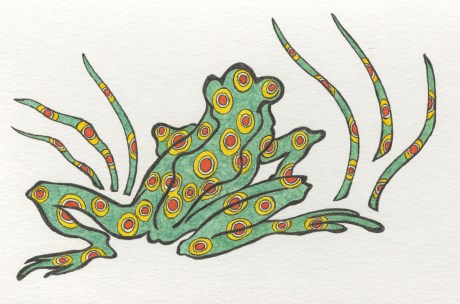
At last, the oldest and bravest of the frogs made a stand, and said: “Oh, please, dear boys, stop your cruel play! Though it may be fun for you, it means death to us!” Design by Meredith Eliassen, 2018.
Always stop to think whether your fun may not be the cause of another’s unhappiness.
A nature parable… “Active and Passive”
January 23, 2018

The Weathercock was having a rough day… design by Meredith Eliassen, 2018.
“Restless life! Restless life!” moaned the Weathercock on the church tower by the seas as he felt the wind sway his direction suddenly. He creaked with dismay, “restless, toiling life, and everybody complaining of one all the time…”
An old woman hobbling towards the church lamenting: “There goes that tiresome weathercock pointing east… now I know why my rheumatism has returned!”
Then a farmer warned the old gravedigger: “Watch out Tomkins! If that rascally weathercock is to be trusted, the wind’s going to bring us rain.”
The steadfast weathercock was horrified that he was always to blame for the weather, and muttered to himself: “Am I to blame? Did I choose my lot? Do you think I would swing every which way if I had a choice?”
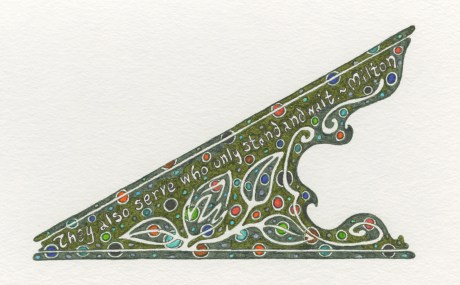
Gatty’s motto for this story: “They also serve who only stand and wait,” is from Milton, 1673 Poems, design by Meredith Eliassen, 2018.
From below, the sundial grumbled under his breath: “Oh, how he chatters away up there… he almost makes me smile.” Reflecting upon his day, “Not a ray of sunshine has fallen upon me today. I wonder what Ol’ Weathercock finds to interesting to talk about. His life is so active, no doubt. Oh, what I would not give to be like him.”
The weathercock looked down at his longtime companion the sundial with envy: “Ah, that’s the life!”
Dial heard his name whispered in the wind: Hello up there! Did you call? Is there anything fresh astir? I get so tired of the long dark useless hours. So come on now, what have you been talking about?”
“Nothing profitable,” replied the weathercock. “I am just grumpy.”
“But why?” Asked the dial. “Your life is so active and bright.”
Weathercock thought Dial was mocking him. “Look at me! Swinging with every peevish blast that crosses the sky. Turn here, turn there, turn everywhere… never a moment’s rest.”
The companions fell silent as humans started passing with their daily routines… pausing a moment to examine the sundial or the weathercock to get a sense of what was coming.
A sailor lingered near the dial and read its weathered motto: “Watch, for ye know not the hour.” He just hankered for a long afternoon to relax, and mentioned this to the gravedigger in passing. Tomkins responded: “You’ll be cured of the wish for idle afternoons when they are forced upon you… wait until you are old like me and then you will understand.” With good-natured goodbyes, the two parted ways leaving the churchyard empty of its living guests.
The sailor went home and warned his sons to keep a lookout for there have been signs of a strong gale arriving and with the high tide, there could be dangerous or even deadly conditions.
Meanwhile, the sundial observed, “Just as I thought, everything is wrong because everybody is so dissatisfied.
Soon the farmer’s wife saw the tracts of white foam, thick like snow fields, on the ocean, followed the breakers as they crashed upon the shore like claps of thunder. That night, a mighty storm – a hurricane – came and stalled over the coastal hamlet causing great fear, but the weathercock and the sundial stayed the course.
The weather eventually cleared and the sun shined brightly over the village and the sea with the brilliancy of spring. Because the villagers recognized the signs and prepared, nobody was hurt and damage was minimal, indeed, the dial and the weathercock were buffeted to the point of shining like new. Villagers look at them renewed gratitude, thinking: “What a mercy!”
Dial heard this and asked his friend: “Are you silent, Weathercock?”
“I was just thinking,” he replied. “I have a new sense of my own responsibility. I have the sensation that everything is useful in its own place and at all times, though humans may not always figure that out.”
The sundial beamed, “that was my impression as well.”
===
Source: Margaret Gatty (1809–1873) wrote about marine biology and was prolific children’s book author and editor who mentored her daughter Juliana Horatia Ewing (1841-1885) in her writing career. While Gatty’s tales were targeted for juvenile audiences, she hoped that they would influence the minds of adults as well. This story is from her Parables from Nature.
 MME Designs's Weblog