Will Turandot Figure out What True Love Means?
March 6, 2016
Turandot by Giacomo Puccini (1858-1924) is most nearly based upon Turandot by Carlo Gozzi that is in turn based on a story from the 12th-century epic The Seven Beauties by Persian poet Nizami about a princess Turan-Dokht how was the daughter of Turan. Set in China, the Prince Calaf, falls in love with aloof Princess Turandot. In order to obtain permission to marry Turandot, any suitor must solve three riddles correctly, and any wrong answer will result in death. The Calaf passes the test, but Turandot still refuses to marry him. He offers her a way out: if she is able to learn his true identity before the next day dawns, he will sacrifice his own life.

Pictured here are Turandot, the Calaf, and his slave Liù. Design by Meredith Eliassen, 2016.
Turandot, with a libretto by Giuseppe Adami (1878-1946) and Renato Simoni (1875-1952), was unfinished at the time of Puccini’s death in 1924 and was completed by Franco Alfano (1875-1954) two years later. It premiered on April 25, 1926.
The Struggle Between Sacred and Profane Love
March 1, 2016
Richard Wagner (1813-1883) composed and wrote the libretto for Tannhäuser und der Sängerkrieg auf Wartburg = Tannhäuser and the Singers’ Contest at Wartburg Castle (1845), which is based uponon two German legends that once again focuses on redemption through love.

Will our protagonist choose mortal love after being seduced by a goddess? Which face with Tannhäuser show? Design by Meredith Eliassen, 2016.
Will the Bond of Friendship Hold?
February 26, 2016
Les pêcheurs de perles (The Pearl Fishers) is an opera in three acts by the French composer George Bizet (1838-1875) with a libretto by Eugène Cormon (1810-1903) and Michel Carré (1821-1872) that premiered in 1863.

An imaginary seascape for Les pêcheurs de perles set ancient island Ceylon featuring to pearl fishers. Design by Meredith Eliassen, 2016.
Set ancient island Ceylon, The Peal Fishers is the story of two men who vow eternal friendship, which is threatened by their love for the same woman who is conflicted with her emotions related to secular love and her sacred oath as a priestess.
Wagner Tonight
February 24, 2016
Richard Wagner (1813-1883) composed and wrote the libretto for Der fliegende Holländer, which premiered in early 1843. In the story, Senta, the bored daughter of a sea captain spins her own reality about a legendary Dutchman who is cursed.
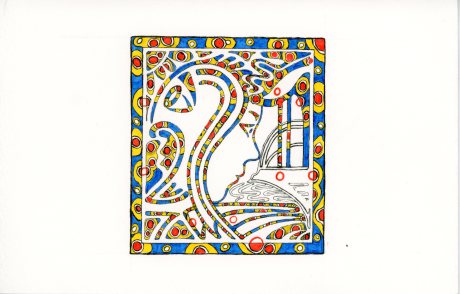
In Wagner’s Der fliegende Holländer, the cursed Dutchman cannot seem to escape Senta’s head. Design by Meredith Eliassen, 2016. Flying Dutchman Notecard
A Little Opera for Mom & Dad
February 17, 2016
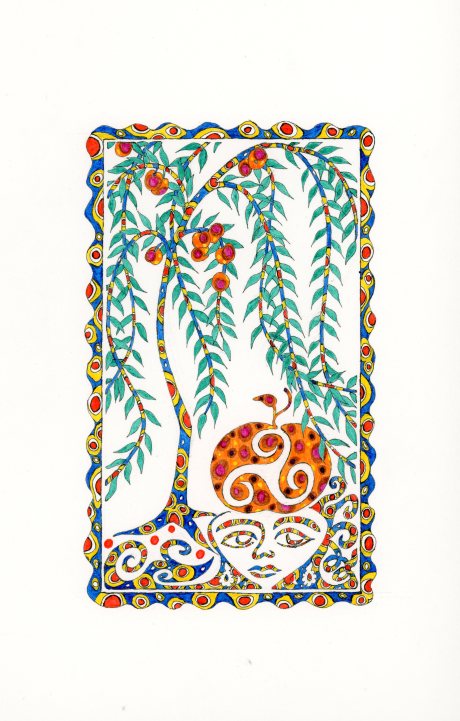
L’arbore di Diana=der Baum der Diana, music by Vicente Martin y Soler (1754-1806), libretto by Lorenzo Da Ponte, (1749-1838), design by Meredith Eliassen, 2015.
Opening night for the Trade Wind Opera Company, where everybody knows your name, they just can’t remember your face…
More popular with contemporary audiences than Mozart’s classic operas with Da Ponte librettos with audiences, this erotic comedy was quickly translated and performed in other counties. Diana, the goddess of chastity has a miraculous tree in her garden that can produce exceptionally large fruit that reveals the goodness or sins of those who pass beneath its branches.
Dante… on Love
February 11, 2016
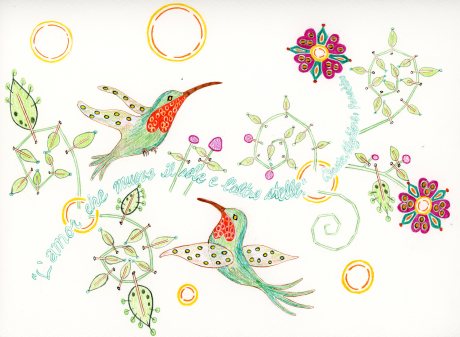
“L’amor che muove il sole e l’altre stelle.” (The love that moves the sun and the other stars.) from “Paradiso” by Dante Alighiere, 1265-1321. Image motif inspired by a card design by Robbin Rawlings. Drawing by Meredith Eliassen, 2016.
Another Beautiful Winter Day…
February 8, 2016
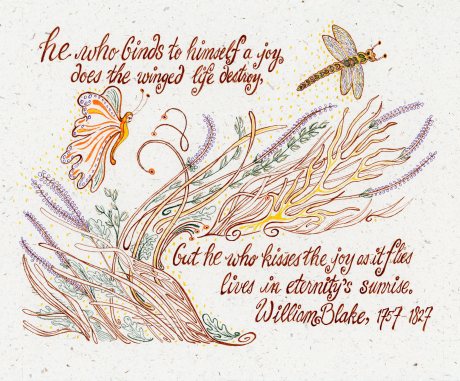
“He who binds to himself a joy does the winged life destroy, but he who kisses the joy as it flies lives in eternity’s sunrise,” words by William Blake (1757-1827), design by Meredith Eliassen, 2016.
Some “Big Game” couter-programming
February 7, 2016
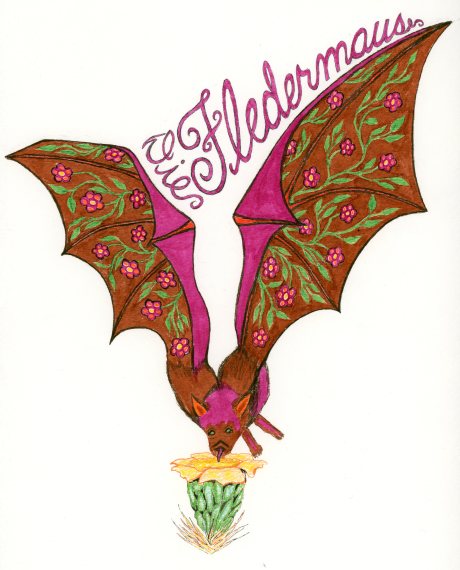
This little bat knows how to find the sweet nectar of life. Design by Meredith Eliassen, 2016.
The Haiku Snail’s Story
February 5, 2016
Haiku is a Japanese poetry form that originally evoked a moment in nature consisting of seventeen syllables in a five-seven-five pattern.
Kobayashi Issa (1763-1828) wrote over 20,000 haiku. Although he was a popular poet, he lived in poverty. Through his many personal trials, his poetry utilizing local dialects and conversational phrases reflects a humility and simplicity. Issa wrote 54 haiku on the snail that serves as a study of their character that I have used for my interpretation of Felix the Helix…
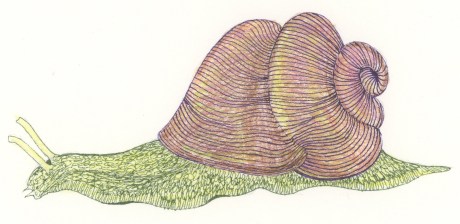
Drawing of Felix the Helix before magical rain storm by Meredith Eliassen.
The snail is remarkable adept at exploring new habitats and spaces. Snails are mollusks; they originated in the oceans and over the course of time adapted to life on dry land. They lost their gills and evolved oxygen-breathing lungs. Felix the Helix (also known as “Happy the Snail”), shown here, is an earth snail with rather dull coloration, though some snails are arboreal and those tend to be brightly colored. Felix has a large fleshy foot, antennae and feelers on its head, and a coiled protective shell home that serves as a vessel encasing its asymmetrical visceral mass. Felix breathes through a kind of air-breathing lung and has a rasping organ in its mouth known as a radula.
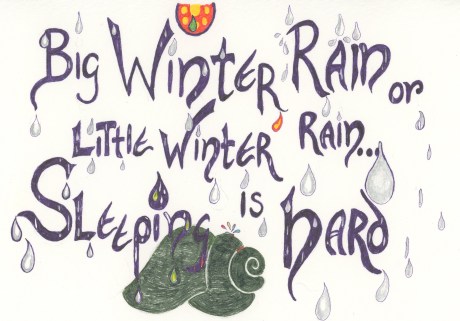
In the winter, a snail can create a door to its shell, retreat into the shell and then close the door. Here Felix stays safe from the winter elements: “Big winter rain or little winter rain… sleeping is hard.” — Issa. Drawing by Meredith Eliassen.
Felix simply moves by following his nature according to his own principles. Though he appears to be slow, he actually flows effortlessly, without purpose and without a goal: he is one with the Universe. He possesses nothing. He moves and acts spontaneously from his nature and without purpose, he has become one with the Universe.
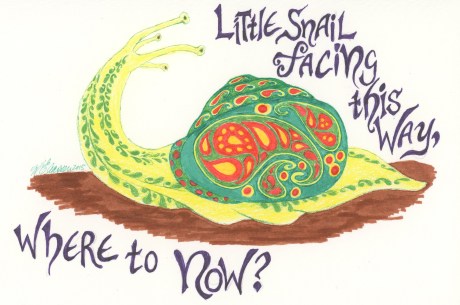
Felix awakens to find himself transformed in the morning: “Little snail facing this way, where to now?” — Issa. Drawing by Meredith Eliassen.
The Ancients…
February 4, 2016
After visiting my parents last year, I returned with a new supply of color pens and stories from the Sedona area. Meet Petro, an ancient member of the Lucky the Lizard posse, who visited my consciousness. A petroglyph is rock art created by removing rock surface by incising, picking, carving, or abrading, and Petro is drawn in the shape of an Arizona petroglyph of a lizard.
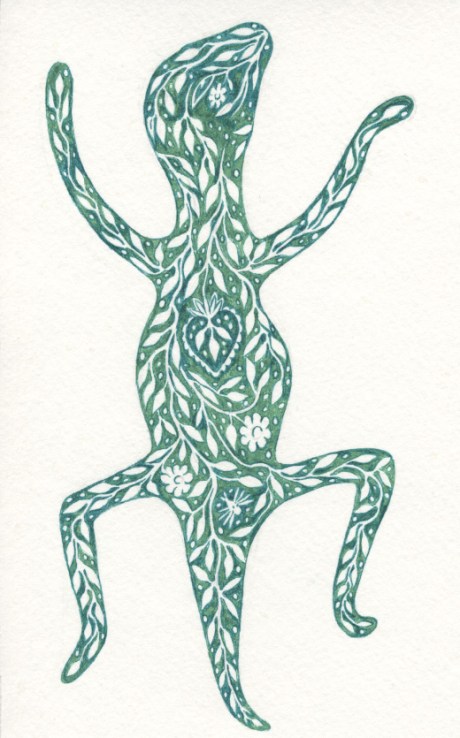
Design by Meredith Eliassen.
 MME Designs's Weblog