Learning by the Rules
October 8, 2014
Before the establishment of free public schools in 1770, girls learned to read at home or at weekly secular Sunday schools (or first day schools), which met to provide instruction in reading for children as well as illiterate adults beginning in the 1790s. First day schools operated on Sundays because children were expected to work during the rest of the week, and girls were more likely to attend Sunday-schools than boys because it was their only option for public education at the time. Virtue, humility, and purity remained characteristics that were prized in women. While upper-class women gathered discretely in parlors to read aloud dialogues to educate themselves on science or to enjoy Dr. Watts’ Divine Songs, they networked. “Republican womanhood,” a concept of American womanhood coined by historian Linda Kerber, to define how the Republican mother integrated political values into her domestic life.
As families from different classes migrated to urban centers, individuals belonging to the growing middle class sought opportunities for “self elevation” or self-improvement in order to move up socially, but a woman’s destiny was tied to her choice of husband. During the nineteenth century, women’s social networking centered on the issues of women’s rights, the abolition of slavery, temperance, women’s suffrage, and missionary work. These social networks often held up throughout “bust” economic cycles. The impulse for reform in the United States during the first half of the nineteenth century was generally manifested in five distinct phases: moral reform (1810s-1820), the creation of utopian societies (1820s), institutional reform (1830s), the abolition movement (1830s), and the movement for women’s rights (1840s). Once these reforms were addressed institutionally, male organizational structures took over, and professionals once again pushed women back into dependent roles.
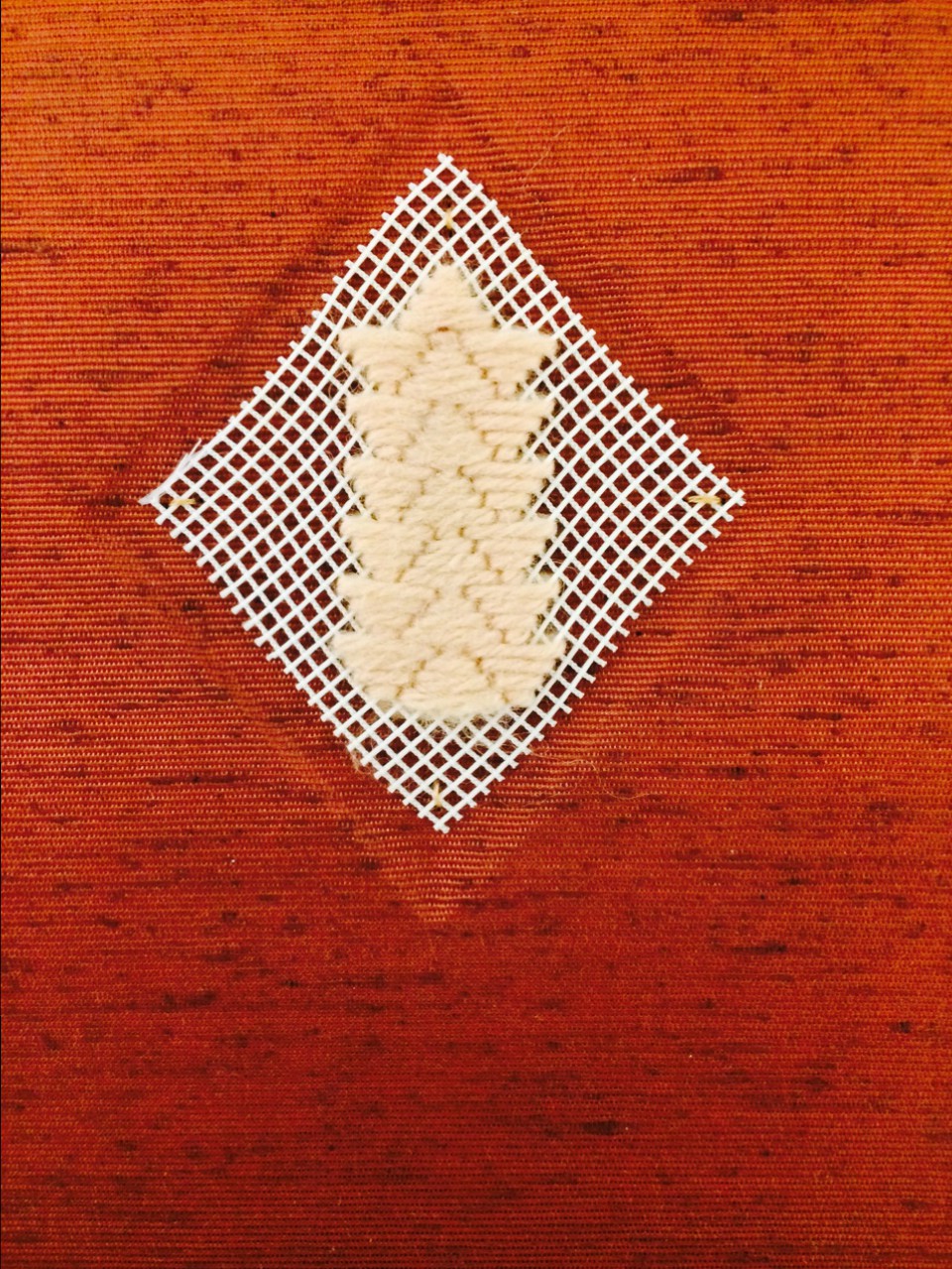
Stitching Swatch Detail
Women provide Transient Housing and Social Networks
October 7, 2014
Women operated boardinghouses from the seventeenth to early-twentieth centuries. Typical boardinghouses, establishments privately operated by families to bring in extra income became popular during the mid-nineteenth century. Some families chose to co-inhabit with other families as boarders, creating two-family households. Thomas Butler Gunn’s satire The Physiology of New York Boarding-Houses (1857), chronicled the variety of female dominated networks found in boardinghouses. Filled with anecdotes about scheming landladies, carousing bachelors, slovenly housemaids, and an odd cast of fellow boarders, boardinghouse life emerged as an aspect of cosmopolitan American culture. Indeed, individuals who chose to live solitary lives during the nineteenth century were considered to be odd loners or hermits.
Taking in boarders, was a crucial economic factor in the financial success of both urban and rural families during the early nineteenth century. Operating a boardinghouse was a rigorous weekly cycle of washing laundry, baking, and mending, and daily cycles of cooking, cleaning and serving. While husbands could leave the boardinghouse to work and run errands, wives and children kept the operation going even when they got sick, injured, or pregnant. Women recognized the economic value of their labor produced by taking in boarders was a means for women to bring cash into the household. Compared to taking in sewing, running a grocery, catering from their kitchens, or working as unpaid labor in their husband’s trades, operating a boardinghouse brought good income that could be reinvested into businesses or supply family needs.
Boardinghouse living could supply a surrogate family along with room and board. Immigrants clustered in boardinghouse communities or “quarters.” These groups generally included young men or women of similar professions, who assimilated to the new climate together. Mealtime became an opportunity to socialize and network for boarders who enjoyed similar foods and spoke the same language. Accustomed to living in urban areas, immigrants set up their own grocery and dry goods stores, liquor stores, boardinghouses, and restaurants. Boardinghouse culture was ephemeral and transient in nature. Boardinghouse living waned during the early twentieth century as urban planners focused on creating apartment communities to accommodate the American sensibility that the single lifestyle was acceptable.
Female Networks under Coverture
October 6, 2014

Detail of twentieth century stitching from Happy Hands Studio (Pendelton, Oregon) from unique artist book by Roberta Lavadour called “Happy Hands”
During the Era of Enlightenment men pressed women to place their whole affections upon family, relegating mothers to rule the “gentle empire” of the home. The sensibilities of common law versus civil law dictated how marriage became a woman’s primary social network. Under Anglo-American common law a wife had no rights in regards to making contracts or holding real property. The status as feme covert (married) or feme sole (single) often determined a woman’s ability to network with other women and with men. Under coverture, wives and children were both treated dependents. Female subordination within the family, men argued, reflected their subordination under common law and divine government that asserted, “Influence by reason when you can, by authority when you must.”
Cloth and clothing production became another area supported by female social networking. Adam Smith described the social networks needed to produce a common woolen coat for a laborer in his The Wealth of Nations: “The shepherd, the sorter of wool, the wool-comber or corder, the dyer, the scribbler, the spinner, the weaver, the fuller, the dresser, with many others, must all join their different arts in order to complete even this homely production.” Feme sole, a never-married woman, has remained an anomaly within women’s networking. The woman who remained unmarried was referred to with the derisive term of “spinster.” When it was first used, to define a woman with the occupation of spinning it was a term of respect. However, a woman without a male protector were obliged to live modest and discrete lives of service to family, church, or a respectable occupation like a teacher, or risk being the target of brutal rumors and speculation. Single women were sometimes stigmatized if they resided in boardinghouses located outside of respectable residential neighborhoods, since “boardinghouse” also euphemistically referred to “bordello.” Widows, also considered to be feme sole, sometimes financed other female enterprises utilizing their “dower” income.
In the United States, many single women moved to the frontiers to pursue careers as schoolteachers or missionaries. During the California Gold Rush, the state legislature enacted laws to enable married women to establish businesses as sole traders, rather than to expose single women to the dangers of dealing with volatile males. An important but subtle shift of power occurred when married women and widows kept controlled their real property – women could establish benevolent relief societies in the formal business or public sector for women who found themselves in bad situations. During the 1870s women doctors in San Francisco established the Pacific Dispensary Hospital for Women and Children where only female physicians cared for patients, but as the organization moved to affiliate with medical colleges they were forced to allow male physicians to administer this teaching hospital.
Little girls were socialized as they learned domestic arts throughout. Girls would assist adult women in their households with spinning thread, weaving cloth, making candles, and needlework including sewing, knitting, dressmaking, quilting, embroidery – decorative sewing done with colored thread. They learned how to sew when they were very young, often stitching their first quilt square by the age of four years, and demonstrated skills learned in samplers.
Women and Historic Social Networking
October 3, 2014
Today the Internet offers women infinite ways of networking socially. Women’s demographic numbers and resources get exploited without equitable representation. Charities advertised the chance to walk for this or run for that cause in order to raise money (or “awareness), but these efforts are also supporting fundraising infrastructures. Women have historically fought to have their voices individually and collectively heard, women have collectively built institutions only to have those institutions usurped by men who asserted that women should to heed collective male expertise. Themes of dependency, poverty, gender, and ultimately mortality delineated how women traditionally networked until the late-nineteenth century. During wartime, women’s social networks sustained their broader communities. Women left to support families when men fathers, brothers and husbands were killed or disabled utilized female skills and artistry to support families, and to hold and maintain family property. However, after the conflicts ended, women were relegated to more dependent roles. Prior to women suffrage, women did not have government representation and were treated as dependents. Excluded from political and economic responsibilities, women collectively focused on their reproductive duties.
In some hunter/gatherer societies women were isolated from men during menstruation. This fundamental dichotomy has been manifested in diverse ways throughout time and across cultures. Midwives served integral roles in traditional female networking. During the eighteenth century, up to 45 percent of women did not survive to the age of fifty years, usually due to complications from childbirth. The skilled midwife within a community was essential to the wellbeing of women in that community until male physicians entered the birthing chamber during the late eighteenth century. A woman’s childbearing years, a period lasting about twenty-five years, along with distractions during her child rearing duties, cumulatively weakened her ability to network beyond her neighborhood or immediate community.
Female networks often centered on food cultivating, harvesting, and preparation. Women used raw natural materials to construct practical items for survival. Women were charged throughout the seasons with harvesting, preserving, and cooking food to make the best use of these resources that including working in the dairy, making butter and cheeses; preserving meat from the hunt and fish; preserving fruits and vegetables, and bee keeping. Women gathered and made baskets to store or carry foodstuffs, water, or other items that exhibited design motifs identifying the community in different regions depending upon the availability of local grasses, bark, twigs, and willow.

Detail of twentieth century stitching from box of from Happy Hands Studio (Pendelton, Oregon) from unique artist book by Roberta Lavadour called “Happy Hands”
Housewife Guides and the Cult of True Womanhood
October 2, 2014
Housewife guides during the nineteenth century provided women with written scripts to follow in organizing daily household tasks as well as their roles in society. First written by men, housewife guides written by women reveal the intellectual thinking of women over the centuries. Within popular culture, even as changing societal attitudes loosened the some of the restrictions on younger women — virtue, humility, and purity remained prized in American women, and women worked within these parameters to run households as they began to organize grassroots reform.
Barbara Welter wrote about the “cult of true womanhood” a sensibility held between 1820 and 1860 that American women were expected to pursue lives of sheltered passivity and ennobled domesticity. In a separate “private” sphere, women had authority over moral and family issues. Women created an “anti-materialistic” world in the home that balanced the “sordid world of men and public life.” In the cult of true womanhood women were encouraged to be pious, pure, domestic and submissive. Mrs. Hester Chapone (1727-1801) in her epistolary book, Letters on the Improvement of the Mind Addressed to a Young Lady (1797) asserted, “A worthy woman is never destitute of valuable friends, who in a great measure supply to her the want of nearer connections.”
Lydia Maria Child (1802-1880) wrote from experience when The American Frugal Housewife (1829) offered practical knowledge for women with husbands who could not provide for families. Child had a prescient mind seeing that one of the great challenges within the American home was the economic and emotional consequences of slavery. Child’s popular compendium, The Little Girl’s Own Book (1833) included maxims for a girl’s health and gracefulness suggesting that girls wake up early and wash frequently in pure cold water and that girls get a lot of outdoor exercise. Beyond offering household advice, she was instrumental in the publication of Harriet Jacobs’ account Incidents in the Life of a Slave Girl (1861) and An Appeal for the Indians (1868), and her views were seen as radical by the mainstream press.
The efficiency with which women ran their households enabled them to organize and network and accomplish substantive reforms. Catherine Beecher (1800-1896) who organized women’s schools and colleges intellectually reconciled, through her writing, how existing patterns of female subordination attributed to the “cult of true womanhood” was necessary to sustain American democratic sensibilities in antebellum America. In her Treatise on Domestic Economy (1841), she illustrated the consistency of Christian ideals of democracy to American social hierarchies. Beecher proposed a new schema for professionalizing domestic work and schooling. She utilized Lockean theory to substantiate her argument that women’s activities required the same autonomous and practical critical thinking skills for domestic tasks in the private sector as were required of men in experiencing success in careers in the public sector. In the wake of the post-Civil War boom, Beecher and sister Harriet Beecher Stowe (1811-1896) in their American Woman’s Home (1869), attempted to direct women to prudently acquire and use the plethora of new consumer products available. The sisters advised, “The chief cause of woman’s disabilities and sufferings, that women are not trained, as men are, for their peculiar duties – the aim of this volume to the honor and remuneration of domestic employment.”
With coverture, the legal sensibility was that wives and children needed to be treated in the same way, and therefore needed to be malleable. Reverend Daniel Smith in his book The Parent’s Friend, or Letters on the Government and Education of Children and Youth (1845) taught that female subordination within the family led to subordination to civil law and divine government: “Let your child understand that your commands must be obeyed. Parental government does not consist in so many whippings, or corrections of this or the other kind, but in fixing in the mind of the child this impression, ‘I must and ought to obey.’” Smith supported the patriarchal hierarchy of coverture that asserted, “Influence by reason when you can, by authority when you must.”
Julia McNair Wright (1840-1903), the wife of a clergyman, was a prolific writer of women’s novels, didactic literature, poems, cookbooks, and scientific works on botany. She carried on in the tradition of Rev. Smith, and was published by the Presbyterian Board of Publication as well as the National Temperance Society. Wright’s 584-page tome The Complete Home: An Encyclopedia of Domestic Life and Affairs (1879) was a text on domestic economy that reflected her influence and popularity with American female readers throughout her forty-year career.
Moving into the twentieth century, women’s voices in regards to domestic work shifted radically as they fought for and obtained the vote. Elizabeth Cady Stanton (1815-1902) was seventy-seven years old when she wrote The Solitude of Self (1892) after stepping down from the presidency of the National American Woman Suffrage Association. Stanton recognized the political ramifications and psychological resources of “self” or of a woman having an individual life, ”Whatever theories may be on woman’s dependence on man, in the supreme moments of her life, he cannot bear her burdens.” Later, Betty Friedan (1921-2006), a journalist writing for popular women’s magazines, in The Feminine Mystique (1963) called on women to seek satisfying and intellectually stimulating careers in public life without renouncing their roles within the home.
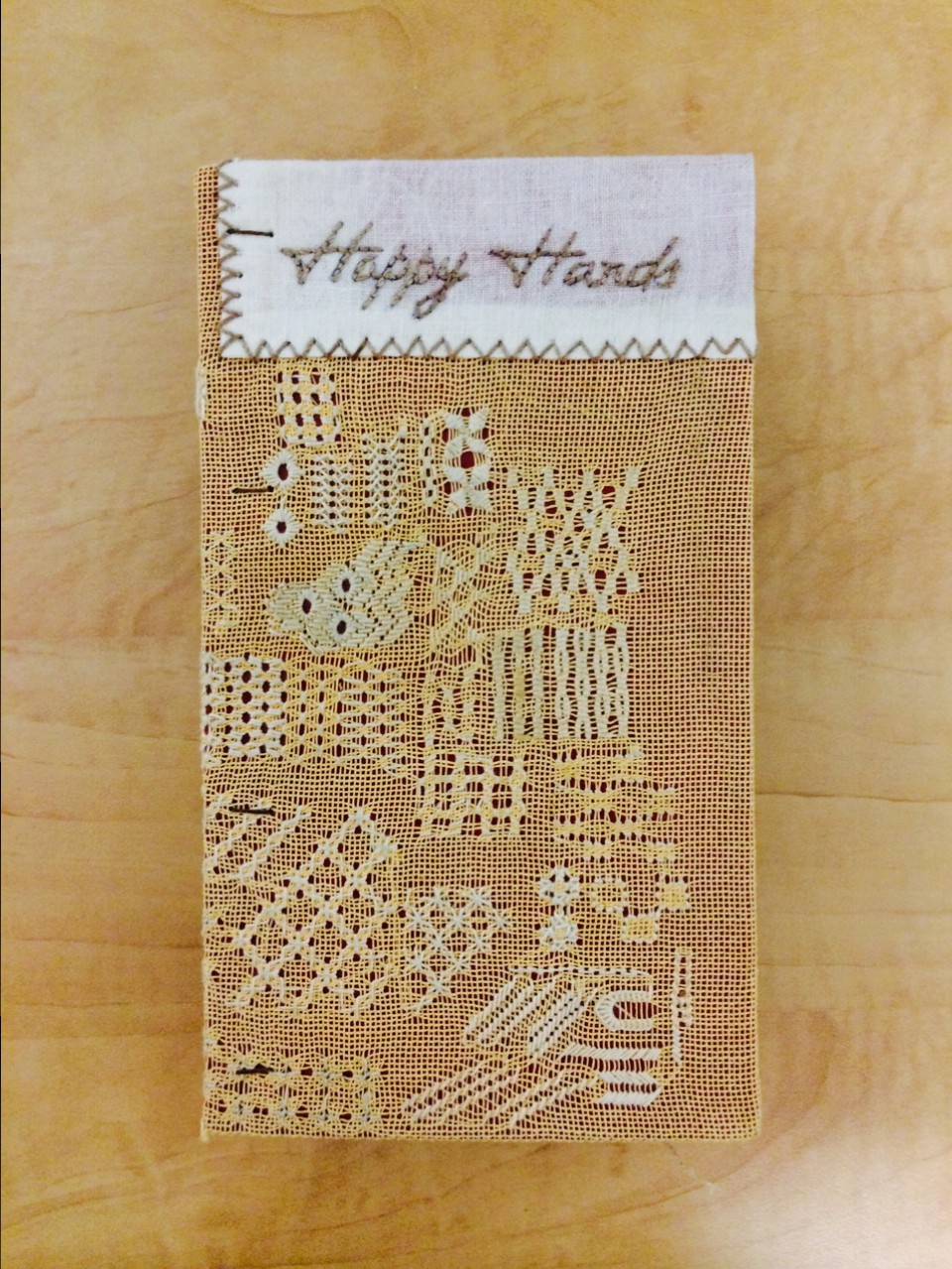
Detail of twentieth century stitching from Happy Hands Studio (Pendelton, Oregon) from unique artist book by Roberta Lavadour called “Happy Hands”
Further Reading
Hemphill, C. Dollett. Bowing to Necessities: A History of Manners in America, 1620-1860. New York: Oxford University Press, 1999.
Where did American Women Writers Lurk?
October 1, 2014
Austen eventually eclipsed her American counterparts, partially because of her great talent, partially because dialogues and epistolary fiction were diminishing in popularity, and partially because Columbia underwent a far more radical transformation than Britannia between the 1790s and 1820s. Women gained greater access to subjects for study that had formerly been off limits. British writer Jane Marcet, née Haldimand, (1769-1858) began to write “conversations” on chemistry, botany, religion, and economics in 1806 and they remained popular textbooks in the United States until the 1850s. American-born proponent for women’s education Emma Willard (1787-1870) began writing books about American history and geography in the 1820s that would greatly expand feminine consciousness relative to national and world conversations for generations. Austen would have related to Willard’s educational philosophy in which mothers taught children to think about current events, geography and history personal own knowledge: Each individual is to himself the centre of his own world; and the more
Intimately he connects his knowledge to himself, the better will it be remembered, the more effectual can it be rendered in after life subservient to his purposes. Hence in geography, he should begin with his own place extending from thence to his country, and to the world (Willard 1828, xiv).
The American Sunday-School Union (A.S.S.U.) was established in Carey’s hometown of Philadelphia in 1817 as a coalition of local Protestant Sunday-school groups. Denominational Sunday schools familiar today superseded the ecumenical A.S.S.U. (Reinier 1996: 121). The A.S.S.U.’s goal beyond establishing Sunday-schools was to provide communities with libraries and reading materials for moral instruction. This non-sectarian organization was a pioneering powerhouse in developing book distribution networks throughout America. Indeed, the A.S.S.U. provided the educational materials and training to children and adults on the frontier – carrying on Carey and Weems’ mission to transmit a shared national identity and values into the rural South (Reinier 1996: 178).
The A.S.S.U. deliberately set out to create indigenous popular literature in America. Writers from many denominations in a single generation produced quality literature so widely read that it caused a complete revolution in the reading habits and tastes of Americans. Authors including women contributing to the Union’s publications but were seldom credited unless the work was of a scientific nature. American in spirit and content, millions of books on health, history, travel, biography, science and fiction lessened the need for dialogues in America. Books were modestly priced to be affordable to most families and remained influential until the 1860s when public libraries began to provide easy access to more attractive literature.
Mathew Carey retired in 1824. His son Henry C. Carey (1793-1879) later served as Lincoln’s chief economic advisor along with his brother-in-law Isaac Lea continued the business as Carey & Lea. During the 1830s, the firm reintroduced Austen to a broader audience of American readers by publishing her major works as a series: Elizabeth Benet, or, Pride and Prejudice (1st American edition from the 3rd London edition, 1832), Mansfield Park (1832), Persuasion (1832), Sense and Sensibility (1833), Northanger Abbey (including a brief biography of Austen, 1833); and when the firm expanded as Carey, Lea & Blanchard a second American edition of Emma was published in 1833.
Bibliography
Reinier, Jacqueline S. From Virtue to Character: American Childhood, 1775-1850. New York: Twayne Publishers, 1996.
Willard, Emma. History of the United States, or Republic of America. New York: White, Gallaher & White, 1829.
Emma and The Female Choice, concluded
September 30, 2014
Wages in America stayed low in large segments of the population, and jobs remained seasonable and precarious even before a financial crisis arose in 1819. In England, an industrious woman of any rank was treated with equivalent respect to a gentleman of high rank, but even Americans of high rank stayed middling in comparison to their British counterparts. If the ‘Republic of Columbia” was to be more than an experiment in democracy, then dissipation, wonton self-indulgence, scattered, wasteful use of resources, would not be tolerated. Industry, characterized by hard work, steadiness, and diligence, combined with meekness, was the feminine ideal for women in the new America.
The American exemplum, “The Female Choice,” published shortly after Austen’s death introduced young Americans to two characters – Dissipation and Industry (Picket 1818: 51-3). In the story, young girl named Melissa sits down in a pleasant wooded area, where she falls asleep. In Melissa’s dream, two women approach. The first woman dressed in a gown of shear pink fabric, green trimmings, and a sash of silver gauze, advances saying, “My dearest Mel’s, I have watched you from your birth. See what I have brought you.” Her fair hair fell in ringlets down her neck, adorned with a headdress of artificial flowers interwoven with feathers. She offers Melissa a ticket to a fancy ball and a gown fashioned with spangles and knots of ribbons, “This dress and this ticket will give you free access to all the delights of my palace. With me you will pass your days in a perpetual round of ever-varying amusements.” She informs Melissa that her sole obligation in return would be to “flutter from flower to flower, and spread your charms before admiring spectators.” She introduces herself as Dissipation, and promises “No restraints, no toil, no dull tasks, are to be found within my happy domains.”
Although simplistic in its nature, Austen would have recognized the seminal choice at hand. Melissa is inclined to follow the fashionable woman when the second lady approached clothed in a simple habit of brown fabric relieved with white. Her smooth hair is pinned under a plain cap and her domineer is serious but satisfied and she is sedate and composed. She holds a distaff for spinning in one hand; a workbasket hangs on her other arm; and the girdle around her waist contains scissors, knitting needles, reels and implements of female work – along with a bunch of keys hanging at her side. This woman states, “Melissa, I have been the friend and companion of your mother; and now I offer you my protection. I have no allurements to tempt you.” She explains, “Instead of spending all of your time in amusements, if you enter yourself in my train, you must rise early, and pass the long day in a variety of employments, some of them difficult, some laborious, and all requiring exertion of body or of mind. You must dress plainly; live mostly at home; and aim to be useful rather than shining.” She clarifies, “But in return, I will ensure you content, even spirits, self-approbation, and the esteem of all who thoroughly know you.” She warns Melissa that Dissipation, “has promised much more than she can ever make good. Perpetual pleasures are no more in the power of dissipation, than of vice or folly to bestow.” She concludes, “My name, it is Industry. I shall never seem to you less amiable than I now do; but, on the contrary, you will like me better and better.” Then she states, “It is time for you to choose whom you will follow, and upon that choice all your happiness depends.”
As in an Austen novel, Melissa is given the opportunity to re-search the situation: overawed by Industry’s guileless manner, she turns again to take another glance at Dissipation who still offers enchanting gifts. Tempted, the girl is unable to resist. By a lucky accident, Dissipation’s true face is unmasked. Her once smiling features of youth and cheerfulness, are transfigured to reveal a countenance wan and ghastly with sickness, and soured by fretfulness. Melissa turns away in horror, and readily offers her hand to Industry.
Austen’s work instilled the sensibility of didactic fairy tales that asserted if a young woman maintained her moral standing she could expect respect in any circumstance. American novelists Foster and Rowson supported the rhetoric that virtue would cement the foundation in the new America. This was not necessarily a sensibility that American women wanted to remember or celebrate once frontier challenged to civilized living diminished. Emma was unique among the Austen heroines because she had no awareness of insecurity; she delineated a character study of dissipation, and was “about the relatively new phenomenon of class consciousness (Duckworth 1971: 152).” Emma presented nuances of male and female dynamics with the character of Frank Churchill. When Churchill appears, “Emma is no longer the puppet-mistress of Highbury but instead becomes a marionette in Churchill’s more subtle show (Duckworth 1971: 163). Churchill is a double-dealer in an Emma-Churchill-Jane triangle – similar to a triangle that unfolded in The Coquette. Emma sees indications of his character, “Emma’s very good opinion of Frank Churchill was a little shaken the following day, by hearing that he was gone off to London merely to have his hair cut (Austen 2011: 199).” She justifies it, “Wickedness is always wickedness but folly is not always folly. – It depends upon those who handle it (Austen 2011: 206).”
In Austen’s world of shared assumptions, every situation has an appropriate and expected public response and individuals communicate by means of a common vocabulary of words and gestures dictated by prescriptive literature. Austen creates dramatic tension in her novels when characters thought to be of high rank fail to “act predictably (Duckworth 1971: 166).” This is the conversation where the fairy tale ending occurs – Emma’s happily-ever-after arrives when she easily steps into the proper role that English society as marked for her by marrying Mr. Knightly.
Bibliography
Austen, Jane. Emma. New York: HarperPerennial Classics, 2011.
Duckworth, Alistair M. The Improvement of the Estate: A Study of Jane Austen’s Novels. Baltimore: Johns Hopkins Press, 1971.
Picket, Albert. The Juvenile Mentor; Being the third part of the Juvenile spelling book containing progressive reading lessons in prose and verse, adapted to the comprehension of youth: calculated to improve them in reading and speaking with elegance and propriety, and to imbue their minds with sentiments of virtue, morality, and religion. New York: Daniel D. Smith, 1818.
Emma, and the Female Choice
September 29, 2014
Emma was published in late-1815, and dedicated, “To His Royal Highness, the Prince Regent,” who would later be crowned King George IV. As in fairy tales, in Austen novels men are always active (they hold virtually all agency) while single women are expected to be passive (acted upon), and once women marry they retire to domesticity in order to produce a male heir. When a woman weds and steps into the role of wife, and she is the agent for intergenerational money and property transfers. Austen’s character Emma is free in her conversations; she appears to be “handsome, clever, and rich (Austen 2011: 3).” Sir Walter Scott (1771-1832) anonymously reviewed Emma in the Quarterly Review (October 1815): The faults of these works arise from the minute detail which the author’s plane comprehends. Characters of folly or simplicity, such as those of old Woodhouse and Mrs. Bates, are ridiculous when first presented but if too often brought forward, or too long dwelt on, the prosing is apt to become as tiresome in fiction as in real society (Austen-Leigh 2008: 107-8).”
Carey was the only American firm to publish an Austen novel during her lifetime and that novel was Emma published in 1816. In a sense, protagonist Emma initiates an egalitarian experiment, but she assumes erroneously that her society’s conversation does not apply to her. This theme would be of great interest to American readers (male and female) as a cautionary tale. To publish a novel featuring a British female character of independent means in America at a time when poverty was a visible threat presented an interesting dichotomy.
The female choice in the United States remained that of submission or alienation as described in The Coquette. Families did not have resources to support self-indulgent women – a taste for dissipation could draw a woman’s attention from domestic production including childbearing and free domestic labor. With two wars occurring within a generation, women experienced periods of independence only when they filled male roles during wartime. When the wars ended, men returned home expecting their patriarchic dominance to resume, and women were systematically relegated to submissive roles.
Like Eliza, Emma does not see the necessity of marriage – she does not recognize that in England marriage is connected to inheritance, land distribution, and economic stability. Emma devotes her time to assisting friends to find upward mobility within marriage, and all the while Emma remains clueless. Emma is capable of voicing adulation as a means to manipulate friends to pursue certain paths, and at one point Mr. Knightly calls her on this point, “You will puff her up with such ideas of her own beauty, and of what she has claims to, that, in a little while, nobody within her reach will be good enough for her. Vanity working on a weak head, produces every sort of mischief (Austen 2011: 61).”
An American essay entitled “Address to Young Misses – By a Lady,” presented a popular emphasis found in contemporary literature that asserted constancy of mind (as opposed to the empty benefits of vanity) created moral strength that does not decay, but rather, increases with use and experience. The author declared, “I listened to the voice of adulation; and her bewitching blandishments allured me to destruction (Boston 1808: n.p.).”
Since Emma’s fickle father Mr. Woodhouse is very rich, until Emma marries a man of good moral character, her future remains very uncertain. Mr. Knightly personifies the model husband for any young woman: he holds a mature and balanced view of the world and has the moral courage to correct the wayward Emma. At one point he states, “I have still the advantage of you by sixteen years experience and by not being a pretty young woman and a spoiled child (Austen 2011: 96).” Emma does not match his sensibility of industry, “She will never submit to anything requiring industry and patience and a subjection of the fancy to the understanding… Emma is spoiled by being the cleverest of her family (Austen 2011: 34).” Emma in England, like Eliza in the United States, does not adhere to societal expectations – she needs to marry and produce a highborn heir. Emma is found “to be doing more than she wished, and less than she ought (Austen 2011: 160)!”
Bibliography
Austen, Jane. Emma. New York: HarperPerennial Classics, 2011.
Austen-Leigh, James Edward, and Katherine Sutherland. A Memoir of Jane Austen and other Family Recollections. Oxford University: Oxford University Press, 2008.
The Boston Primer being an improvement of the New England primer: Containing among many other things suitable for young Children, the Catechism, with a variety of instructive lessons and hymns, suited to the capabilities of children and designed to assist them in learning to read and write. Boston: Printed and sold by Manning and Loring, 1808.
Awakening young Women to the “Re-perusal” of Industry
September 26, 2014
Jane Austen drafted Sense and Sensibility as an epistolary novel in about 1795 and Pride and Prejudice was drafted as an epistolary novel called First Impressions between 1796 and 1797. Austen’s novels chronicled the challenges of British middle- upper class women navigating through a particular conversation – American viewpoints were not part of her consciousness. Women in the United States also faced tumultuous economic and social climates but received inculcation to be productive. American playwright Royall Tyler (1757-1826) lamented on the impact of national mourning on Columbia’s collective consciousness and the impact of various captivity narratives on American literature, which he described as “some dreary somebody’s day of Doom (Bradsher 1912: 32).”
A British embargo on American goods in 1809 created shortages of money and book sales declined (Leary, 1984, 142). American intellectuals were disturbed by the notion that the United States remained immature – lacking a national character. While the United States had won economic independence, it remained culturally dependent on England and the output of the American press consisted of reprints of British authors (Bradsher 1912: 29).” Americans continued to read British books, order British products, and emulate English models of metropolitan behavior. The development of a distinct American literature “was retarded for a half a century merely by the lack of a medium through which it might express itself.” The War of 1812 coincided with the War of the Sixth and diverted personnel and resources from England’s battles in France. Americans who fought in the War of 1812 considered it to be America’s second war for independence. Another period of economic depression followed the War of 1812, which continued into the early-1820s. This barren period in American literature came as one generation of literary and intellectual giants was dying out, “and a new one which forms the pride of American literature was just coming into existence (Bradsher 1912: 65).”
Carey combated these trends by publishing didactic literature. Sunday schools books written at this time revealed that working-class labor and poverty were part of a trend towards secularization. But the issues were far more complex. Sunday-school literature was first introduced to British children during the 1790s and became the predominant genre of literature for the newly literate adults. Hannah More established a system for distributing chapbooks with her Cheap Repository Tracts between 1795 and 1798. Parish workers distributed tracts designed to teach virtuous conduct and the evils of intemperance, blind ambition, and vice. These tracts written in a lively and entertaining style for young readers were brought home and used to teach older family members to read. In America, the New York Tract Society was established in 1812; the New England Tract Society was established in 1814; and the Hartford Evangelical Tract Society was established subsequent to the Battle for Baltimore in 1815.
Critics could speculate that Austen’s stories were so timeless due to her lofty indifference to current events in her treatments; one would hardly know that the industrial revolution was underway with the steam engine transforming manufacturing or that the abolitionist movement culminated with reforms in England in 1808 from reading her books. Sense and Sensibility was published in 1811 and wartime England was the backdrop for Pride and Prejudice published in 1813 (Austen 2003: 78). Austen thought the latter was not half “so entertaining” as Sense and Sensibility; they both promoted the notion of re-searching or rereading events to discover hidden meanings. Austen devoted considerable time in Pride and Prejudice for Elizabeth Bennett to reread letters from her sister Jane and Darcy to see elements of character beyond the surface or to correct “first impressions.” Elizabeth Bennett’s ability to re-peruse events allowed her to discern facts from her life’s exemplum (Lynch 1998: 129). Austen imbedded an element of realism into Mansfield Park (1814) where she developed a male character Edmund Bertram who succeeded with moral courage rather than just inheritance (Austen 2003: 87). Mansfield Park presented the “estate” including slaves in Antigua symbolizing the whole social and moral inheritance; it challenged the status quo of slavery in American culture, and therefore it would not appealed to Carey as a good prospect when he was trying to cultivate a market in the American South.
Bibliography
Austen, Jane. Jane Austen’s letters. Philadelphia: Pavilion Press, 2003.
Bradsher, Earl L. Mathew Carey, editor, author, and publisher: A Study in American literary Development. New York: Columbia University Press, 1912.
Leary, Lewis. The book-peddling parson: An account of the life and works of Mason Locke Weems, patriot, pitchman, author, and purveyor of morality to the citizenry of the early United States of America. Chapel Hill: Algonquin Books, 1984.
Lynch, Deidre. The Economy of Character: Novels, Market Culture, and the Business of inner Meaning. Chicago: University of Chicago Press, 1988.
Columbia’s Folklorist & Emma comes to America
September 25, 2014
Mathew Carey (1760-1839) launched the career of chapman Mason Locke Weems (1754-1825), who charmed Columbia’s common folk with his soapbox and plethora of little books on religion and right living as he carried the news of the day. Weems observed that amidst a land of plenty, many Americans seemed to surrender to their inclination towards gluttony and bawdy entertainments. He preached to the newly literate and his chapbooks became their introduction to enlightened thinking. Weems lamented, “The country is in darkness (Leary 1984: 2).” He observed that in the rural areas of the frontier, people struggled with what their newly achieved freedoms meant. Their thoughts according to Weems were “uninformed, their minds bitter, and their manners savage.” Weems recognized that Americans with a growing sense of nationalism needed stories of “homegrown” heroes. Weems, a Freemason who obtained his medical and theological training in England, offered a moral agenda for Americans far different from clergy featured in Jane Austen’s fictional landscapes. Weems identified piety, patriotism, industry, benevolence, and justice as immortal characteristics that could be cultivated in all Americans. Dissipation, wonton self-indulgence, scattered, wasteful use of resources that were akin to the mob violence. The Founding Fathers perceived these attributes to be the unnatural break down of the Columbia’s spiritual body. However, Carey recognized America’s thirst for British literature so he was among the many American publishers to import and pirate British literature to be repackaged into chapbooks.
Carey published the first American edition of Emma in 1816; it was distributed in Philadelphia from his establishment located at 121 Chestnut Street and in Boston by Wells & Lilly, Booksellers. In Austen’s story Emma, the vicar Mr. Elton mirrors the protagonist in his conversations. He is described as, “very full of his own claims and little concerned about the feelings of others (Austen 2011: 131).” While Austen’s works point to Anglican clergy with some disdain, Weems was far more eccentric (some would say zealous) in seeking patronage than any Austin-created vicar. Earlier, Weems’ experiences in England, specifically the Anglican Church’s restrictions on American clergy, caused deep resentment. He self-published a small booklet in 1799 called The Philanthropist, or, A Good Twelve Cents work of Political Love Power, for the fair Daughters and patriotic Sons of Virginia. Weems cribbed Scottish reverend William Lawrence Brown (1755-1830) from his Essay on the National Equality of Man (1793) embellishing it to suit his populist style. The Philanthropist argued that American citizens should gratefully ante up the tax of $1 per $1,000 essayed to support the federal government, “for in no country do they derive so much from government, or pay so little to it,” which was small and efficient in comparison to the British government that was obliged to support the Anglican Church and the Crown (Weems 1799: 21).”
Bibliography
Austen, Jane. Emma. New York: HarperPerennial Classics, 2011.
Leary, Lewis. The book-peddling Parson: An account of the Life and Works of Mason Locke Weems, patriot, pitchman, author, and purveyor of morality to the citizenry of the early United States of America. Chapel Hill: Algonquin Books, 1984.
Weems, Mason Locke. The Philanthropist, or, A good Twelve Cents worth of Political Love Powder, for the fair Daughters and patriotic Sons of America. Dumfries, VA.: Printed by J. May, 1799.
 MME Designs's Weblog