California Indian Baskets – part 5
September 9, 2014
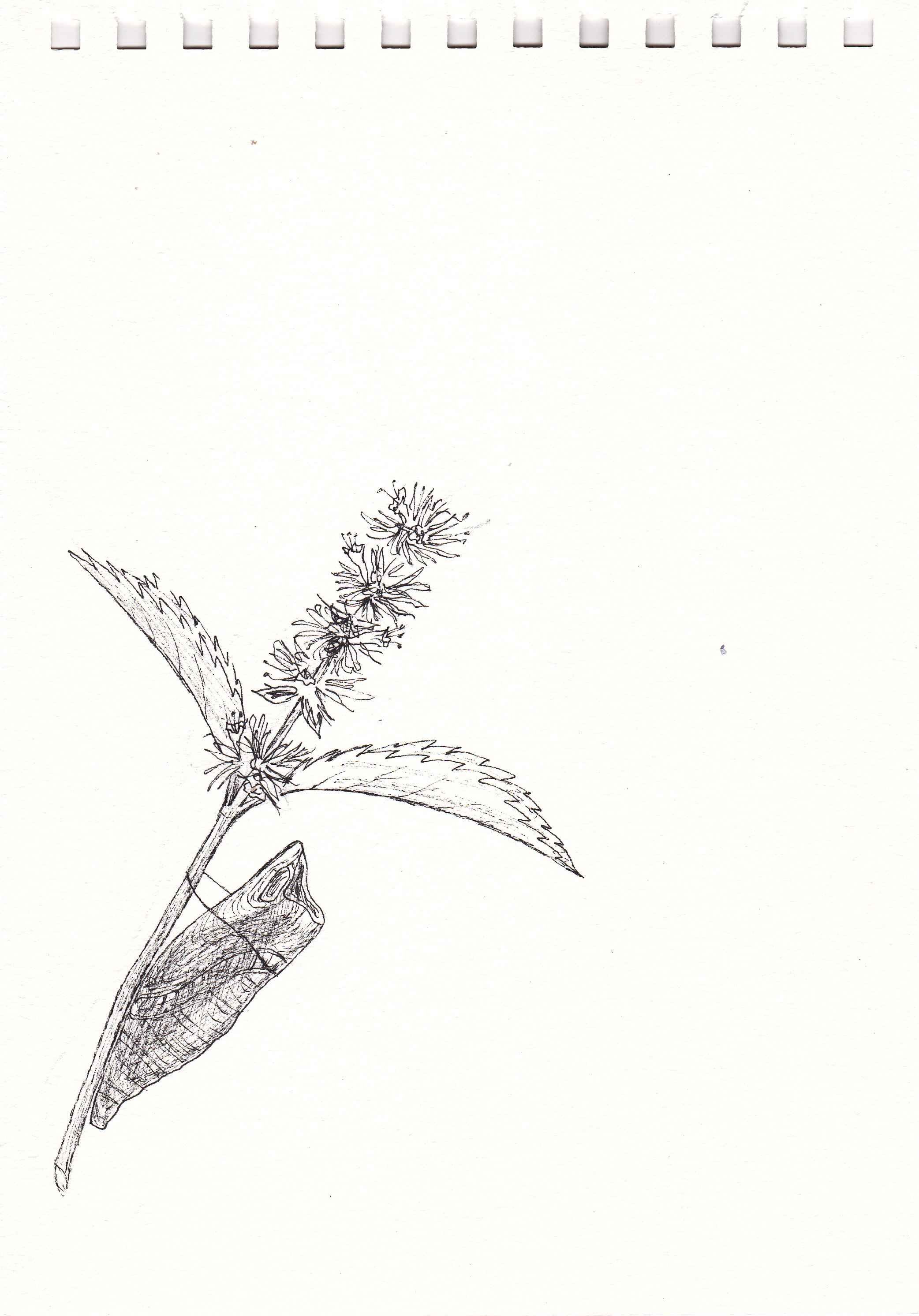
This chrysalis attached to a branch represents the pupal stage when a butterfly undergoes its metamorphosis. The California Indian basket makers seemed to emulate nature when they engineered baskets.
California Indian artistry was reflected in pragmatic ways with their fine nets for carrying burdens, trapping birds and fish. A Pomo burden net made of Indian hemp Apocynum cannabinum fiber cordage with trade Coast Miwok clamshell beads would have held a burden basket, and was used to transport things on an individual’s back using the headband to balance the load. Baskets were used to gather, prepare, store, and serve food. Coiled baskets made from slender willow branches were stitched into place with fine threads made from the underground rhizomes of the sedge plant. The warp and weft, and coiling were terms connected transferring knowledge for making coiled cooking baskets, basket hoppers and coiled cups. Large tightly woven-cooking baskets made from roots that were soaked efficiently hold water to withstand basket boiling to cook acorn mush and other foods. The hopper basket mortar was placed on the ground and the hopper basket constructed from small nicely scraped coiled shoots was placed on top. Water and acorn meal were placed into the basket then hot rocks were dropped in, bringing the content to a boil within minutes.

Burden Baskets were used for food gathering and transporting things. This one features a headband decorated with shell beads like ones made by Coast Miwok that were used in trading.
San Francisco Bay Area tribes prized cylindrical shell beads. Clamshell bead currency conveyed a pragmatic aesthetic value in daily items such as baskets and nets as well as sacred meaning in ceremonial rites that transcended the dominant abstract notion of paper or coin currency. Beyond being used as money (a medium of exchange), clamshell discs reflected value that was generally accepted or in vogue; within the context of time and place it reflected a quality of being and abundance that was widely accepted and circulated from person to person. Clam disc beads manufactured by the Coast Miwok were discovered at cremation sites at Olompali in Marin County suggesting that baskets embellished with these beads were burned with the dead.
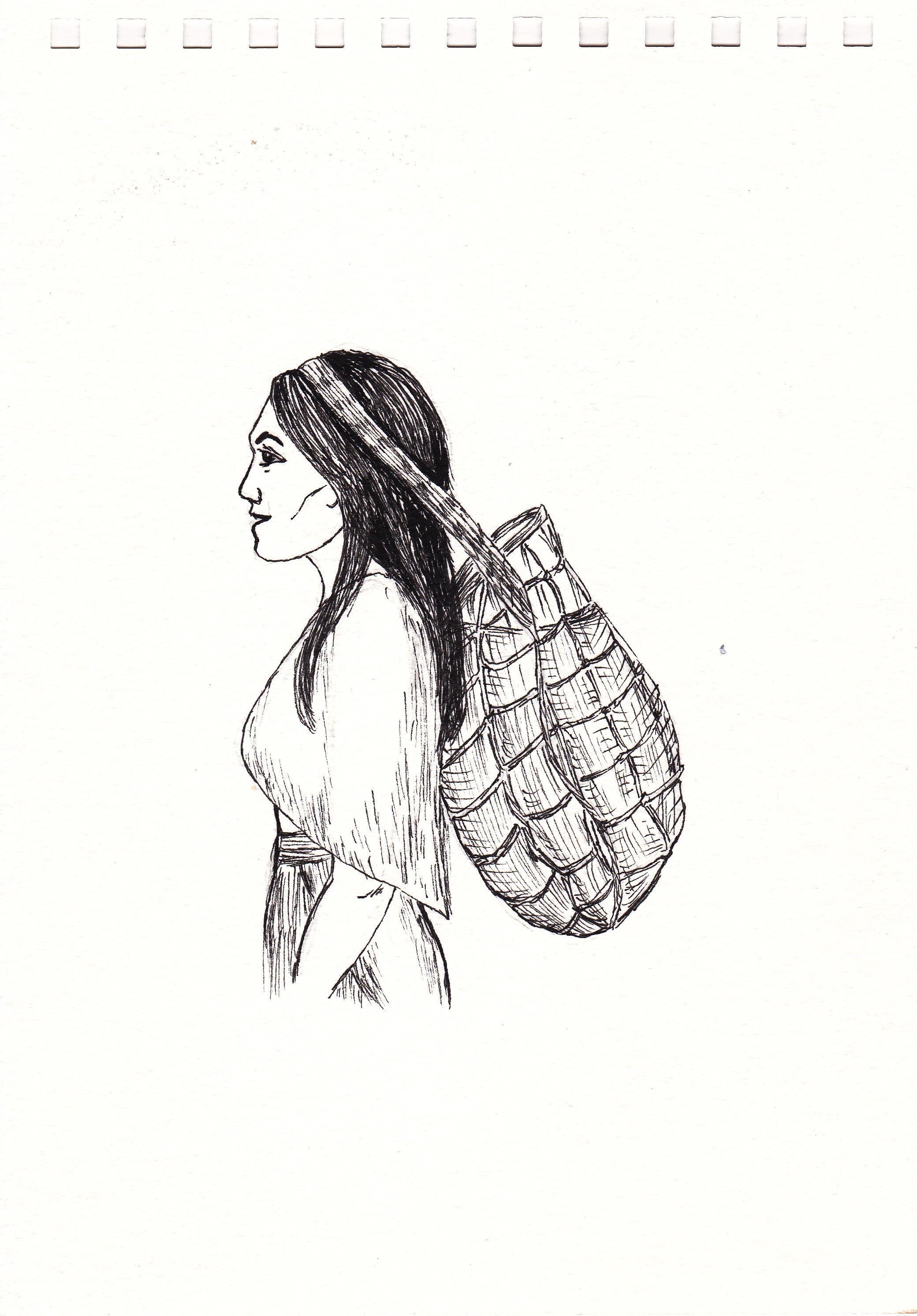
Once California Indians entered the Mission systems, they lost the ability to gather and cultivate native plants needed to make baskets, they also lost access to the foods that they had evolved with. This is an example of a burden net made with hemp.
California Indian Baskets – part 4
September 8, 2014
Specific geographic locations fostered the development of distinct stylistic basket motifs. Generic baskets were not produced; names were assigned to baskets classified by function. Working mothers safely carried infants in tule shade cradles. Tightly woven storage baskets about 2’ x 3’ constructed of hazel with straight sides were traditionally hung in structures. Acorn baskets featured an open stitch to allow air to move through the seeds in a coastal climate where fog supported mold growth. Parching trays were round and flat; close woven water-resistant conical burden basket held seeds; course woven conical burden baskets were constructed of hazel were used to gather foodstuffs; and coiled basket hoppers for grinding acorns. Men made large non-water resistant burden baskets with a handle on each side to store dried acorns. One man on each side using handles carried the basket that was placed on sticks or grass inside the granary.
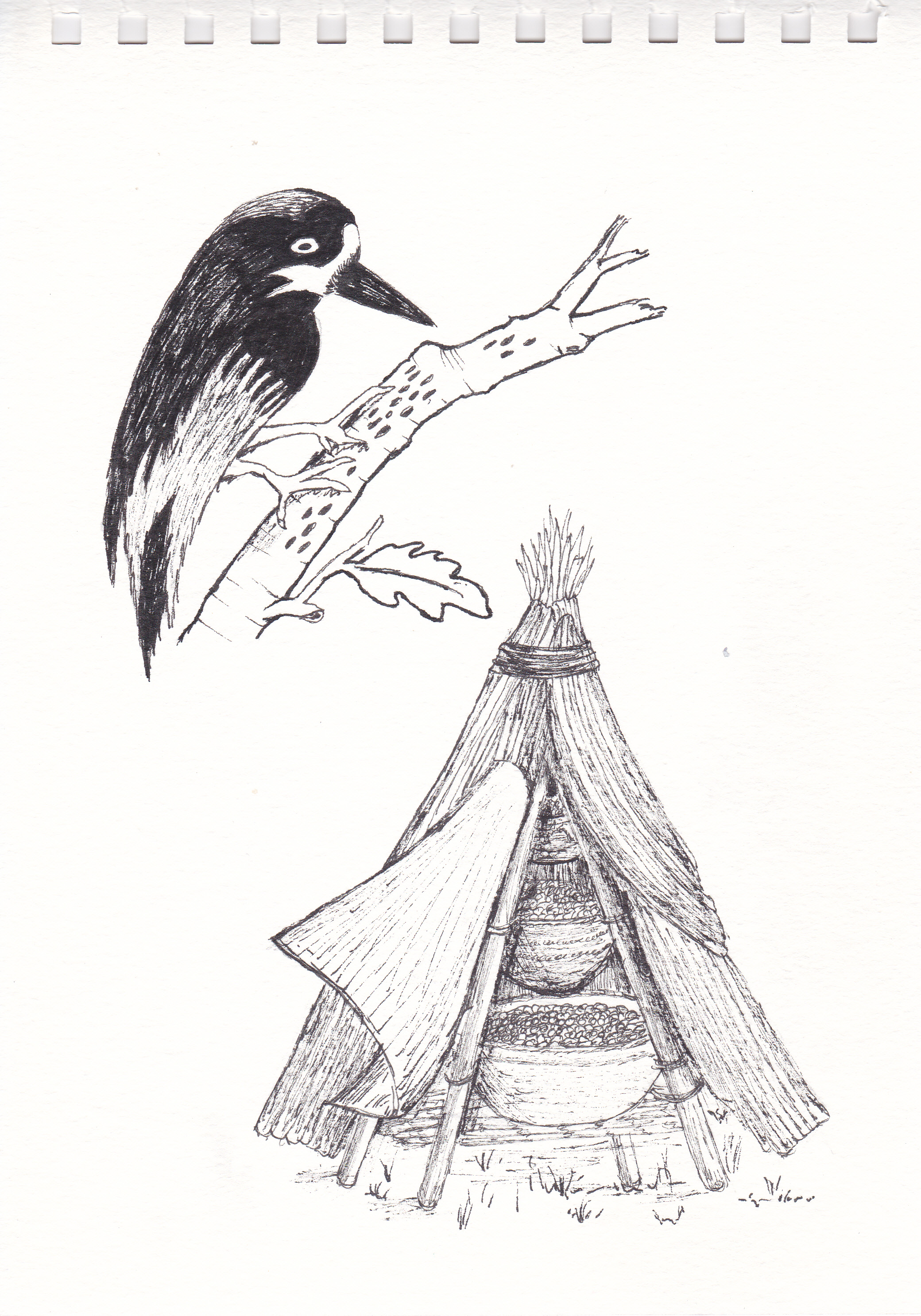
The acorn woodpecker stores in trees while California Indians traditionally stockpiled acorns over a couple of years in baskets secured in small bark-covered structures that allowed for good air circulation in the foggy coastal climate.
California Indian Baskets – part 3
September 6, 2014
The basket maker’s signature is discerned in the basket’s starting foundation and in the direction of the basketwork. A basket speaks as a gift – it presents a blessing whispering in our ears, observe the seasonal changes, look beyond the surface to focus on ancestral treasures that will only enlarge in daily life proportionally as they occupy thoughts. Basket makers observed plants and animals as ethno-botanists and artists that adapted to their surroundings. Coiled basketry requires a form of sewing; instead of using needles Coast Miwok employed bone awls. Women wore protective wraparound deerskin skirts to do basketry stitching with an awl made from bone. Coast Miwok developed crafts reflecting traditions and wisdom culled through observation. Indigenous Californians practiced controlled burns in gathering areas a year prior to gathering materials in order to harvest young shoots. Man’s relationship with a spiritual universe where nature was considered a “being” and humans were part of nature.
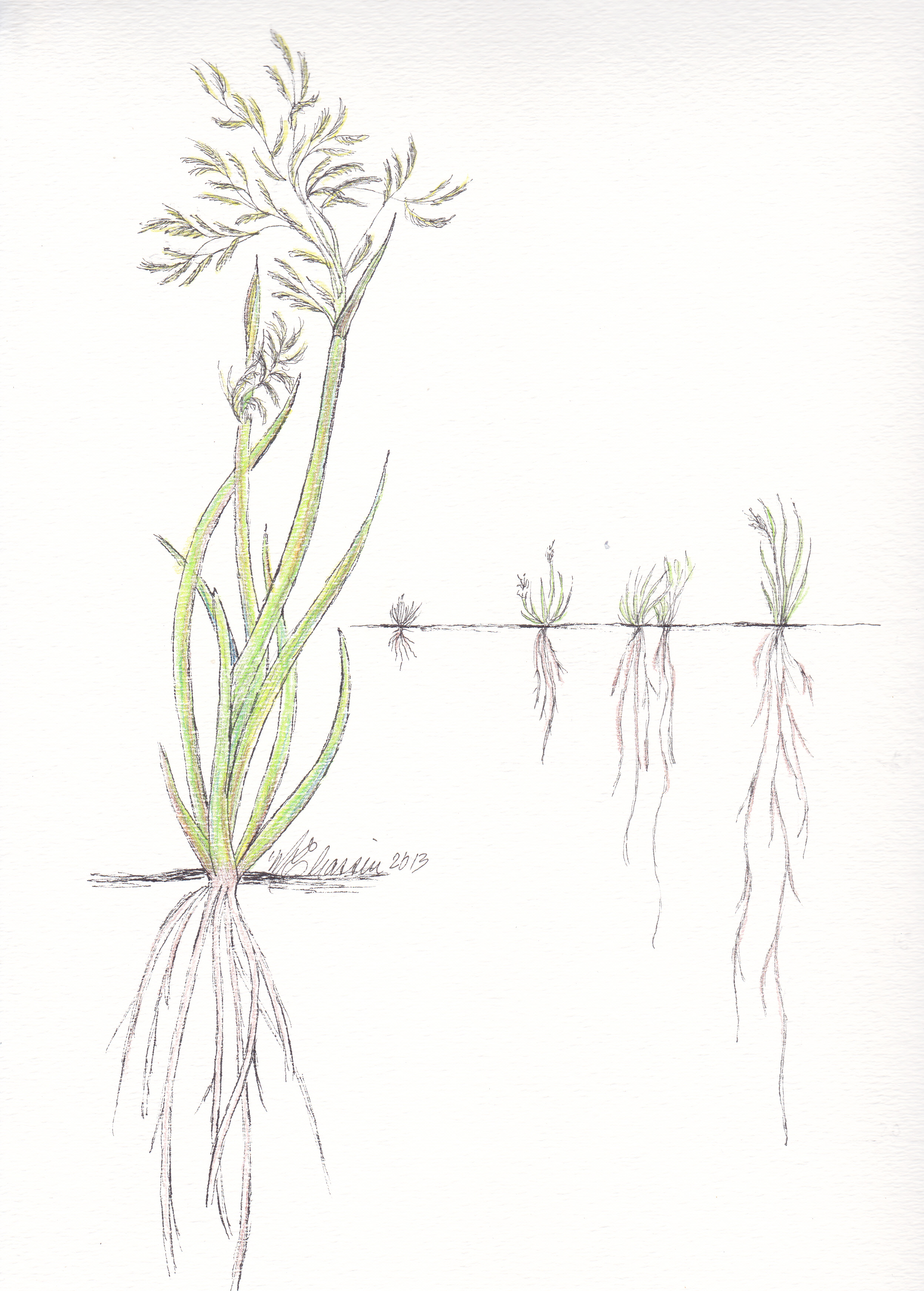
California Indian basket makers learned about the materials for engineering durable baskets by observing nature. The sedges used in many baskets have long root systems that evolved with local climate change. Today these native plants are being planted again for sustainable landscaping so that what is ancient is new again.
Coast Miwok and Pomo to their north were sophisticated in in cultivating the land. They studied cause and effect – abundance from a cultivated pristine landscape was manifested in variation in basket making materials used to create baskets for diverse uses. This was reflected in spoon-shaped wickerwork seedbeaters made of willow and hazel that were used only to harvest only mature seeds leaving immature seeds to propagate for posterity. Thought formations of seedbeaters from a distant era were impressed over time in clay earth at Olompali in Marin County to be excavated during the twentieth century.
Coast Miwok ate tule roots, but other plant parts were employed in constructing dwellings, granaries, and boats. The strength of tule fibers, grass-like sedges of the genus Scirpus growing along rivers and by wetlands, was identified for manufacturing water-resistant products. Sedge beds along streams under the shade of oak trees were carefully worked by basket makers who used a digging stick to expose the rhizomes for select the best rhysomes for baskets. Tule was processed as an absorbent material in infant diapers and sanitary napkins that were burned after use.
Basketry woven from plant materials, rather than pottery, crafted by Coast Miwok, Esselen, Costanoan, and Pomo tribes, reflects the region’s unique climate, topography, and native plants. Rainfall patterns, soil types, and growth characteristics of regional plants from their roots to shoots were observed throughout the year with each season unfolding changes in pliability and hues, and basket makers knew the best spots for gathering. Women pruned wild plants throughout the year, to eliminate knobs and lateral branches, to cultivate only straight rhizomes and branches. Form and function (employing sophisticated weaving techniques) were requisite to produce baskets able to endure stress, weight, and wear.
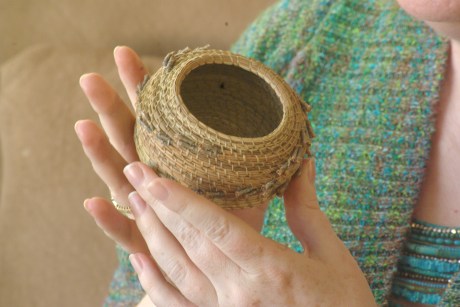
Modern pine needle basket by Joan Denys (Costanoan-Esselen, Monterey Bay California) acquired at the SFSU Powwow, spring 2011. Photographed by R. I. Otterbach, 2014.
California Indian Baskets – part 2
September 5, 2014
The Coast Miwok, originally a Northern California group of peaceful hunter-gatherer tribes, made their home in what is today Marin and southern Sonoma counties. The Coast Miwok consisted of about fifteen independent multi-village tribes that spoke related languages – however – linguists later assigned this grouping the name Coast Miwok.
Status in this environment was achieved through the artistry and accomplishments. The Coast Miwok headman (hoipu) and headwoman (maien) controlled social behavior through suggestion and influence rather than through heredity or coercion. Baskets were constructed for gendered essential to economic stability, diplomatic intertribal relationships, and a sacred harmony. Spirit imbued the creation of baskets from the basket making materials to their eventual contents.
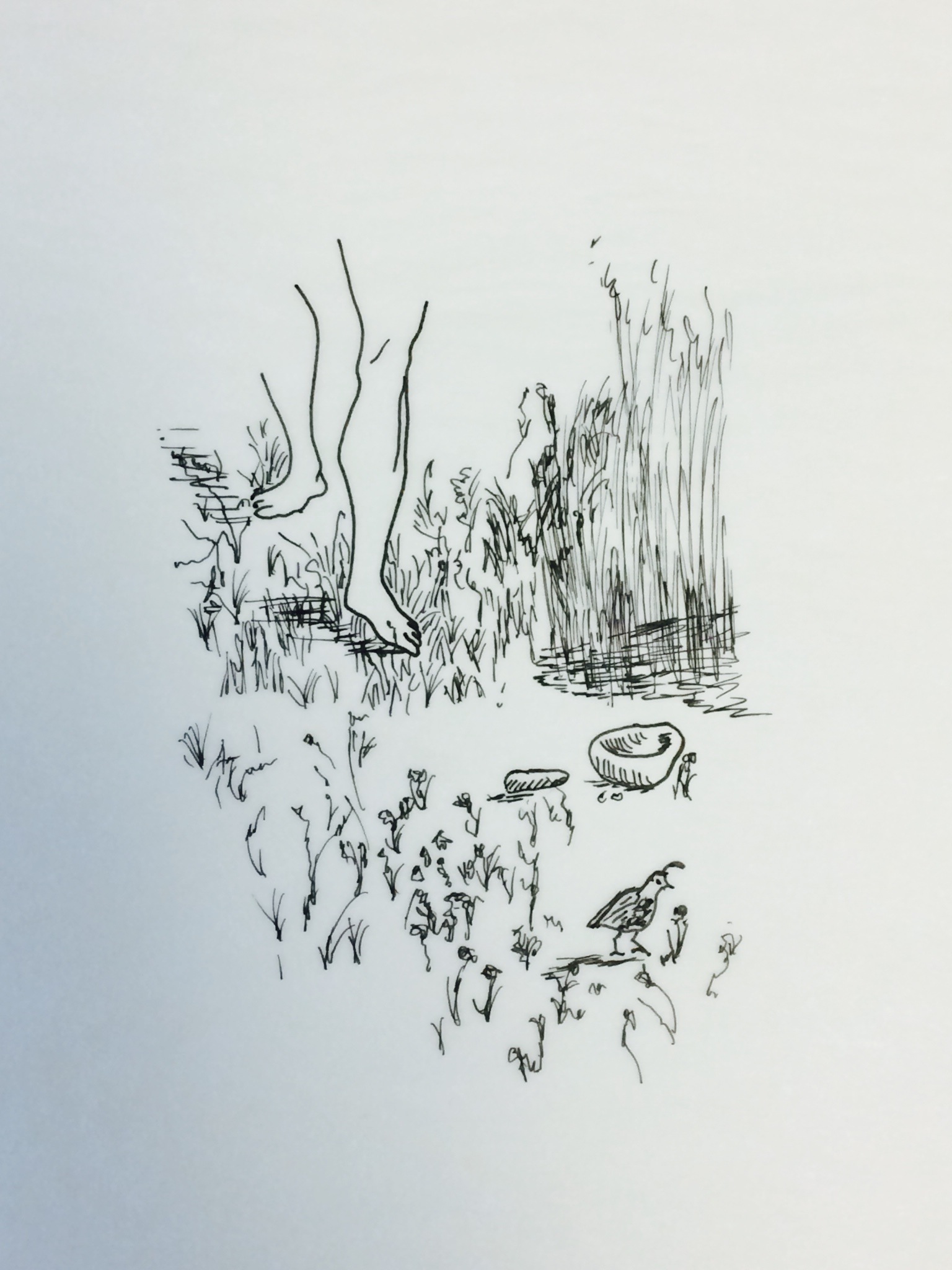
Oak trees were central to Coast Miwok life. Stewardship of oak groves passed through family lines. Acorns, which can be stored for two years or more, were the most important seeds for life contributing carbohydrates, protein, fiber, and fat to diet. From about 1200 A.D., the Coast Miwok and other coastal tribes began to manufacture clamshell beads used as currency in exchange for a wide range of goods and services from an edible clam Saxidomus nuttali with a thick shell found only near Tomales Bay and Limantour Estero. The value of currency was linked to communal function and aesthetics and not to abstract concepts of individually accumulated material wealth.
Coyote Gathers Feathers
September 4, 2014
Native Californians incorporated the notion of controlled burns as part of their creation stories. In a Pomo creation story collected during the summer of 1904, a trickster coyote employed fire in a world-burn that burns mountaintops and then supplies water (specifically Clear Lake) by throwing native tule roots and non-native grapevine roots into the mountain tops to create streams. As in many creation stories from other regions, the trickster creator does not achieve the respect that he feels is deserved, his people are soon looking for ways to destroy him.
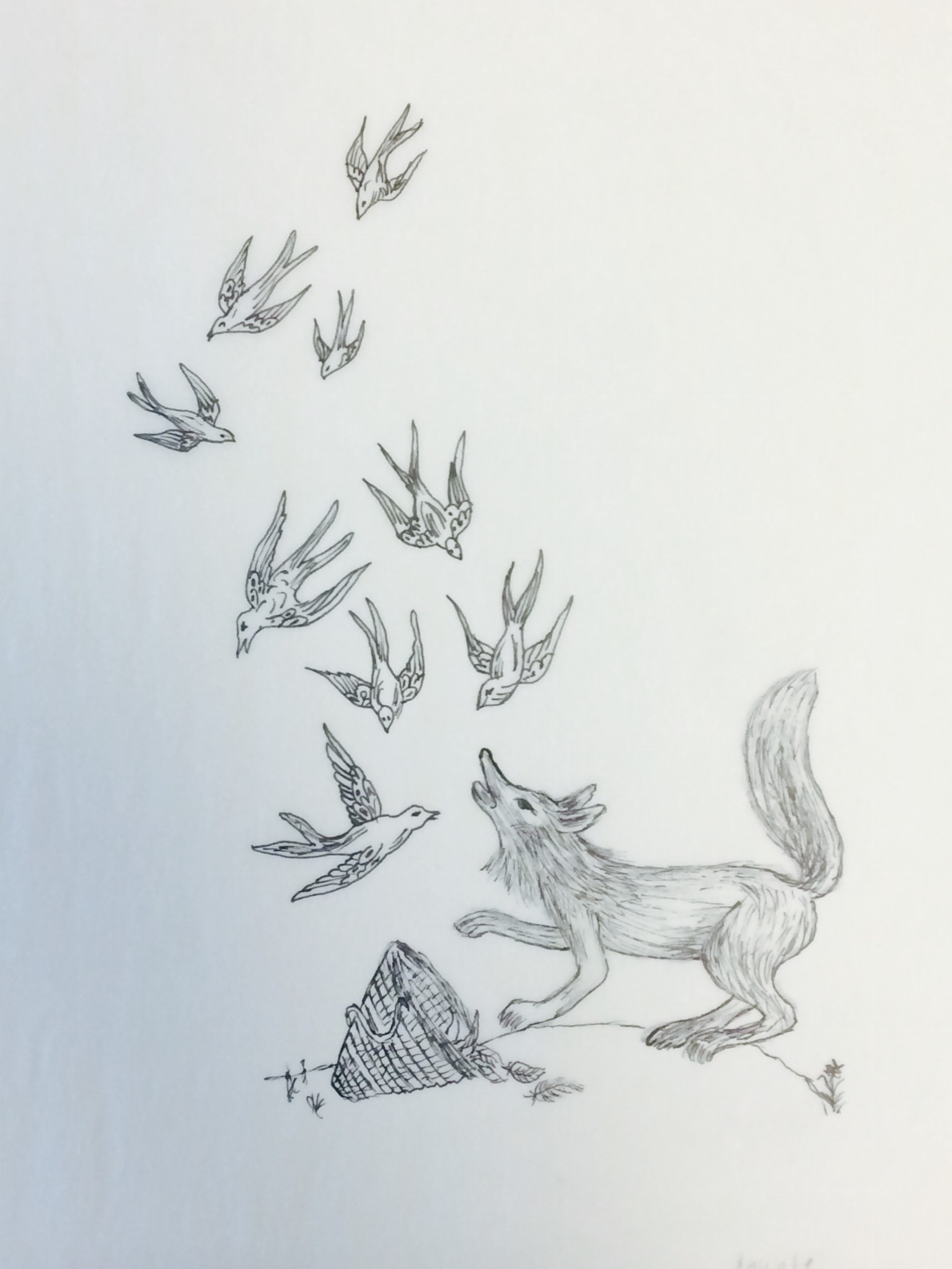
Coyote enticed the birds to giving him their feathers so that he could create humans.
Source for Further Reading: S.A. Barnett, “A Composite Myth of the Pomo Indians,” Journal of American Folklore 19: 72 (Jan.-Mar. 1906), 37-51.
Distance Lends Enchantment to the View!
September 3, 2014
Our campus has updated its Gator mascot to look more aggressive, and this old song came to mind… Samuel Woodworth (1784-1842) wrote the popular broadside ballad, “The Hunters of Kentucky,” originally known as “New Orleans,” as a tribute to Andrew Jackson’s decisive victory during the Battle of New Orleans in 1815.
YE gentlemen and ladies fair;
Who grace this famous city,
Just listen if you’ve time to spare,
While I rehearse a ditty;
And for the opportunity
Conceive yourselves quite lucky,
For ‘tis not often that you see
A hunter from Kentucky.
Oh Kentucky, the hunters of Kentucky!
Oh Kentucky, the hunters of Kentucky!
We are a hardy, free-born race,
Each man to fear a stranger;
Whate’er the game we join in chase
Despoiling time and danger
And if a daring foe annoys,
Whate’er his strength and forces,
We’ll show him that Kentucky boys
Are Alligator horses.
Oh Kentucky, &c.
I s’pose you’ve read it in the prints,
How Packenham attempted
To make old History Jackson wince,
But soon his scheme repented,
For se, with rifles ready cock’d,
Thought such occasion lucky,
And soon around the gen’ral flock’d
The hunters of Kentucky.
Oh Kentucky, &c.
You’ve hear, I s’pose how New Orleans
Is fam’d for wealth and beauty,
There’s girls ev’ry hue it seems,
From snowy white to sooty,
So Packenham he made his brags
If he in fight was luckey
He’d have their girls and cotton bags,
In spite of old Kentucky.
Oh Kentucky, &c.
But Jackson he was wide awake,
And was not scar’d at trifles,
For well he knew what aim we take
With our Kentucky rifles.
So he led us down to Cypress swamp.
The ground was low and mucky,
There stood John Bull in martial pomp
And here was old Kentucky.
Oh Kentucky, &c.
A bank was rais’d to hide our breasts,
Not that we thought of dying,
But that we always like to rest,
Unless the game is flying.
Behind it stood our little force.
None wished it to be greater,
For ev’ry man was half a horse,
And half an alligator.
Oh Kentucky, &c.
They did not let our patience tire,
Before they show’d their faces;
We did not choose to waste our fire,
So snugly kept our places.
But when so near we saw them wink,
We thought it time to stop ‘em,
And ‘twould have done you good I think,
To see Kentuckians drop ‘em.
Oh Kentucky, &c.
They found, at last, ‘twas vain to fight,
Where head was all the booty,
And so they wisely took flight,
And left us all our beauty.
And now, if danger e’er annoys,
Remember what our trade is,
Just send for us Kentucky boys,
And we’ll protect ye, ladies.
Oh Kentucky, &c.
The song became Jackson’s presidential campaign song in 1828, and the song found its way into popular culture when author James Fennimore Cooper mentioned it in his 1827 novel called The Prairie. He went on to write the classic broadside ballad called, “The Old Oaken Bucket” that was published in the New York Republican Chronicle on June 3, 1818 and was later set to music by George F. Kiallmark in 1826. Ol’ Samuel’s dream of crossing the country would eventually come to pass; he would find his way to San Francisco on the Pacific Coast posthumously.
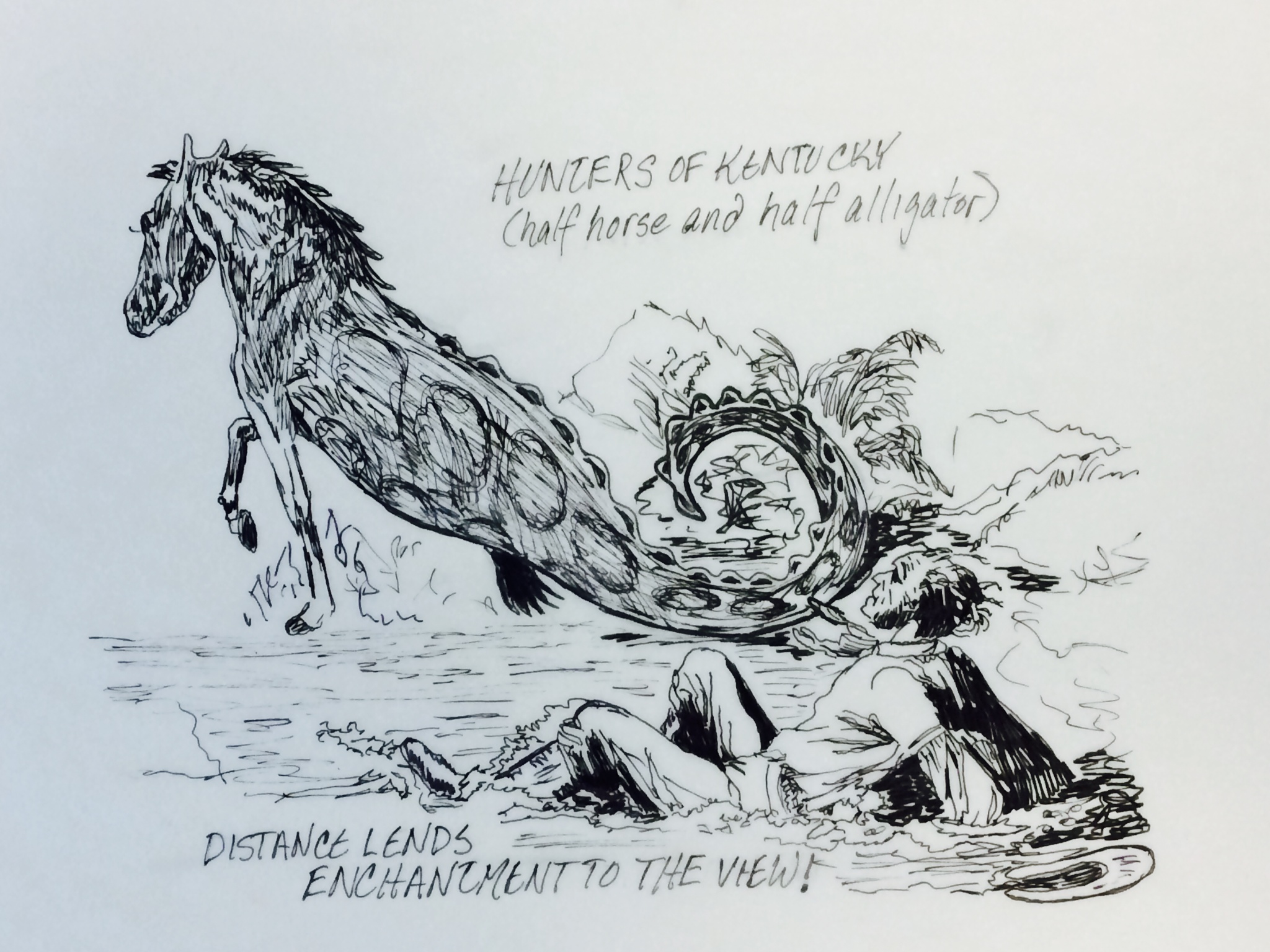
From the ballad by Woodward called Hunters of Kentucky.
California Indian Baskets – part 1
September 2, 2014
I grew up in the San Francisco North Bay and an area considered to be historic tribal lands for the Coast Miwok. We had a friend of the family that had California Indian baskets in his home that were functional. Betty Goerke in her book Chief Marin: Leader, Rebel, and Legend, A History of Marin County’s Namesake and his People (Berkeley: Heyday Books, 2007) includes photographs of elaborate baskets residing in European and Russian museums made by Coast Miwok women. California Indian baskets cannot be found in California museums. I have thought about these baskets over time, and what it must mean to a group when their artifacts cannot be found in public collections where they can see them and study them. It is one thing to have these creations safely secured in tribal hands, or returned to the spirit world as they were intended; it is another to thing that perhaps their cultural value has been buried by the thoughtlessness of aggressors. The language of historic California Indian baskets is like a tossed pebble creating ripples throughout a calm lake; like an earthquake sending shock-waves over the earth; as the ocean tide after a storm reveals an ephemeral shoreline that shifts with each new wave – it is to the modern world an echo of primordial wisdom that speaks to the collective human consciousness.

Seedbeaters are loosely woven baskets used to gather edible seeds, immature seeds were returned to the earth for another season
Laure Albin-Guillot (1879-1962) was married to a physician/scientist and she tapped into her husband’s lifelong interest in micrography to create a stunning series of photomicrographs of crystals printed on colored and metallic papers. Her Micrographie decorative (Paris: Draeger Freres, 1931) is a shining example of natural pattern that can be seen elementally.
Yerba buena (good herb)
August 28, 2014
The first name for San Francisco was Yerba Buena (meaning good herb) because the mint plant was found amongst the dunes and long the coast and used in medicinal teas and remedies.
Back from a long absence…
August 28, 2014
I started this blog ages ago and forgot about it. I have been doing a lot of writing and not much designing, but will post some of my work soon.
 MME Designs's Weblog