Dante… on Love
February 11, 2016
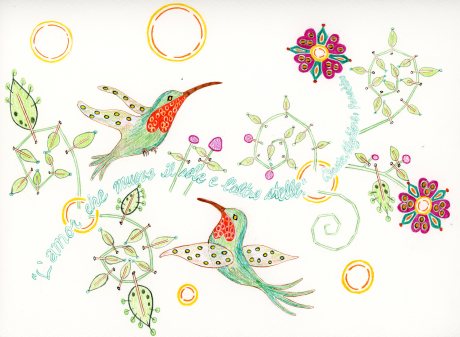
“L’amor che muove il sole e l’altre stelle.” (The love that moves the sun and the other stars.) from “Paradiso” by Dante Alighiere, 1265-1321. Image motif inspired by a card design by Robbin Rawlings. Drawing by Meredith Eliassen, 2016.
Some “Big Game” couter-programming
February 7, 2016
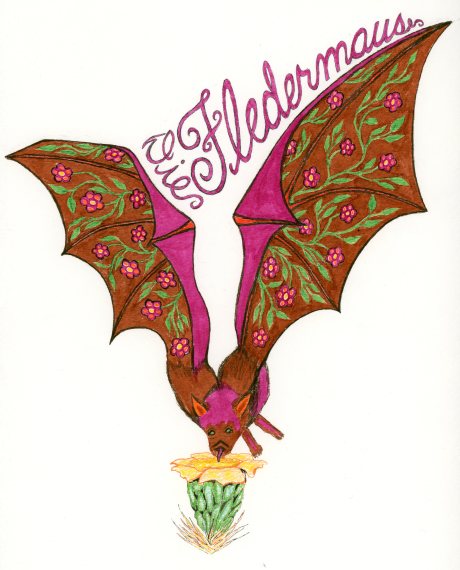
This little bat knows how to find the sweet nectar of life. Design by Meredith Eliassen, 2016.
More on Math…
February 3, 2016
Euclid wrote: “There is no royal road to geometry.”
Adam H. Dickey wrote: “Figures are not things but thoughts; they are mental concepts, and as such they are available to every body.”
John L. Dobson wrote: “By the demise of those with poorer eyes, we gained our visual acuity, and by the demise of those with smaller brains, we improved our capacity to understand. It is that capacity which sets us apart amongst the watchers of the skies.”
Envision Euclid and Dobson together… as lizards, conversing.

Euclid (left) examines abstract calculation as Dobson (right) gazes at the heavens. Design by Meredith Eliassen, 2016.
Introducing Dobson and Euclid, the mathematical (gecko) sector of the Lucky the Lizard Posse. Euclid & Dobson Notecard
For the Birds…
January 27, 2016
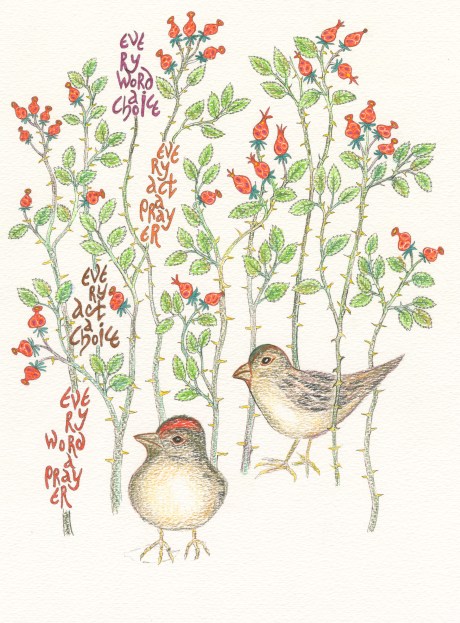
“eve ry word a choice eve ry act a pray er eve ry act a choice eve ry word a prayer” Words by Robert Lax (1915-2000) from “In the Beginning was Love: Contemplative Words of Robert Lax,” edited with an introduction by S. T. Georgiou (2015), design by Meredith Eliassen, 2016.
Some books on millefiore
January 8, 2015
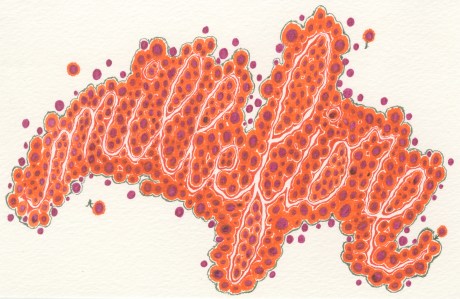
Design of millefiori by Meredith Eliassen.
Glassmaker John Burton discusses modern techniques for producing glass in Glass Philosophy and Method (New York: Bonanza Books, 1967) Burton chronicles the history and development of certain techniques and illustrates with photographs how to make millefiori glass.
Axel von Saldren concentrates on the early manufacturing of glass in Ancient Glass in the Museum of Fine Arts, Boston (Boston: Museum of Fine Arts, 1968). He theorizes that glass originated in Egypt and Mesopotamia as vessels and traces the migration of the glassmaking industry. The millefiori motif is traces to Mesopotamia in the 15th century BCE, to the early Roman Empire when monochrome elements were used, and then to Venice. Glass beads are discussed but not in connection to the millefiori motif. Photographs illustrate many examples of millefiori in Museum collection pieces.
Donald M. Harden provides an excellent overview of early glass in “Ancient Glass, Part 1: Pre-Roman,” Archeological Journal 125 (1969): 46-72. For the person interested in a detailed history of early glass, this is probably the most comprehensive paper published on this complicated early period.
Paul N. Perrot, Paul V. Gardiner, and James S Plant profile the work of Frederick Carder (1863-1963), founder of Steuben Glass works that later became a division of Corning Glass Works in Steuben: Seventy Years of American Glassmaking (New York: Preager Publishers, 1974). In Carder’s early designs, he developed the modern variation on the millefiori motif for glass manufacturing, the creating an American variation on the Venetian millefiori motif.
Sidney M. Goldstein traces the millefiori design motif to the earliest periods of glassmaking in Pre-Roman and Early Roman Glass in the Corning Museum of Glass (Corning, NY: Corning Museum of Glass, 1979). Such sites as Tel-A Rimas, ‘Aqar Quf, and Marlik in Western Asia are discussed. Goldstein expounds on various glass making techniques. The catalog shows the vast Corning Collection containing examples of millefiori dishes, petalla cups and fragments of Roman glass revetments and mosaic glass inlay but non of the beads are millefiori.
Millefiori
January 7, 2015
Millefiori, which literally translates to “thousand flowers,” is a motif that dates back thousands of years. Originally used in early glass and tile making, the design became a natural motif in bead making. The method for making millefiori is at once a decorative and manufacturing process and has been used in a number of different media. Millefiore is often grouped with mosaic glassmaking, although the manufacturing technique is similar, the two motifs are very distinct. Millefiori is a flower motif that dates back to the 1st-3rd centuries BCE and mosaic motifs are geometric and figurative that date back to the 15th century BCE.
Lois Sherr Dubin discusses the symbolic and cultural nature of beads in History of Beads from 30,000 BC to the Present (New York: Harry H. Abrams, Inc., 1987). Beautifully illustrated, this book shows an abundance of beads from all over the world. Graphics include a map of the Roman World; distribution of bead and bead materials from 1 BCE to 1 CE; bead migration; and a time line of bead history. The writing is ambiguous: millefiori, mosaic, and eye beads are lumped together when they are three significantly different styles. The graphics are more informative than the text.
Gustave E. Pazaurec shows how beads were used in fashion and craft in Glasperien und Perlenarbeiten in Alter und Neuer Zeit (Darmstadt: A. Koch, 1911). Pazaurek enables the reader to see beads in historic context; it contains only a brief discussion of millefiore beads with pictures of Roman beads.
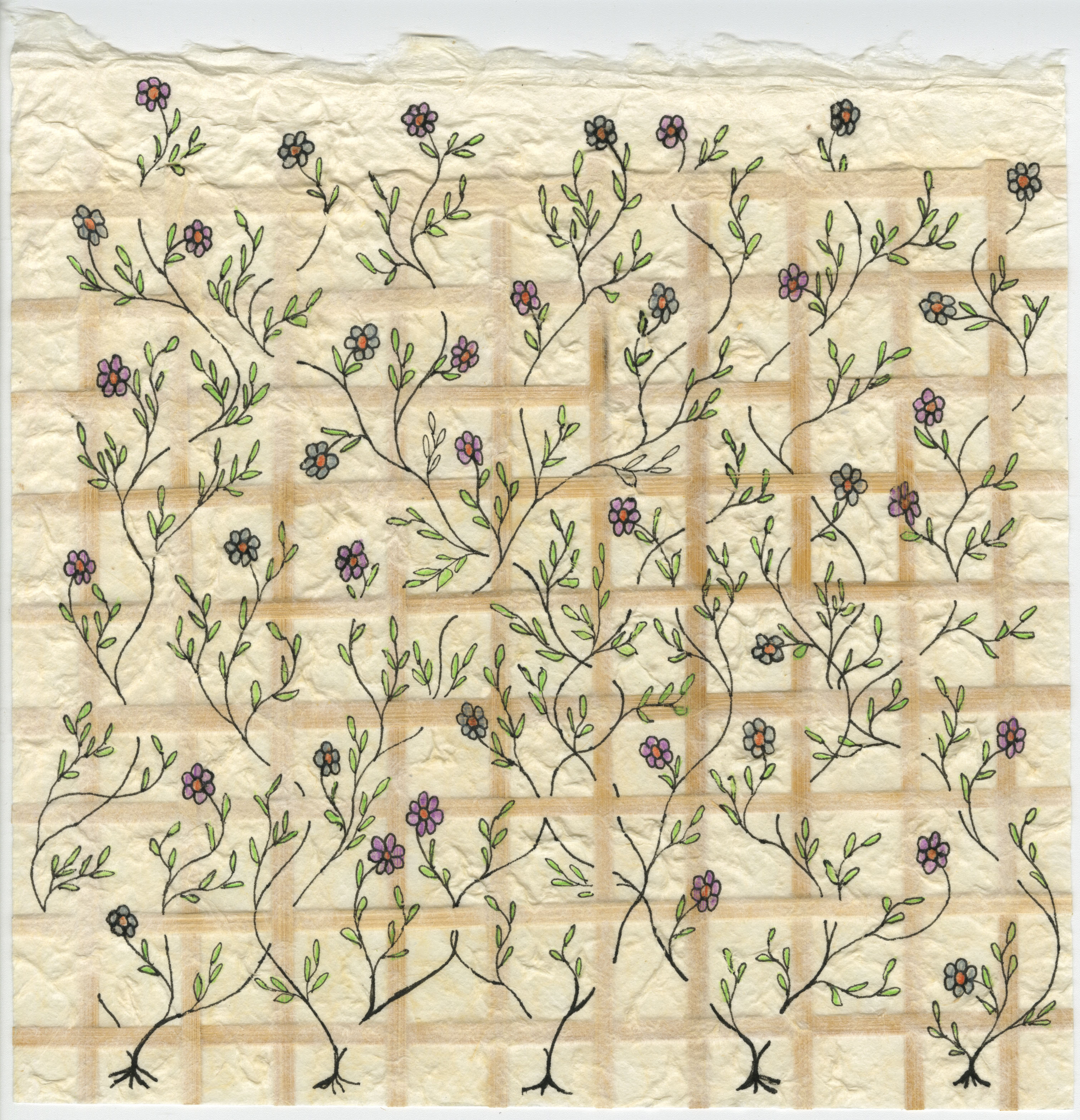
Flowers weave through the natural trellis in handmade paper. Drawing by Meredith Eliassen
Millefiore
November 29, 2007
The millefiori (thousand flowers) motif has shown up in Europe and Africa for over five hundred years. I want to learn where it originated, and where it is showing up in the world today.
 MME Designs's Weblog