Child translating within a natural context
April 6, 2018
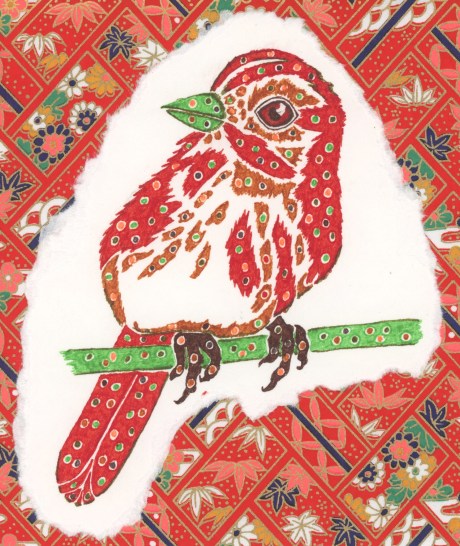
Lydia Maria Child sought to reform with inherited literary genres. Rose Marian and the Flower Fairies is a translation of a German legend about a fifteen-year-old girl named Marian who lives in a verdant mountain community, and Marian who relates more to nature than to other humans. Bird drawing mounted on Japanese paper, by Meredith Eliassen, 2018.
Purchase red songbird notecard here.

Having no playmates, Marian talks to the flowers, “as if they were intelligent beings, that can understand her words (11).” When Marian’s mother dies, she perceives that she has become an angel, “gone to dwell with celestial beings (18).” Marian refuses to leave the side of her mother’s grave and the doctors soon observe, “If she keeps ever wakeful, and this profound melancholy continues, she will certainly become insane (23).” Flower drawing mounted on Japanese paper, by Meredith Eliassen, 2018.
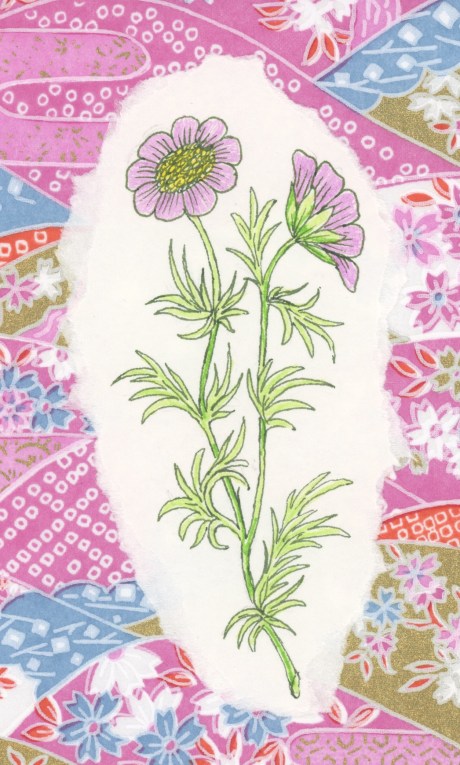
The flowers seek to console Marian until a beautiful benevolent spirit came upon them smiling and said, “Beautiful and fragrant ones, be not afraid of me, I come to ask your assistance in conveying the good young princess to a happy home, where she will never more know trouble (24).” The flowers assist by giving up their fragrances to create a concoction that helped Marion to sleep eternally. Flower drawing mounted on Japanese paper, by Meredith Eliassen, 2018.
With the Civil War, Child’s hard-hitting career was eclipsed, but her writing became more relevant as it holistically prescribe character development within divergent audiences. After Abraham Lincoln announced the drafting of an Emancipation Proclamation in late September 1862, Harriet Beecher Stowe (1811-1896) called on Mary Lincoln in New York City to request an invitation to the White House. Lincoln met Stowe and supposedly greeted her with the comment, “So you’re the little woman who made this Great War.” When news of the Emancipation Proclamation arrived on January 1, 1863, Stowe was attending a New Year’s Jubilee celebration at the Boston Music Hall. The crowd gave Stowe a standing ovation.
The Civil War changed the tone of all children’s literature to depict changing patriarchal gender roles as soldiers left wives and widows to head households. Post-bellum juvenile literature reflected new sensibilities as characteristics of “childhood” and attitudes towards what constituted “worthy poor” changed. Sentimental stories with absent father figures always featured a male figure, who appeared to rescue a disabled girl. Child’s stories, like Rose Marian and the Flower Fairies (1865) translated from a German legend presented a feminine, nature-centered view. In children’s literature, more sentimental concepts of girlhood and female adolescence emerged out of the Civil War. Northern publishers developed lucrative family markets; so American literature achieved an economic boost after the war. The phenomenon of girl and family stories (or domestic novels) written by female authors reflected the development of a middle-class domestic audience that became pivotal to American literary history. These authors projected their own desire for societal change into their juvenile female characters and subsequently on young readers.
A City and its Dogs: San Francisco’s Bummer and Lazarus
April 5, 2018
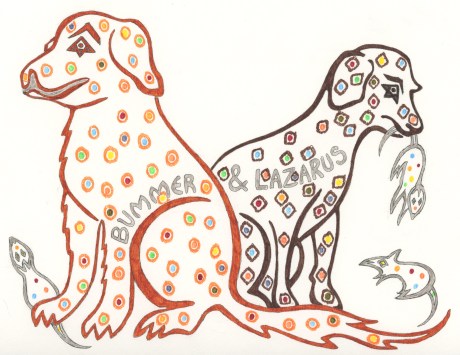
Journalists depicted Bummer and Lazarus’s exploits in very humanistic terms during the early 1860s, endowing the adventures of two nasty feral dogs with romance and drama. This drawing of Bummer and Lazarus as working ratters is by Meredith Eliassen, 2018.
Prior to the establishment of the establishment of the San Francisco SPCA in 1868, two feral dogs named Bummer and Lazarus established a home base outside a downtown bar that was popular with local journalists. The Press described the apparent bond between the dogs to show that the two strays might actually be useful to society and served as a metaphor for conflicted behavior in human beings unfolding during the Civil War in the national headlines. News stories published in various news outlets created a buzz that opened the community perception to a sensibility of humane treatment for animals.
At this time, stray dogs barking disturbed the relative peace and they were regularly poisoned, trapped, and killed. Shooting stray and feral animals was common practice but it created safety hazards in the business district and tenements. Bummer, a black-and-white Newfoundland, established a home base outside Frederick Marten’s Saloon in 1860. His ratting talents soon garnered a following of passers-by, so Marten’s patrons and local merchants fed him. Lazarus was a mutt that Bummer rescued from a fight with a larger dog a year later; he was named Lazarus because he was so badly injured and was not expected to live. The saloon, a hub for journalists, became a key to changing public perceptions related to animal welfare when San Francisco’s leading newspapers including, Californian, Daily Alta California, Daily Morning Call, and Daily Evening Bulletin started publishing the exploits of the dogs in very humanistic terms. Newsmen created a persona for Bummer as a faithful gentleman down on his luck, and Lazarus was depicted as a scamp. As Lydia Maria Child described in feminine terms a cat named “Grizzly Tom” based upon a real cat who ended up caring for orphaned kittens, the journalists used masculine rhetoric to show how Bummer appeared to care the injured dog, coaxing him to eat shared scraps from his own scavenging, and how with care and encouragement, the dog recovered and within days. Lazarus and Bummer became a team of exceptional ratters.
In reality, Bummer and Lazarus could be vicious: they regularly fought other dogs and ransacked shops when owners failed to close doors. However, the ongoing stories struck a chord and served as a metaphor for conflicted behavior in humans. At one point, Bummer got shot in the leg and Lazarus abandoned him to run with another dog. The newspapers had a field day: they portrayed the bitter sting of desertion that Bummer felt from being abandoned by a fair-weather companion who he once saved from sure death. Once Bummer recovered, Lazarus returned to their old stomping grounds. News stories published in various outlets created a buzz that opened the community to a sensibility of humane treatment for animals.
In response to ongoing noise and dog attacks, San Franciscans enacted a tough ordinance banning unlicensed dogs in April 1862. Stray and feral dogs were captured and taken to the pound. If they were not claimed within 48 hours and the five-dollar fine was not paid, they were put down. The pound-master’s van was seen and heard passing through San Francisco’s cobblestone streets in the early morning hours. The wagon, led by two horses and driven by a dogcatcher, had open sides revealing the luckless unlicensed dogs along with occasional pet goats, pigs, and lambs. A vaquero assisted the dogcatcher, as another rode along side, ready to lasso any strays in their path. An inexperienced pound-master mistakenly captured Lazarus on June 14, 1862. Angry San Franciscans demanded his release, actually petitioning city supervisors to have the two dogs declared city property so they could wander the city unmolested. City supervisors ordered Lazarus’s release and exempted Bummer and Lazarus from local 1962 ordinance. Lazarus was poisoned with rat bane-laced meat after biting a boy and died in October 1863. Angry San Franciscans, once again up in arms, put up a $50 reward for the poisoner’s capture. The Press had less interest in Bummer without his sidekick, and the faithful gentleman died two years later after being kicked by a drunk. Cartoonist Edward Jump (1832-1883) produced an ironic lithograph called “Funeral for Lazarus,” which appeared in The Wasp, and at the rear of the cortege a self-satisfied dogcatcher reclines on his cart.
Source: Albert S. Evans “The zealous pound master,” in A la California: Sketches of Life in the Golden State (San Francisco: A. L. Bancroft & Company, 1873).
Exploring Child’s animal landscapes
April 4, 2018
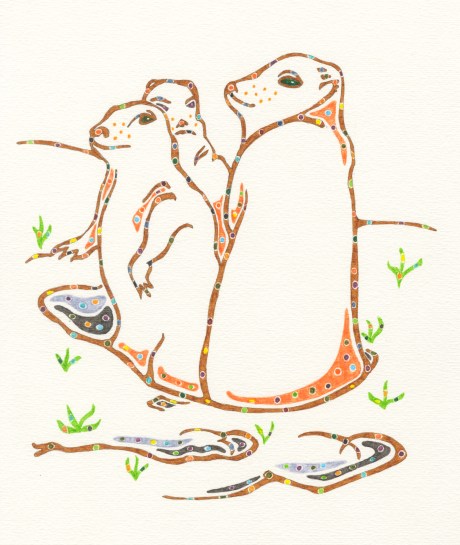
In a story featuring a strong Native American female character, Lydia Maria Child suggested that animals have alternative societies. This drawing of prairie dogs, inspired by the story “Willie Wharton,” is by Meredith Eliassen, 2018.
Lydia Maria Child’s fictional character of young Willie Wharton is sensitized to nature and creatures of the prairie including moles, squirrels, and prairie dogs. Child positioned children as closer to God, therefore, closer to nature. She also perceived that animals had indigenous societies. When Wharton brought a Native American girl home, he asserted, “She’s my girl. I found her.”
Child relied upon moral suasion to foster humanitarian awakening; she sought to reform with inherited literary genres. A family on the prairie sets aside contemporary biases to take in a Native American girl, and not understanding her cultural background, they treat her like a pet until her family came to collect her. While Child’s language seems racist by today’s standards, her logic was actually powerfully progressive for her times suggesting that you treat all living creatures with kindness.
During the Civil War, the U.S. Army’s California Volunteers deployed resources in response to the “General Order, No. 4,” issued on April 9, 1862, which supported a movement to kill adult male California Indians so that women and children could be sold into slavery for profit: “Every Indian captured in this district during the present war who has engaged in hostilities against whites, present or absent, will be hanged on the spot, women and children in all cases being spared.” As late as 1867, even after Congress passed the Thirteenth Amendment outlawing involuntary servitude, some vigilantes in far northern California continued the murdering, kidnapping and maintenance of an illicit slave trade in California Indians even as the sale of Chinese-American women into slavery continued.
In the story, Child reiterates a theme she earlier explored in The Little Girl’s Own Book, where she discourages children from taking non-domesticated animals in as pets:
“It is a good rule to keep only such animals as are happier for being domesticated; such as kittens, dogs, or pet lambs. I would not keep a robin shut up in a cage, for the price of fifty birds. Do what you can for him, you cannot make him half so happy as he would be abroad among the sunshine and the flowers. Canary birds must be kept in the house; because they came from the warm islands of Canary. And it would kill them to expose hem to our winter; but, kind little reader, if you have any feathered prisoners, which belong to our own climate, I beg of you to open the door and let them fly the first bright day the next spring. I have likewise an objection to keeping rabbits and squirrels; because I am sure they are not so happy as they would be in their native woods.”
Sources: Lydia Maria Child. “Willie Wharton” Atlantic Monthly 11 (March 1863): 324-345 and “On Keeping Animals,” The Little Girl’s Own Book. New York: Edward Kearney 1843: 242.
Critter transformations and character development
April 2, 2018
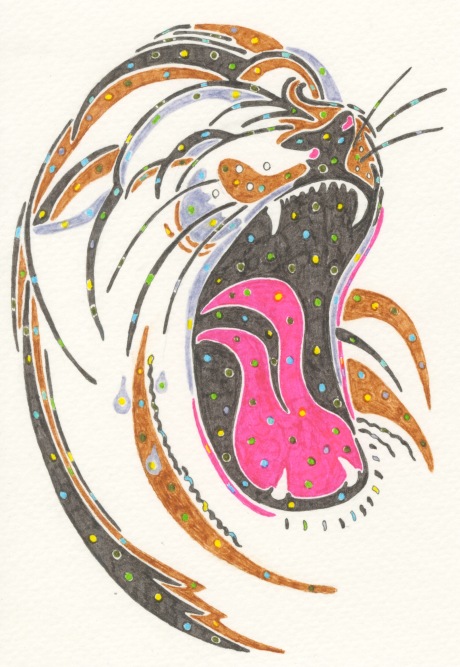
Grizzly Tom inspired by Lydia Maria Child’s story “Pussy Malta and Grizzly Tom,” written specially for Our Dumb Animals 2: 11 (April 1870): 105. Design by Meredith Eliassen.
This story is an account of two cats that Child encountered while boarding with Joseph and Margaret Carpenter and their Quaker family while her husband David dealt with debts from a lawsuit during the 1830s. The Carpenters operated a farm and interracial household in an isolated area near New Rochelle, New York that was a stop in the Underground Railroad. The family had two cats, a slender, working, female Maltese cat names Pussy Malta and a cantankerous, infirm old cat named Grizzly Tom who had been a fixture on the farm since he was a kitten. The two cats had a fragile relationship because Tom was so disagreeable: “spitting and growling, clawing and scratching whenever he was not asleep.” Pussy Malta conversely was a hunter who was protective of her recent litter of three kittens whose eyes were still unopened. Pussy Malta kept a watchful eye on Tom while they both lapped up milk from the same trough to see what he would be up to next.
One day, Pussy Malta became very sick… and even with care, she only got worse and began convulsing. Tom, who had been asleep on the stoop heard her cries and went to see what was wrong. Tom immediately softened, laying his paw gently on her fur as if to say “I wish I could help you.” However, sadly, Pussy Malta died within the hour leaving her three kitten orphaned curled up on a piece of rug on Tom’s stoop.
Grizzly Tom assessed the situation as the mother cat grew cold and stiff, and returned to the stoop where he steadfastly watched over the brood like a foster father, protecting them until they were old enough to fend for themselves. What’s more, Grizzly Tom proved to be an extraordinarily nurturing parent, never deserting the kittens even though they often teased him, pulling his ragged fur and playing with his tail as he slept, all the while, never striking them a blow.
Timeline of Lydia Maria Child’s work
March 23, 2018
“Little girls should never feed animals with any new food, without asking advice of those who are experienced.” Quote from Lydia Maria Child, “On Keeping Animals,” in The Little Girl’s Own Book (243); design by Meredith Eliassen, 2018.
In the coming weeks I am going to explore works by a pioneering American author, Lydia Maria Child (1802-1888), who wrote stories about the importance of treating animals humanely. I will explore her logic within the contexts of changing times. Child began her career during the 1820s, and was well established by the 1860s as an activist on many levels. She was invited to author the preface to Harriet Jacobs’ Incidents in the Life of a Slave Girl on 1861, and wrote pioneering pamphlets supporting the abolition of slavery and Native American rights. The designs will stylistically mimic embroidery designs.
1812 – The New York Tract Society was established.
1814 – The New England Tract Society was established.
1815 – The Hartford Evangelical Tract Society was established.
1817 – The Hartford Evangelical Tract Society, as a result of the Battle for Baltimore in 1814, published Happy Poverty, or, the Story of Poor Ellen. Funds raised from the sale of this tract supported the operations of the Baltimore General Dispensary that aided persons in distress.
1820s and 1830s – Epidemics of small pox, yellow fever, and diphtheria swept the United States.
1821 – The first American high school, established in Boston.
1823 – Clement Clark Moore’s poem “A Visit from St. Nicholas” changes perceptions of Christmas from a German holiday to a gift-giving occasion in the United States.
1825 – The American Tract Society was established.
1826 – German educator Friedrich Fröbel’s The Education of Man, encourages parents to install mobiles in cradles to insure “occupation for the senses and the mind” to foster early child development.
1826-1834 – Child established the Juvenile Miscellany as the first American children’s magazine. Child had to give up editorial control because her reform work with the abolition movement, and her liberal views on Native Americans became too controversial.
1827 – Peter Parley’s Tales of America by Samuel Goodrich (1793-1860) is published. Goodrich created his pseudonym from Hannah More’s tract called “Parley the Porter,” and his innovative benevolent narrator revolutionized the didactic and historic narrative style for children’s literature.
1829 – Child’s The Frugal Housewife published.
1830s – Jacob Abbott (1803-1879), a Congregational minister, begins his “Rollo” series of instructional books and William Holmes McGuffey (1800-1873) begins his series of “Eclectic Readers.” Both authors shape American consciousness with their packaging or literature that teaches morality.
1830 – Child established and edited M. of Lowell gets her story “Blind Susan, or, The Affectionate Family” published in Juvenile Miscellany. This story graphically describes medical treatments for vision loss resulting from scarlet fever.
1831 – Child’s Mother’s Book is published. It is an early American prescriptive book for rearing children and contains a story about a young mother that is abusive to a cat.
1833 – Girl’s Own Book is published
1832 – Jacob Abbott’s The Young Christian, or, A Familiar Illustration of Principles of Christian Duties is published.
1838 – The American Sunday-School Union publishes their Union Spelling Book.
1845 – Child’s most remembered poem, “A Boy’s Thanksgiving Day” is published. It also appears in her Flowers for Children. II. For children from four to six years old. (New York: C.S. Francis & Co., 1845). Flowers for Children was published between 1844 and 1846.
1850 – Child’s translation of the German legend Rose Marian and the Flower Fairies is published. It is a transcendental romance about the death of an orphan.
1851-1852 – Harriet Beacher Stowe’s Uncle Tom’s Cabin is published in serial form, initially a family story, it was quickly rewritten for children, and like Pilgrim’s Progress was published in “words of one syllable” to be used as a primer.
1853 – Child’s biography of Isaac Tatem Hopper (1771-1852), an American Quaker abolitionist is published. Child devotes a section about his youth utilizing his relationships with animals to show how his consciousness is expanded.
1855 – At the women’s rights convention at Seneca Falls, N.Y., some women wear bloomers to draw attention to artificial distinctions created by restrictive clothing that limit daily physical activities for women.
1861-1865 – The American Civil War. The Little Pilgrim, a Northern Christian magazine for children is published.
1863 – Louisa May Alcott writes Hospital Sketches based upon her experiences as an Army nurse during the Civil War that leads to reform in military hospitals. This success paves the way for her to get Little Women published.
1865 – The United States establishes Christmas as a national holiday. With this shift, Americans begin the practice of exchanging handmade or inexpensive toys and gifts among a wide circle of acquaintances and charities.
1866 – The American Society for the prevention of Cruelty to Animals was established in New York City in 1866
1867 – Societies for the Prevention of Cruelty to Animals were established in Buffalo, New York, Pennsylvania, and Montgomery, Ohio.
1867 – Horatio Alger Jr. gets Ragged Dick published.
1868 – “An Act for the more effectual prevention of cruelty to animals,” (AB 421) was introduced to the California Legislature on March 28, 1868, and approved. California Governor Haight signed the Act into law on March 30, 1868, and it took effect on June 1, 1868. The San Francisco Society for the Prevention of Cruelty to animals was the sixth humane society to be formed in the United States and the first west of the Mississippi River after Massachusetts.
1870 – “Pansy” (Isabella MacDonald Alden, 1841-1930) publishes her most popular didactic novel for children called Esther Ried. Late in life she moved to the San Francisco Bay Area
1872 – Susan Coolidge (pseudonym for Sarah Chauncy Woolsey) published What Katy Did that became the first popular American children’s novel featuring a character with a spinal cord injury. The American Public Health Association is founded.
1873 – Mary Mapes Dodge becomes the editor of St. Nicholas magazine.
1874 – The Society of the Prevention of Cruelty to Children is established in New York.
1883 – Kate Douglas Wiggin writes the Story of Patsy to raise funds and awareness for the Silver Street Kindergarten in a working-class San Francisco neighborhood.
 MME Designs's Weblog