The Medium of Drugs… Childhood of the 1960s Counterculture
September 27, 2016

“San Francisco was where children were gathering and calling themselves ‘hippies’.” Observation by Joan Didion, 1968; design by Meredith Eliassen, 2016.
The Hippie movement directly impacted a minority counterculture group, but had tremendous implications for the entire American society. Benign neglect, drugs, open and alternative sex practices, young parents, new communal family configurations, and no discipline shaped a generation. Events during the Summer of Love in 1967 were fluid, loosely organized around the music and drug scene. Marijuana was the common drug of hippies while LSD was used on special occasions as a catalyst for mysticism. Well-educated men cultivated this environment by creating a mystique about drug-culture as a rite of passage for Flower Children. Oregon-born Ken Kesey (1935-2001) spread a drug gospel, claiming that under the right conditions LSD made users feel like they were in the Garden of Eden. For Leary and Kesey who were mature, the use of LSD was a social experiment, but for naive Flower Children, drugs became an initiation or opportunity to surrender self.
The Summer of Love was a youth movement that presented history with ironic dichotomies of childhood. Intellectuals may have organized the events, but uneducated youths gave it life and fuel. Folk and electric rock musicians fostered the image of the “Hippie” and the “Flower Child,” while the Scott McKenzie and John Phillips song, “San Francisco (Wear Some Flowers in Your Hair),” beckoned disenfranchised teenagers and college students to leave their families and come to San Francisco. The Summer of Love was supposed to be the dawning of a new era of youth and virtue, but it also brought venereal disease and infections for thousands of transient youths searching for a substitute for familial love.
From its inception, the Summer of Love was intended to be a rainbow-ing event full of color and heightened senses. It was actually a male-driven, male-dominated movement that placed young females outside of familiar boundaries, and changed the familial dynamics for a generation. Art posters depicted voluptuous earth goddesses, while photographs by Gene Anthony and Elaine Mayes recorded women in subservient positions sitting on mattresses (sometimes holding babies) on the floor with men standing in the foreground. The Summer of Love also presented a volatile stage for exploring gender and sexuality – a Vanity Fair for runaway youth. Hippie children, often the offspring of young parents, suffered with the benign neglect, no safe boundaries, and no inhibitions when parents refused to take on adult roles and transient adults created ambiguous situations that could be opportunities predatory sexual behavior.
The Ancients and Media Ecology
September 12, 2016
Child culture has to some extent always been an adult societal construct since children are dependent upon adults as this stage. Lydia Maria Child, 1802-1880 wrote in the preface of her The Mother’s Book (1832): “We are told that when Antipater demanded of the Lacedemonians fifty of their children as hostages, they replied that they would rather surrender fifty of the most eminent men in the state, whose principles were already formed, than children to whom the want of early instruction would be a loss altogether irreparable (vii).”
Marshall McLuhan (1911-1980) asserted that three inventions were vectors for successive social transformation: the written phonetic alphabet carried humans from tribal to literate society; the printing press carried humans from literate to print society; and the telegraph carried humans from print to today’s increasingly electronic society by progressively arousing different brain patterns over generations that are distinctive to each particular form of dominant communication.
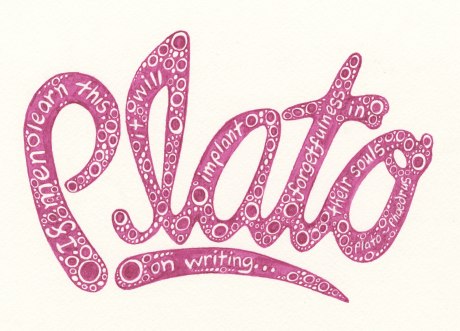
Plato… on writing, in “Phaedrus”: ‘If men learn this, it will implant forgetfulness in their souls… they will cease to exercise memory because they will rely on that which is written, calling things to remembrance no longer from within themselves, but by means of external marks.’ Design by Meredith Eliassen, 2016.
In the medieval world, there was no separate sphere for children; adults and the young had access to all common conversations that were part of the culture; a seven year old boy only differed from his father in his capacity to engage in love and war. The translation of sounds into letters and new visible symbolic objects radically altered the human consciousness: words could be read repeatedly and when individuals became literate, they could build upon recorded knowledge and advance thinking. When Aldus Manutius (1449-1515) began to mass-produce pocket-sized texts featuring italic type in 1502, this technology allowed humans to easily transport and share ideas. Media ecologists concur that with the print age, a consciousness of childhood as a distinct period of human development first emerged with a moral chiaroscuro of print media where the semantics of childhood was delineated by adult societal constructs of parenthood.
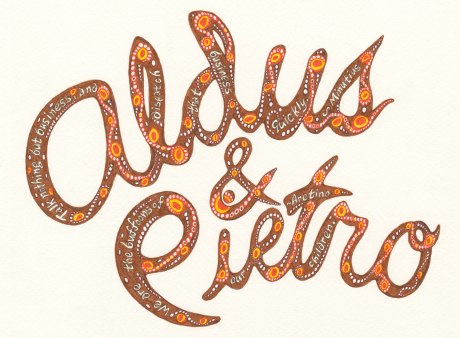
Aldus Manutius (1449-1515) established his printing house in Venice in about 1490. The Aldine Press was a corporate entity; the entrance placard conveyed the proprietor’s eithic: “Talk of nothing but business; and dispatch that business quickly.” Pietro Aretino (1492 -1556) was an Italian author, playwright, poet, satirist and blackmailer who wielded immense influence on contemporary art and politics and developed early pornographic literature. He wrote “We are the buffoons of our children.” Design by Meredith Eliassen, 2016.
Giovanni Francesco Straparola, approximately 1460-1557 (roughly translates to “The Babbler”) is credited with having introduced the genre of fairy tale, including “The Puss in Boots,” into contemporary European literature. He published a collection of popular stories incorporating practical jokes, romances, and fables in the style of the Decameron in Venice in 1550. It passed through sixteen editions in twenty years and was translated into French and German. The frame story is that Francesca Gonzaga, daughter of Ottaviano Sforza, Duke of Milan, escapes the commotions in that city and retires to the island of Murano, near Venice, where surrounded by a number of distinguished ladies and gentlemen, she passes the time in listening to stories related by the company. Thirteen nights are spent in this way, and seventy-four stories are told, when the approach of Lent cuts short the diversion. These stories are of the most varied form and origin and many are borrowed without acknowledgment from other writers including Morlini, Boccaccio, and others. Twenty-nine of the tales are from Straparola; they had never appeared before in European literature, but they were in no sense original to Straparola. His work had no influence on contemporary Italian literature (and was actually banned in areas), and was soon forgotten.
Learn more about media ecologists from the Media Ecologist Association.
Angelou on the Semantics of Education
August 30, 2016
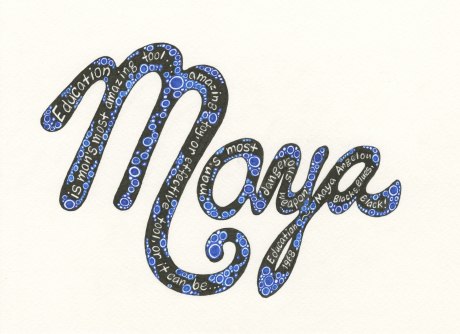
“Education is man’s most amazing tool… amazing toy, or effective tool, or it can be… man’s most effective weapon. Education” Maya Angelou “Blacks, Blues, Black!,” 1968. Design by Meredith Eliassen
“Blacks, Blues, Black!” (Episode 6: Education)
Conversely, Native Americans in California used baskets as if they are extensions of the human body; infants were immersed in water-holding baskets as they get immersed in culture. Basket makers are engineers who create amplified baskets from spiritualized raw natural materials; as children learned gendered tasks related to basket and net making, they learned cultural values. Here we perceive the concept of ecology as the study of environment and how its structure and content impact human beings. When the United States government attempted to eradicate the tribes in southern Oregon, they destroyed functional Native American baskets as a war tactic. In southern Oregon, during the Rogue River Indian War (1855-1856), vigilantes and army troops attacked Tututni villages employing a military tactic to undermine tribal stability by destroying all baskets and their contents that were use in every aspect of life, because without baskets, the tribes were unable to survive (See note).
In medieval European England, Biblical translator and reformer John Wycliffe (1338-1384) came to regard the scriptures as the only reliable guide to the Truth that came from God. Wycliffe maintained that all Christians should rely on the Bible rather than on the teachings of popes and clerics. He said that there was no scriptural justification for the papacy. In keeping with Wycliffe’s belief that scripture was the only authoritative reliable guide to living a good life, he became involved in efforts to translate the Bible into English as a means of empowering the common folk. Wycliffe asserted that not having English-language Bibles meant that it was not accessible to laypeople, therefore the common people were being deprived of God’s Word because it was written in the language of a foreign people.
Note: Stephen Dow Beckham, Requiem for a People: The Rogue Indians and the Frontiersmen (Norman: University of Oklahoma Press, 1971), 27.
Oh yes, gotta’ have more from Bill…
August 18, 2016
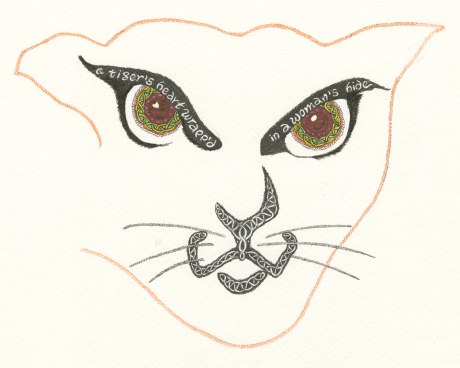
“O Tiger’s heart wrapp’d in a woman’s body.” King Henry IV, Part III: York’s monologue: words by William Shakespeare, design by Meredith Eliassen, 2016.
More from Dante…
August 4, 2016
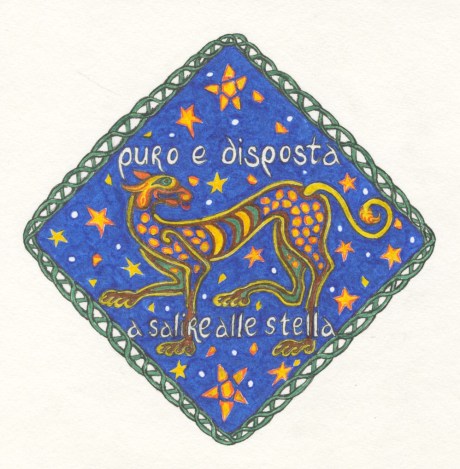
Dante Alighieri (1265-1321) “Puro e disposta a salire alle stella=Pure and disposed to mount unto the stars.” Purgatorio, canto 33, 1, 145. Creature of Celtic design, by Meredith Eliassen, 2016.
More Shakespeare…
June 28, 2016
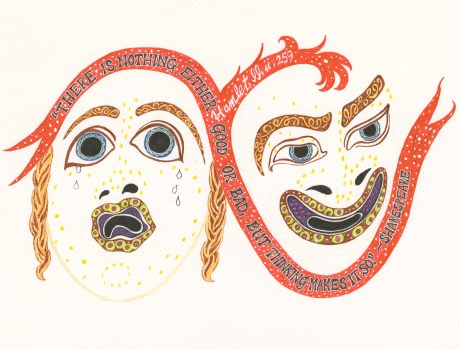
“There is nothing either good or bad, but thinking makes it so.” Words by William Shakespeare in Hamlet, act 2, scene 2, design inspired by the Tragic Comic Masks in the Hadrian’s Villa mosaic drawn by Meredith Eliassen, 2016.
TRUTH.
May 15, 2016
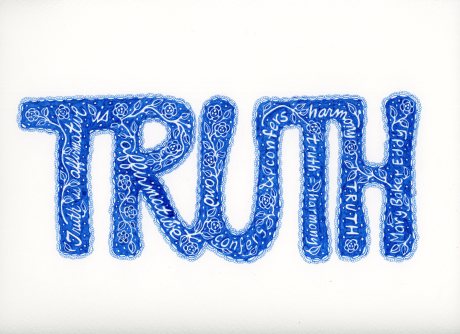
Inspired by a statement by Mary Baker Eddy found in Science and Health with Key to the Scriptures (418:20): “Truth is affirmative, and confers harmony.” Design by Meredith Eliassen, 2016.
Cleaning House
March 30, 2016
Chaucer’s got it right, in taking care of our own business, we demonstrate our truth.
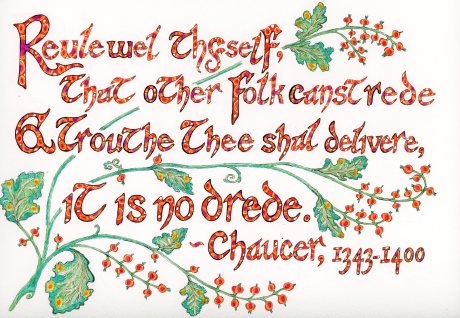
“Ruele wel thyself, that other folk canst rede and trouthe thee shall delivere, it is no drede.” Quote from Geoffrey Chaucer, 1343-1400, drawing inspired by illuminated manuscript by Meredith Eliassen, 2016.
I will be taking a brief hiatus to clean house and should return in May. Thanks for visiting this blog. I look forward to more adventures in the future.
Wild Thing…
March 24, 2016
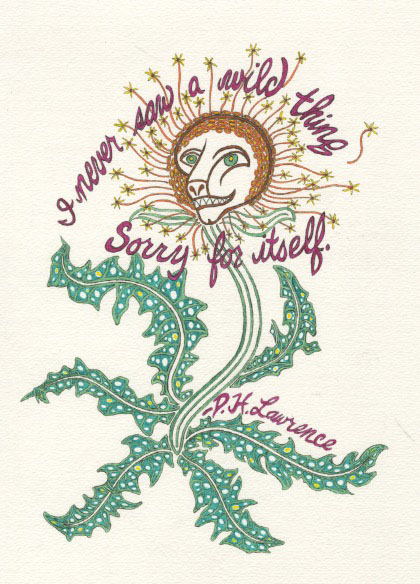
“I never saw a wild thing sorry for itself.” Quote by D. H. Lawrence, drawing by Meredith Eliassen, 2017.
Dante… on Love
February 11, 2016
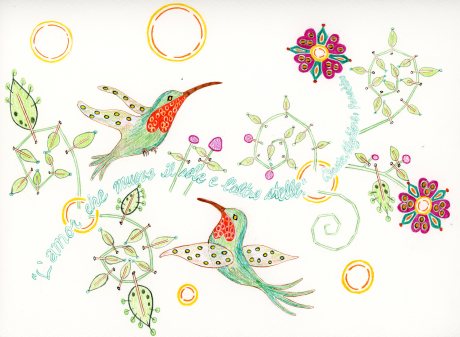
“L’amor che muove il sole e l’altre stelle.” (The love that moves the sun and the other stars.) from “Paradiso” by Dante Alighiere, 1265-1321. Image motif inspired by a card design by Robbin Rawlings. Drawing by Meredith Eliassen, 2016.
 MME Designs's Weblog