There is no place like home…
April 9, 2018
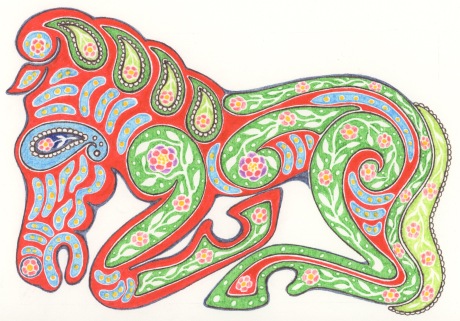
A little red pony from the magician’s shadow box inspired by an ancient carving of a reclining horse found at a burial site at Tuva, Siberia, design by Meredith Eliassen, 2018.
Lydia Maria Child (1802-1888) in her story called, “The Magician’s Shadow Box,” explores human wanderlust with a protagonist named Gaspar. Exposed to progressive international objects and ideas in the small ordinary village where he lives, Gaspar becomes frustrated and runs away into the forest where he is confronted with the natural world. At a first milestone, he throws a stone at a bullfrog that croaks and dives for safety into a nearby pond. At a second milestone, Gaspar unthinkingly throws a pebble at a bird that takes flight, releasing an apple from a tree. Child suggests that Gaspar does not intent to harm these creatures; he has just been thoughtless. At a third milestone, Gaspar meets a mysterious little man cracking chestnuts that for some reason he just cannot pass. Try as he may, the little man will not let Gaspar pass until he has shown him the objects in his little carved shadow box. The little man asserts: “Come now, it is foolish for you to go trudging about all over the world. You will never see anything more than pollywogs and sandflies, and those you can find in your native village…”
Gaspar takes the little man’s chestnuts and returns home. He exchanges them for a horse that he believes will carry him out into a bigger world. However, the horse he receives is mechanical and does not have a soul. Once on the horse, Gaspar finds himself on a journey from which he cannot stop or disembark to explore what his heart truly seeks. Gaspar again returns to his village with a collection of epic imaginings and opens his own curio museum curated with his own creative imaginings. Everyone is very impressed, except for a girl named Hope who has her own take on things. Gaspar takes Hope to meet the little man with the chestnuts, and Hope offers him sprits (wine) for a glimpse at his treasure trove, but she is not impressed. Hope observes: ‘All very pretty, but rather stiff and monotonous… not so good as you can paint, Gaspar. Come, let us go home.”
Source: Lydia Maria Child. (1856). “The Magician’s Shadow Box” The Magician’s Shadow Box and other stories. Boston.
Child translating within a natural context
April 6, 2018
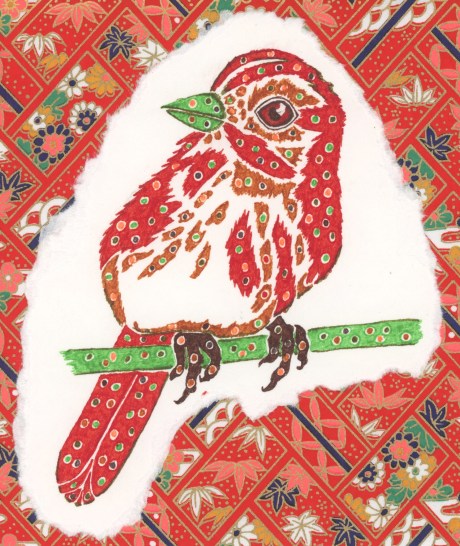
Lydia Maria Child sought to reform with inherited literary genres. Rose Marian and the Flower Fairies is a translation of a German legend about a fifteen-year-old girl named Marian who lives in a verdant mountain community, and Marian who relates more to nature than to other humans. Bird drawing mounted on Japanese paper, by Meredith Eliassen, 2018.
Purchase red songbird notecard here.

Having no playmates, Marian talks to the flowers, “as if they were intelligent beings, that can understand her words (11).” When Marian’s mother dies, she perceives that she has become an angel, “gone to dwell with celestial beings (18).” Marian refuses to leave the side of her mother’s grave and the doctors soon observe, “If she keeps ever wakeful, and this profound melancholy continues, she will certainly become insane (23).” Flower drawing mounted on Japanese paper, by Meredith Eliassen, 2018.
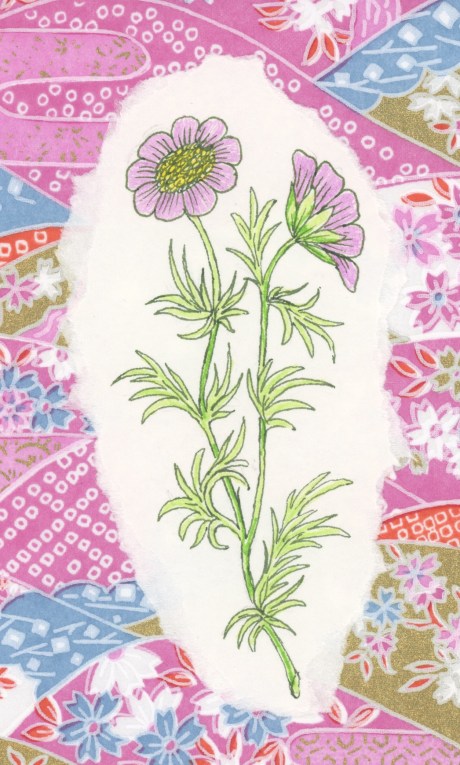
The flowers seek to console Marian until a beautiful benevolent spirit came upon them smiling and said, “Beautiful and fragrant ones, be not afraid of me, I come to ask your assistance in conveying the good young princess to a happy home, where she will never more know trouble (24).” The flowers assist by giving up their fragrances to create a concoction that helped Marion to sleep eternally. Flower drawing mounted on Japanese paper, by Meredith Eliassen, 2018.
With the Civil War, Child’s hard-hitting career was eclipsed, but her writing became more relevant as it holistically prescribe character development within divergent audiences. After Abraham Lincoln announced the drafting of an Emancipation Proclamation in late September 1862, Harriet Beecher Stowe (1811-1896) called on Mary Lincoln in New York City to request an invitation to the White House. Lincoln met Stowe and supposedly greeted her with the comment, “So you’re the little woman who made this Great War.” When news of the Emancipation Proclamation arrived on January 1, 1863, Stowe was attending a New Year’s Jubilee celebration at the Boston Music Hall. The crowd gave Stowe a standing ovation.
The Civil War changed the tone of all children’s literature to depict changing patriarchal gender roles as soldiers left wives and widows to head households. Post-bellum juvenile literature reflected new sensibilities as characteristics of “childhood” and attitudes towards what constituted “worthy poor” changed. Sentimental stories with absent father figures always featured a male figure, who appeared to rescue a disabled girl. Child’s stories, like Rose Marian and the Flower Fairies (1865) translated from a German legend presented a feminine, nature-centered view. In children’s literature, more sentimental concepts of girlhood and female adolescence emerged out of the Civil War. Northern publishers developed lucrative family markets; so American literature achieved an economic boost after the war. The phenomenon of girl and family stories (or domestic novels) written by female authors reflected the development of a middle-class domestic audience that became pivotal to American literary history. These authors projected their own desire for societal change into their juvenile female characters and subsequently on young readers.
Exploring Child’s animal landscapes
April 4, 2018
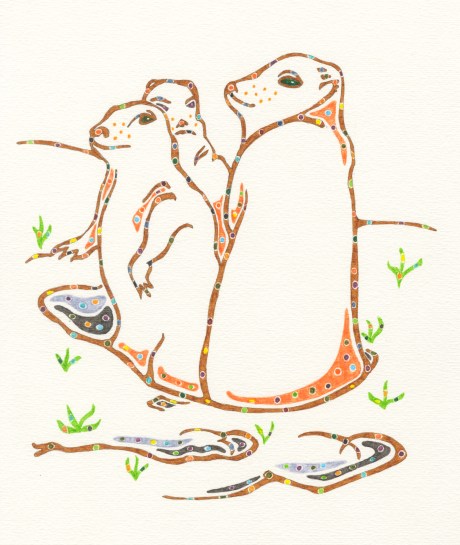
In a story featuring a strong Native American female character, Lydia Maria Child suggested that animals have alternative societies. This drawing of prairie dogs, inspired by the story “Willie Wharton,” is by Meredith Eliassen, 2018.
Lydia Maria Child’s fictional character of young Willie Wharton is sensitized to nature and creatures of the prairie including moles, squirrels, and prairie dogs. Child positioned children as closer to God, therefore, closer to nature. She also perceived that animals had indigenous societies. When Wharton brought a Native American girl home, he asserted, “She’s my girl. I found her.”
Child relied upon moral suasion to foster humanitarian awakening; she sought to reform with inherited literary genres. A family on the prairie sets aside contemporary biases to take in a Native American girl, and not understanding her cultural background, they treat her like a pet until her family came to collect her. While Child’s language seems racist by today’s standards, her logic was actually powerfully progressive for her times suggesting that you treat all living creatures with kindness.
During the Civil War, the U.S. Army’s California Volunteers deployed resources in response to the “General Order, No. 4,” issued on April 9, 1862, which supported a movement to kill adult male California Indians so that women and children could be sold into slavery for profit: “Every Indian captured in this district during the present war who has engaged in hostilities against whites, present or absent, will be hanged on the spot, women and children in all cases being spared.” As late as 1867, even after Congress passed the Thirteenth Amendment outlawing involuntary servitude, some vigilantes in far northern California continued the murdering, kidnapping and maintenance of an illicit slave trade in California Indians even as the sale of Chinese-American women into slavery continued.
In the story, Child reiterates a theme she earlier explored in The Little Girl’s Own Book, where she discourages children from taking non-domesticated animals in as pets:
“It is a good rule to keep only such animals as are happier for being domesticated; such as kittens, dogs, or pet lambs. I would not keep a robin shut up in a cage, for the price of fifty birds. Do what you can for him, you cannot make him half so happy as he would be abroad among the sunshine and the flowers. Canary birds must be kept in the house; because they came from the warm islands of Canary. And it would kill them to expose hem to our winter; but, kind little reader, if you have any feathered prisoners, which belong to our own climate, I beg of you to open the door and let them fly the first bright day the next spring. I have likewise an objection to keeping rabbits and squirrels; because I am sure they are not so happy as they would be in their native woods.”
Sources: Lydia Maria Child. “Willie Wharton” Atlantic Monthly 11 (March 1863): 324-345 and “On Keeping Animals,” The Little Girl’s Own Book. New York: Edward Kearney 1843: 242.
Critter transformations and character development
April 2, 2018
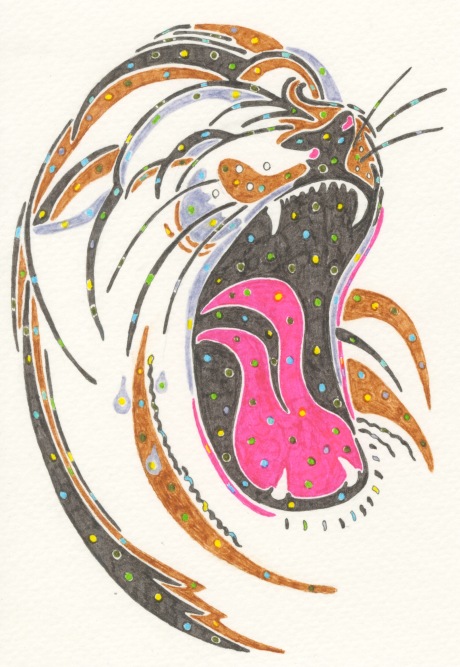
Grizzly Tom inspired by Lydia Maria Child’s story “Pussy Malta and Grizzly Tom,” written specially for Our Dumb Animals 2: 11 (April 1870): 105. Design by Meredith Eliassen.
This story is an account of two cats that Child encountered while boarding with Joseph and Margaret Carpenter and their Quaker family while her husband David dealt with debts from a lawsuit during the 1830s. The Carpenters operated a farm and interracial household in an isolated area near New Rochelle, New York that was a stop in the Underground Railroad. The family had two cats, a slender, working, female Maltese cat names Pussy Malta and a cantankerous, infirm old cat named Grizzly Tom who had been a fixture on the farm since he was a kitten. The two cats had a fragile relationship because Tom was so disagreeable: “spitting and growling, clawing and scratching whenever he was not asleep.” Pussy Malta conversely was a hunter who was protective of her recent litter of three kittens whose eyes were still unopened. Pussy Malta kept a watchful eye on Tom while they both lapped up milk from the same trough to see what he would be up to next.
One day, Pussy Malta became very sick… and even with care, she only got worse and began convulsing. Tom, who had been asleep on the stoop heard her cries and went to see what was wrong. Tom immediately softened, laying his paw gently on her fur as if to say “I wish I could help you.” However, sadly, Pussy Malta died within the hour leaving her three kitten orphaned curled up on a piece of rug on Tom’s stoop.
Grizzly Tom assessed the situation as the mother cat grew cold and stiff, and returned to the stoop where he steadfastly watched over the brood like a foster father, protecting them until they were old enough to fend for themselves. What’s more, Grizzly Tom proved to be an extraordinarily nurturing parent, never deserting the kittens even though they often teased him, pulling his ragged fur and playing with his tail as he slept, all the while, never striking them a blow.
Timeline of Lydia Maria Child’s work
March 23, 2018
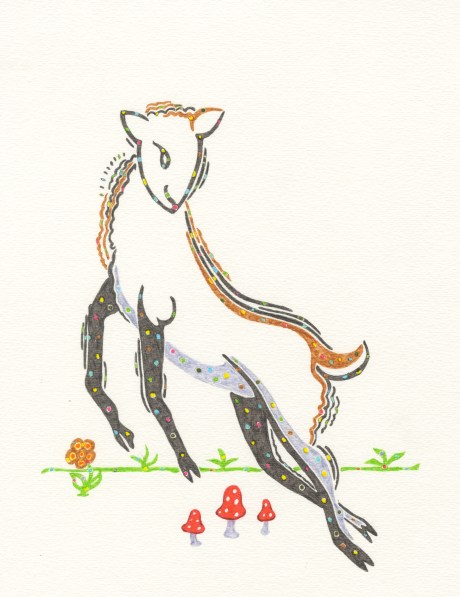
“Little girls should never feed animals with any new food, without asking advice of those who are experienced.” Quote from Lydia Maria Child, “On Keeping Animals,” in The Little Girl’s Own Book (243); design by Meredith Eliassen, 2018.
In the coming weeks I am going to explore works by a pioneering American author, Lydia Maria Child (1802-1888), who wrote stories about the importance of treating animals humanely. I will explore her logic within the contexts of changing times. Child began her career during the 1820s, and was well established by the 1860s as an activist on many levels. She was invited to author the preface to Harriet Jacobs’ Incidents in the Life of a Slave Girl on 1861, and wrote pioneering pamphlets supporting the abolition of slavery and Native American rights. The designs will stylistically mimic embroidery designs.
1812 – The New York Tract Society was established.
1814 – The New England Tract Society was established.
1815 – The Hartford Evangelical Tract Society was established.
1817 – The Hartford Evangelical Tract Society, as a result of the Battle for Baltimore in 1814, published Happy Poverty, or, the Story of Poor Ellen. Funds raised from the sale of this tract supported the operations of the Baltimore General Dispensary that aided persons in distress.
1820s and 1830s – Epidemics of small pox, yellow fever, and diphtheria swept the United States.
1821 – The first American high school, established in Boston.
1823 – Clement Clark Moore’s poem “A Visit from St. Nicholas” changes perceptions of Christmas from a German holiday to a gift-giving occasion in the United States.
1825 – The American Tract Society was established.
1826 – German educator Friedrich Fröbel’s The Education of Man, encourages parents to install mobiles in cradles to insure “occupation for the senses and the mind” to foster early child development.
1826-1834 – Child established the Juvenile Miscellany as the first American children’s magazine. Child had to give up editorial control because her reform work with the abolition movement, and her liberal views on Native Americans became too controversial.
1827 – Peter Parley’s Tales of America by Samuel Goodrich (1793-1860) is published. Goodrich created his pseudonym from Hannah More’s tract called “Parley the Porter,” and his innovative benevolent narrator revolutionized the didactic and historic narrative style for children’s literature.
1829 – Child’s The Frugal Housewife published.
1830s – Jacob Abbott (1803-1879), a Congregational minister, begins his “Rollo” series of instructional books and William Holmes McGuffey (1800-1873) begins his series of “Eclectic Readers.” Both authors shape American consciousness with their packaging or literature that teaches morality.
1830 – Child established and edited M. of Lowell gets her story “Blind Susan, or, The Affectionate Family” published in Juvenile Miscellany. This story graphically describes medical treatments for vision loss resulting from scarlet fever.
1831 – Child’s Mother’s Book is published. It is an early American prescriptive book for rearing children and contains a story about a young mother that is abusive to a cat.
1833 – Girl’s Own Book is published
1832 – Jacob Abbott’s The Young Christian, or, A Familiar Illustration of Principles of Christian Duties is published.
1838 – The American Sunday-School Union publishes their Union Spelling Book.
1845 – Child’s most remembered poem, “A Boy’s Thanksgiving Day” is published. It also appears in her Flowers for Children. II. For children from four to six years old. (New York: C.S. Francis & Co., 1845). Flowers for Children was published between 1844 and 1846.
1850 – Child’s translation of the German legend Rose Marian and the Flower Fairies is published. It is a transcendental romance about the death of an orphan.
1851-1852 – Harriet Beacher Stowe’s Uncle Tom’s Cabin is published in serial form, initially a family story, it was quickly rewritten for children, and like Pilgrim’s Progress was published in “words of one syllable” to be used as a primer.
1853 – Child’s biography of Isaac Tatem Hopper (1771-1852), an American Quaker abolitionist is published. Child devotes a section about his youth utilizing his relationships with animals to show how his consciousness is expanded.
1855 – At the women’s rights convention at Seneca Falls, N.Y., some women wear bloomers to draw attention to artificial distinctions created by restrictive clothing that limit daily physical activities for women.
1861-1865 – The American Civil War. The Little Pilgrim, a Northern Christian magazine for children is published.
1863 – Louisa May Alcott writes Hospital Sketches based upon her experiences as an Army nurse during the Civil War that leads to reform in military hospitals. This success paves the way for her to get Little Women published.
1865 – The United States establishes Christmas as a national holiday. With this shift, Americans begin the practice of exchanging handmade or inexpensive toys and gifts among a wide circle of acquaintances and charities.
1866 – The American Society for the prevention of Cruelty to Animals was established in New York City in 1866
1867 – Societies for the Prevention of Cruelty to Animals were established in Buffalo, New York, Pennsylvania, and Montgomery, Ohio.
1867 – Horatio Alger Jr. gets Ragged Dick published.
1868 – “An Act for the more effectual prevention of cruelty to animals,” (AB 421) was introduced to the California Legislature on March 28, 1868, and approved. California Governor Haight signed the Act into law on March 30, 1868, and it took effect on June 1, 1868. The San Francisco Society for the Prevention of Cruelty to animals was the sixth humane society to be formed in the United States and the first west of the Mississippi River after Massachusetts.
1870 – “Pansy” (Isabella MacDonald Alden, 1841-1930) publishes her most popular didactic novel for children called Esther Ried. Late in life she moved to the San Francisco Bay Area
1872 – Susan Coolidge (pseudonym for Sarah Chauncy Woolsey) published What Katy Did that became the first popular American children’s novel featuring a character with a spinal cord injury. The American Public Health Association is founded.
1873 – Mary Mapes Dodge becomes the editor of St. Nicholas magazine.
1874 – The Society of the Prevention of Cruelty to Children is established in New York.
1883 – Kate Douglas Wiggin writes the Story of Patsy to raise funds and awareness for the Silver Street Kindergarten in a working-class San Francisco neighborhood.
Still looking for that four-leaf clover…
March 16, 2018
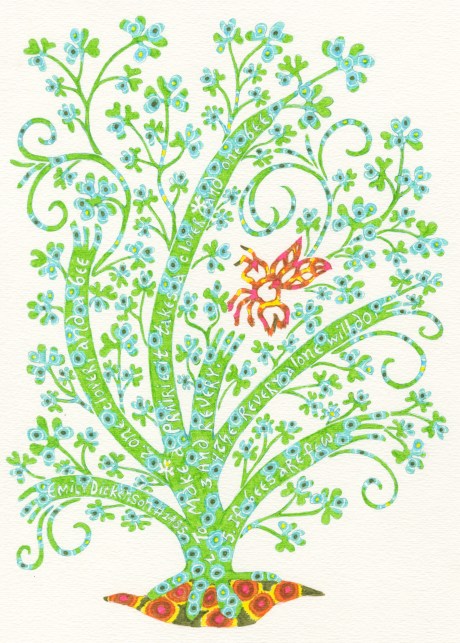
“To make a prairie it takes a clover and one bee, one clover and one bee, and revery. The revery alone will do, if bees are few.” Words by Emily Dickenson, No. 1755, design with one four-leaf clover by Meredith Eliassen, 2018.
The Rat with a Bell… a fable
February 21, 2018
There was an old country house that was infested with rats and nothing could be secured from their depredations. The vermin scaled the walls to reach the farmer’s bacon hanging from the ceiling and hanging shelves offered no protection for the cheese and pastries. The preserves and sweetmeats were no safer in the pantry, the rats gnawed through cupboard doors, undermined floors, and ran races behind the wainscots.
The cats could not reach them, the vermin were too clever and too well fed to bother with poisoned bait, and traps only caught a few heedless stragglers. However, the farmer caught one of these stragglers and fitted him with a small bell and then let him loose.
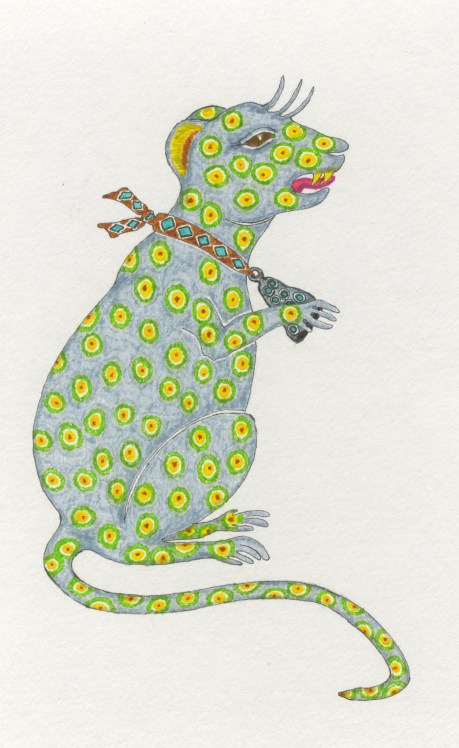
Moral: He who is raised so much above his fellow creatures as to be the object of their terror, but suffer for it in loosing all the comforts of society. He is a solitary being in the midst of crowds. He keeps them at a distance and they equally shun him. Dread and affection cannot subsist together. Design by Meredith Eliassen, 2018.
Overjoyed by his freedom, the rat ran into the nearest whole and searched for his companions. They heard the tinkle, tinkle at a distance and assumed it was an enemy in their midst and scattered in every-which way. The bell-bearer pursued, and soon guessing the cause of their flight, he was greatly amused. He chased his friends from hole to hole, and room to room, laughing all the while at their fears, even as he increased it by all means in his power. Soon he had the whole house to himself. He thought, “That’s right, the fewer, the better.” So he rioted alone and stuffed himself with goodies until he could hardly walk.
For two or three days, life was good. He ate and ate, until he grew tired of his lonely condition and longed for his old family and friends. The difficulty now was how to get rid of the bell. He pulled and tugged with his fore-feet until he nearly wore all of the fur from his neck, but all in vain. The bell was now his plague and torment, so the rat wandered from room to room searching for a companion, but they all stayed out of his reach At last, as he moped about in despair, he fill into a puss’s clutches and was devoured in an instant.
Source: John Aikin (1747-1822) and Anna Lætitia Barbauld (1743-1825), Evenings at home, or, The juvenile budget opened (New-York: Harper & Brothers, 82 Cliff-Street, 1839.) Barbauld was unable to publish because of her political stances, and collaborated with her brother to get this book published.
A nature parable… “Active and Passive”
January 23, 2018

The Weathercock was having a rough day… design by Meredith Eliassen, 2018.
“Restless life! Restless life!” moaned the Weathercock on the church tower by the seas as he felt the wind sway his direction suddenly. He creaked with dismay, “restless, toiling life, and everybody complaining of one all the time…”
An old woman hobbling towards the church lamenting: “There goes that tiresome weathercock pointing east… now I know why my rheumatism has returned!”
Then a farmer warned the old gravedigger: “Watch out Tomkins! If that rascally weathercock is to be trusted, the wind’s going to bring us rain.”
The steadfast weathercock was horrified that he was always to blame for the weather, and muttered to himself: “Am I to blame? Did I choose my lot? Do you think I would swing every which way if I had a choice?”
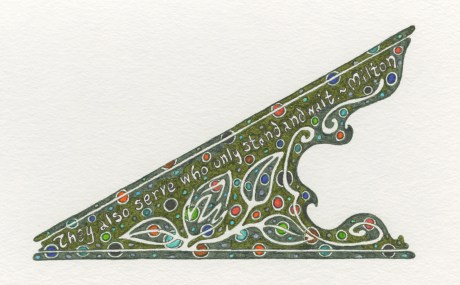
Gatty’s motto for this story: “They also serve who only stand and wait,” is from Milton, 1673 Poems, design by Meredith Eliassen, 2018.
From below, the sundial grumbled under his breath: “Oh, how he chatters away up there… he almost makes me smile.” Reflecting upon his day, “Not a ray of sunshine has fallen upon me today. I wonder what Ol’ Weathercock finds to interesting to talk about. His life is so active, no doubt. Oh, what I would not give to be like him.”
The weathercock looked down at his longtime companion the sundial with envy: “Ah, that’s the life!”
Dial heard his name whispered in the wind: Hello up there! Did you call? Is there anything fresh astir? I get so tired of the long dark useless hours. So come on now, what have you been talking about?”
“Nothing profitable,” replied the weathercock. “I am just grumpy.”
“But why?” Asked the dial. “Your life is so active and bright.”
Weathercock thought Dial was mocking him. “Look at me! Swinging with every peevish blast that crosses the sky. Turn here, turn there, turn everywhere… never a moment’s rest.”
The companions fell silent as humans started passing with their daily routines… pausing a moment to examine the sundial or the weathercock to get a sense of what was coming.
A sailor lingered near the dial and read its weathered motto: “Watch, for ye know not the hour.” He just hankered for a long afternoon to relax, and mentioned this to the gravedigger in passing. Tomkins responded: “You’ll be cured of the wish for idle afternoons when they are forced upon you… wait until you are old like me and then you will understand.” With good-natured goodbyes, the two parted ways leaving the churchyard empty of its living guests.
The sailor went home and warned his sons to keep a lookout for there have been signs of a strong gale arriving and with the high tide, there could be dangerous or even deadly conditions.
Meanwhile, the sundial observed, “Just as I thought, everything is wrong because everybody is so dissatisfied.
Soon the farmer’s wife saw the tracts of white foam, thick like snow fields, on the ocean, followed the breakers as they crashed upon the shore like claps of thunder. That night, a mighty storm – a hurricane – came and stalled over the coastal hamlet causing great fear, but the weathercock and the sundial stayed the course.
The weather eventually cleared and the sun shined brightly over the village and the sea with the brilliancy of spring. Because the villagers recognized the signs and prepared, nobody was hurt and damage was minimal, indeed, the dial and the weathercock were buffeted to the point of shining like new. Villagers look at them renewed gratitude, thinking: “What a mercy!”
Dial heard this and asked his friend: “Are you silent, Weathercock?”
“I was just thinking,” he replied. “I have a new sense of my own responsibility. I have the sensation that everything is useful in its own place and at all times, though humans may not always figure that out.”
The sundial beamed, “that was my impression as well.”
===
Source: Margaret Gatty (1809–1873) wrote about marine biology and was prolific children’s book author and editor who mentored her daughter Juliana Horatia Ewing (1841-1885) in her writing career. While Gatty’s tales were targeted for juvenile audiences, she hoped that they would influence the minds of adults as well. This story is from her Parables from Nature.
Rosamond’s Choice
January 18, 2018
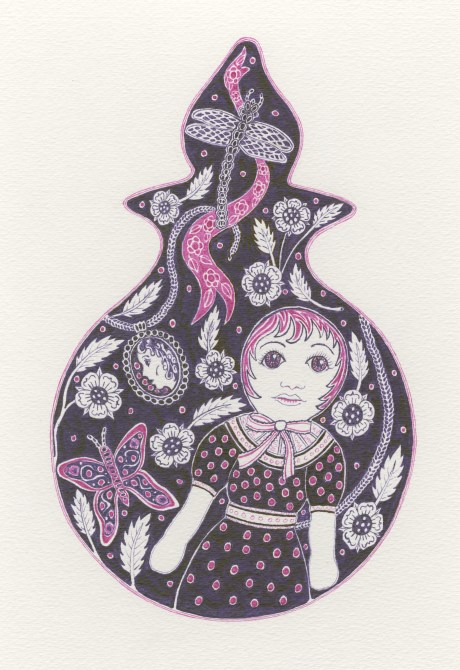
Design of the purple jar, inspired by consumer parable by Maria Edgeworth (1768-1849), by Meredith Eliassen, 2018.
Long ago, Rosamond, a little girl about seven years old, was walking with her mother. They passed many shops and she saw a great variety of things in the windows that were unfamiliar to her. Rosamond wanted to stop and look at them but the streets were crowded and she was afraid to let go of her mother’s hand.
As they passed a toy shop, she looked up at her mother and said, “How happy I would be if I had all of these pretty things.”
What, Rosamond… all!” Her mother exclaimed: “Do you wish them all?”
“Yes, all.”
Soon they arrived at a milliner’s shop that had windows decorated with ribbons, lace, and festoons of artificial flowers.
“Mommy, what beautiful roses! Won’t you buy some of them?”
“No, my dear.”
“Why?”
“Because I don’t want them, my dear.”
Next, they passed a jewelry shop that caught Rosamond’s eye. There were a great many baubles arranged in drawers behind the glass.
“Mommy, will you buy some of these?”
“Which one?”
“Which? I don’t know: any of them will do; they are all pretty.”
Yes, they are all pretty, but of what use would they be to me?”
“Use! Oh I’m sure you could find a use for them if only you would buy them first.”
“But I would rather find out the use first.” Her mother said.
“Well, then Mommy, there are buckles; you know buckles are useful things.”
I have a pair of buckles and I don’t need another. Her mother said and then walked on leaving Rosamond upset that her mother did not want anything.
Soon they passed an apothecary store that had some very interesting colorful things in the window that Rosamond had never seen before, but she did not know what the store was selling. “Oh Mommy, look at that!’ She cried, “Look, look! — blue, green, red, yellow, and purple!” What beautiful things? Won’t you buy some of these these?”
“What use would they be to me, Rosamond?
Rosamond pointed at a purple jar and said, “You might put flowers in them and they would look so pretty. I wish I had one of them.”
Her mother looked at her sternly. “You have a flower pot and that is not a flower pot.”
“But I could use it as a flower pot.”
“Perhaps if you examined it closer, you might be disappointed.”
“No, I am sure I want it.” Rosamond countered, “Perhaps you have no money.”
“Yes, I have money.”
“Mommy,” she said excitedly. “If I had money, I would buy roses, and boxes, and jewelry, and purple flower pots, and everything.”
Rosamond was obliged to pause in the middle her speech. “Oh, Mommy! Can we stop, I have a stone in my shoe and it is hurting me.”
“How come there is a stone in your shoe?”

Rosamond pointed at a big hole in her shoe. “My shoes are quite worn out, can you get me another pair?” Design by Meredith Eliassen, 2017.
Her mother looked closer. “Rosie, I don’t have enough money to buy shoes, and flower pots, and buckles, and boxes, and everything.
This was not what Rosamond wanted to hear, especially since her foot was starting to really hurt, obliging her to hop every other step, so that she could think of nothing else. Soon her mother brought her to a shoe store, and they entered it. The shoe store was full so the two had to wait for assistance. Rosamond was not very interested in the shoes because they appeared to be very drab and the store smelled of leather. Rosamond looked around and spotted a small pair of shoes: “These will do, they will just fit me find, I’m sure.”
Her mother went up to the shoes and observed: “Perhaps, but you cannot be sure until you have tried them on…” Adding, “Any more than you can be quite sure of that you would want the purple vase, until you have examined it more closely.”
Rosamond, a bit contrary today, quipped: “Why, I don’t know about the shoes, but I am quite sure that I would want the purple jar.”
Her mother saw the opportunity for a teaching moment, responded: “Well, dear, which would you rather have: that jar or a pair of shoes?”
“Mommy, can I have both?”
“No, not both.”
“Then I would like the jar.”
“Okay, but I will not give you another pair of shoes this month. Are you sure?”
With that, Rosamond paused. A month was a long time for a seven-year-old girl. She needed the shoes, yet the purple jar beckoned her. Her shoes were not that bad, they could be worn a little longer. “I can make the shoes last until the end of the month, don’t you think?”
Oh, my dear, I want you to think for yourself.” Her mother went off to inspect some shoes for her own needs, leaving Rosamond to ponder her options.
When she returned, “Well, Rosie, what have you decided?”
“I choose the flower pot… it will make me happy.”
Her mother paused, and then said, “Very well, you shall have it. Clasp your shoe and come home.” They stopped at the apothecary shop and requested that the jar be delivered, and continued on. The walk home was long as Rosamond was obliged to stop many times to remove stones from her shoe, and soon was limping with pain. However, her thoughts of the purple jar prevailed and she defended her choice again and again.
Once they arrived home, Rosamond immediately went into the garden to look for some flowers for the jar, anticipating its arrival. Hours passed before the jar was delivered, and when it came, she asked, “May I have it now?”
“Yes, my dear; it is yours.”
Rosamond, in her excitement, dropped the flowers onto the carpet and seized the purple flower pot. She lifted the top: “Oh Mommy! There is something dark in it that smell awful. What is it? I didn’t want this dark stuff!”
“Nor do I, my dear.”
“What should I do with it?”
“I don’t know.”
“But it is no use to me!”
“That, I can’t help!”
“I will have to pour it out and fill the jar with water for the flowers.”
“As you wish.”

Rosamond proceeded to empty the purple vase into the sink only to discover that when the vase was empty, it was no longer a purple vase. It was just plain white glass that appeared to be the beautiful color from the liquor with which it had been filled. Design by Meredith Eliassen, 2018.
Rosamond burst into tears.
“What’s the matter, my dear?” Her mother asked, somewhat mockingly. “It will be of as much use to you now as ever for a flower pot.”
“But it is not as pretty.”
“Didn’t I tell you to examine it more closely?”
To Rosamond’s chagrin, she was in no position to negotiate: “If I give you the flower pot will you get me the shoes, after all?”
“No Rosie, you have dumped its contents down the sink, the shop will not accept it as a return now. The best thing you can do now is to bear your disappointment with good humor.”
It was a long month, indeed.
Source: This story was based upon Maria Edgeworth’s parable called the “Purple Jar” (1796).
By Rose for Rose… a dreamcatcher
December 12, 2017
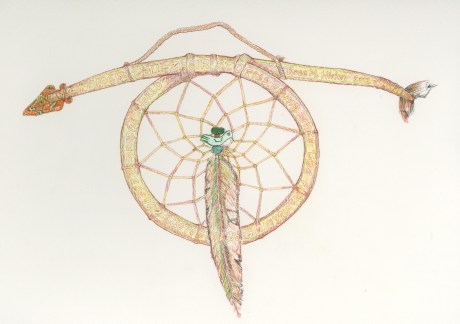
“Women tell their stories rising into the air along the edge of the world.” Rose M. Hickey, 2012.
 MME Designs's Weblog