Give that neighborhood tree a big hug!
October 3, 2018

Designed by Meredith Eliassen, 2018.
Mystery critter landed on my drawing board…
September 22, 2018
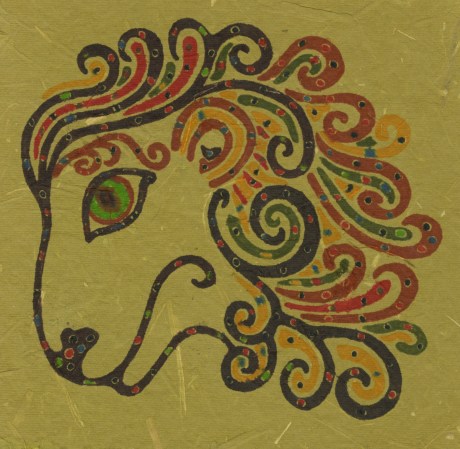
Drawing on handmade paper by Meredith Eliassen, 2018.
To those in Florence’s path….
September 17, 2018
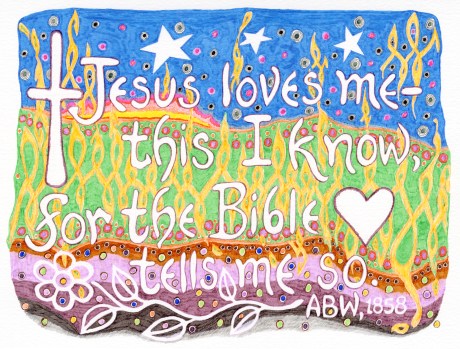
“Jesus Loves Me” is a hymn written by Anna Bartlet Warner (1827–1915) based upon 1 Corintians 6:18. The lyrics first appeared as a poem that her older sister Susan Warner (1819–1885) used in a novel called Say and Seal (1860), in which the words were spoken comfort a dying child. The Warner sisters often collaborated, and Susan is best remembered for her The Wide, Wide World (1850). “Jesus Loves Me” design by Meredith Eliassen, 2018.
A little Gospel may help, the tune is easy… Here are the complete lyrics:
Jesus loves me—this I know,
For the Bible tells me so;
Little ones to him belong,—
They are weak, but he is strong.
Jesus loves me—loves me still,
Though I’m very weak and ill;
From his shining throne on high,
Comes to watch me where I lie.
Jesus loves me—he will stay,
Close beside me all the way.
Then his little child will take,
Up to heaven for his dear sake.
It’s ol’ ABW… still teaching the fish to swim
August 24, 2018

Design by Meredith Eliassen, 2018.
“Piscem nature doces,” Latin proverb attributed to Dutch humanist Desiderius Erasmus Roterodamus (1466-1536) in his Adagia, meaning “you are teaching a fish to swim.”
Beloved friends, be safe…
August 23, 2018
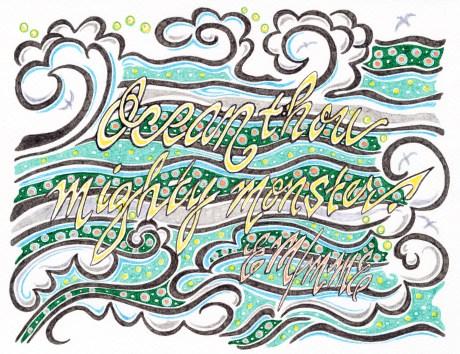
“Ocean thou mighty monster,” designed by Meredith Eliassen, 2018.
Preface to tone poem by Edward MacDowell (1860-1908) called To the Sea, which delineated a tonal oceanscape with its magnitude, mystery, and vast beauty.
Explorations with Interaction of Color
August 20, 2018

European 1: Visual memory is not very good. Humans discern color less effectively than audio and many know only about thirty colors. Design by Meredith Eliassen, 2018.
Minium, red sulphide of lead, was commonly used for small initials in illuminations and inspired the name for a genre of miniature painting: miniare –> miniature.
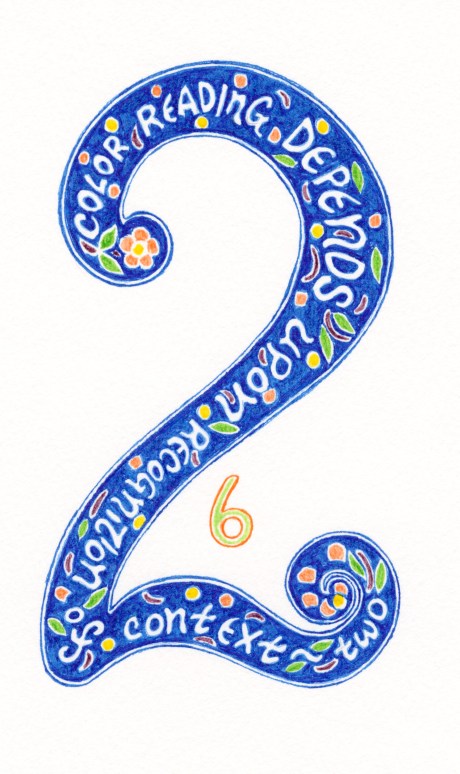
European 2: Reading color is contextual because we perceive color within spatial contexts. The interaction of color is seeing what happens between adjacent colors. Gestalt psychology asserts that human behave and perceive in unified patterns, the parts of which cannot be understood in isolation. Design by Meredith Eliassen, 2018.
Blue is often associated with mourning. During the Middle Ages, many gothic churches were colored with blue because it was thought to reflect the divine. For this reason, many portraits of the Virgin Mary have her donning robes of vibrant blue.
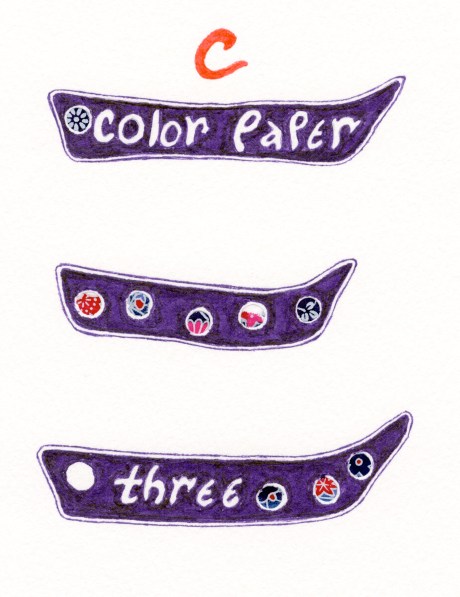
Chinese 3: Albers had students utilize color papers to do exercises so that they focused on the interaction of color rather than mixing colors. Design by Meredith Eliassen, 2018.
Purple, blending red and blue, for many cultures, signifies power, it is not very visible in the color spectrum even though violet reflects the very shortest spectral wavelength that humans can see.
The Many Faces of Color…
August 15, 2018
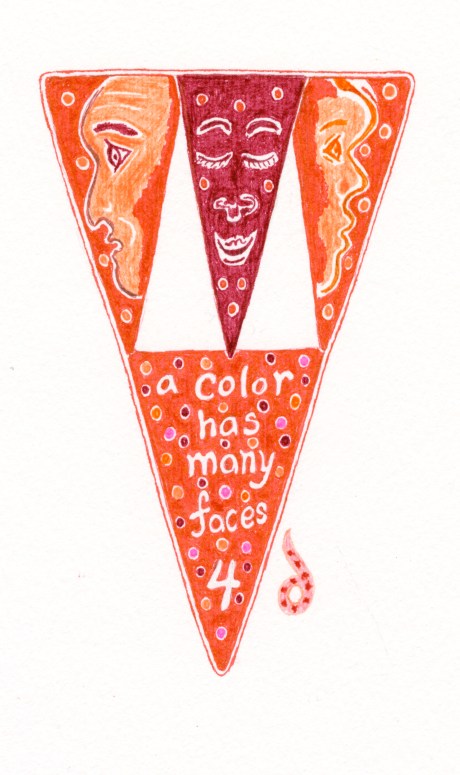
Babylonian 4: a color has many faces that are reflected in experiences that are relative in nature. Observations of color within different contexts creating deceptive optical illusions. Design by Meredith Eliassen, 2018.
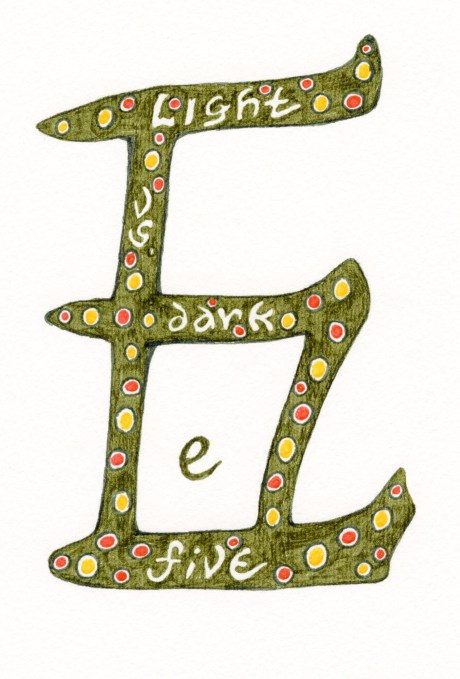
Chinese 5: Our eye’s ability to adjust its retina is a means to adjust to higher or lower light condition; when seeing gradual gradations between light and dark, humans are often unable to distinguish between subtly lighter or darker colors so that some shades of gray get lost. Design by Meredith Eliassen, 2018.
Deceiving color
August 14, 2018
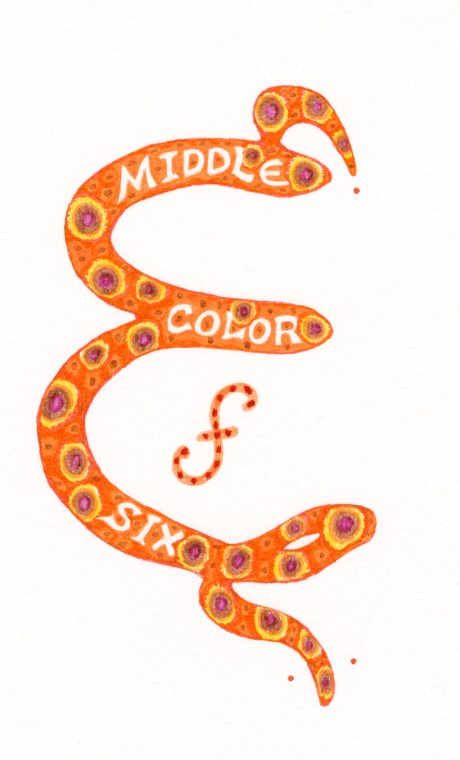
Hindu 6 illustrates the concept of middle color to show that color performs simultaneous functions. Design by Meredith Eliassen, 2018.
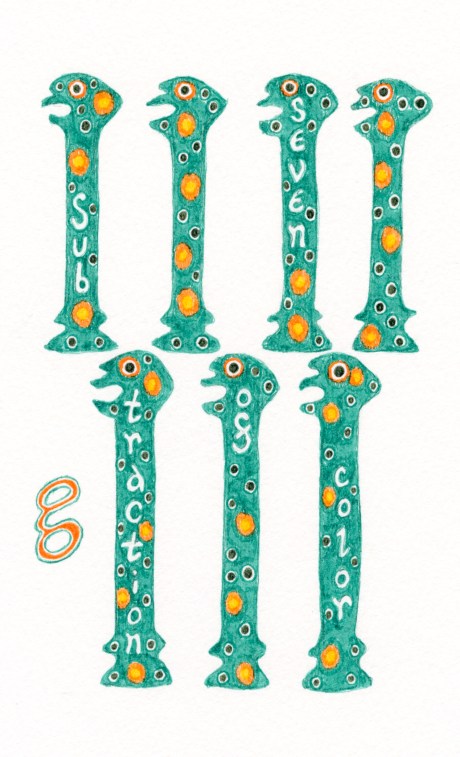
Ancient Egyptian 7 illustrates the concept of the subtraction of color to show that color can perform many roles. Design by Meredith Eliassen, 2018.
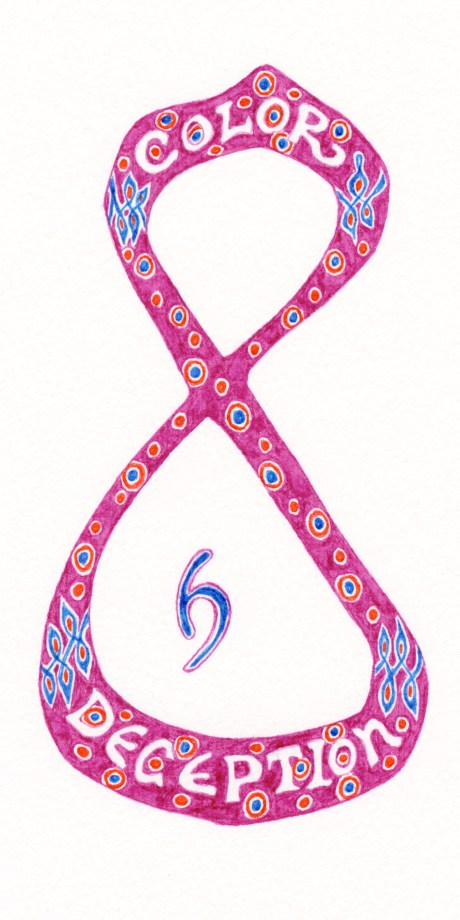
Ancient Roman 8 illustrates after-image color deception. The human retina receives three primary colors (red, yellow, or blue); by staring at the red, it becomes fatigued and sensitive to red sections so that a subsequent sudden shift of focus to white will cause the mine to perceive red’s complimentary color. Design by Meredith Eliassen, 2018.
To purchase other designs as cards from Zazzle.
Color’s illusions…
August 13, 2018
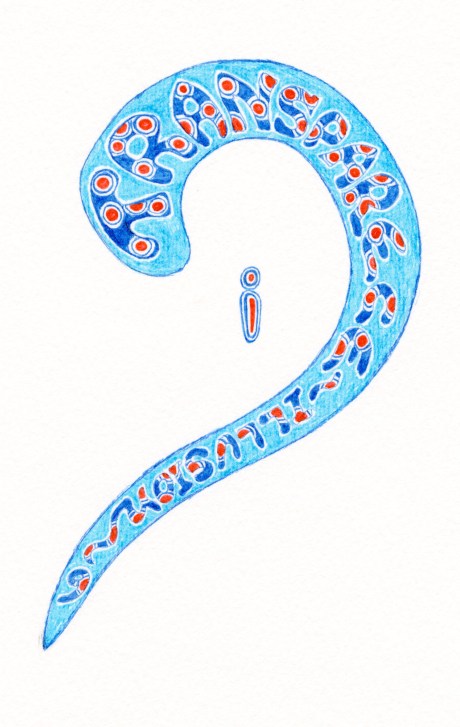
Ancient European 9, circa 12th century illustrates the illusion of transparence when color mixture leads to a loss of opacity so that it appears transparent or translucent. Design by Meredith Eliassen, 2018.
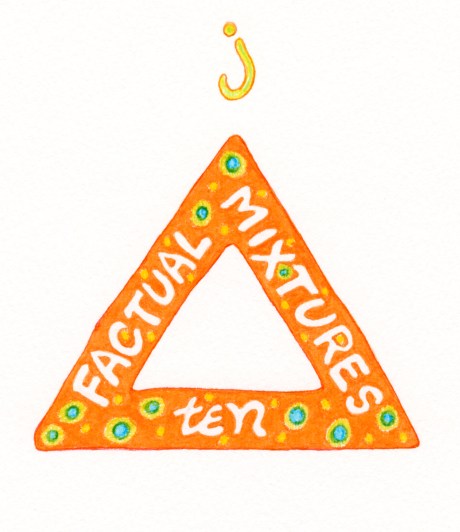
Greek 10 shows that transparent illusions occur as color gains light only in direct color.
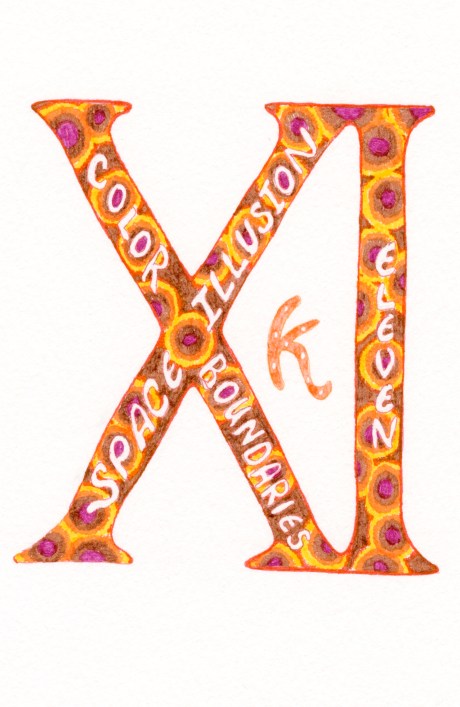
Roman 11 illustrates color boundaries and plastic action, a space-illusion employed by Paul Cézanne (1839-1906), design by Meredith Eliassen, 2018.
The Impressionists….
August 10, 2018
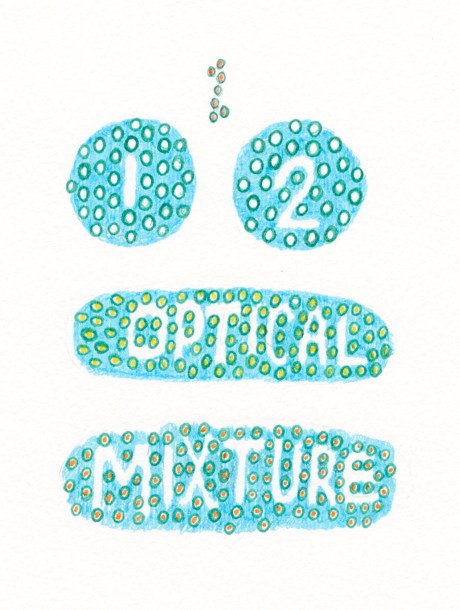
“Mayan 12” illustrates optical mixture where color dots change other colors by merging into a new color, which was used by Impressionists. Pointillism is a technique of painting in which small, distinct dots of color are applied in patterns to form an image. Georges Seurat (1859-1891) and Paul Signac (1863-1935) developed the technique in 1886, branching from Impressionism. Design by Meredith Eliassen, 2018.

“Mayan 13” illustrates the Bezold Effect, another optical illusion, named after a German professor of meteorology, Wilhelm von Bezold (1837–1907), who discovered that a color may appear different depending on its relation to adjacent colors, which happens when small areas of color are interspersed. Design by Meredith Eliassen, 2018.
 MME Designs's Weblog