The Medium of Drugs… Childhood of the 1960s Counterculture
September 27, 2016

“San Francisco was where children were gathering and calling themselves ‘hippies’.” Observation by Joan Didion, 1968; design by Meredith Eliassen, 2016.
The Hippie movement directly impacted a minority counterculture group, but had tremendous implications for the entire American society. Benign neglect, drugs, open and alternative sex practices, young parents, new communal family configurations, and no discipline shaped a generation. Events during the Summer of Love in 1967 were fluid, loosely organized around the music and drug scene. Marijuana was the common drug of hippies while LSD was used on special occasions as a catalyst for mysticism. Well-educated men cultivated this environment by creating a mystique about drug-culture as a rite of passage for Flower Children. Oregon-born Ken Kesey (1935-2001) spread a drug gospel, claiming that under the right conditions LSD made users feel like they were in the Garden of Eden. For Leary and Kesey who were mature, the use of LSD was a social experiment, but for naive Flower Children, drugs became an initiation or opportunity to surrender self.
The Summer of Love was a youth movement that presented history with ironic dichotomies of childhood. Intellectuals may have organized the events, but uneducated youths gave it life and fuel. Folk and electric rock musicians fostered the image of the “Hippie” and the “Flower Child,” while the Scott McKenzie and John Phillips song, “San Francisco (Wear Some Flowers in Your Hair),” beckoned disenfranchised teenagers and college students to leave their families and come to San Francisco. The Summer of Love was supposed to be the dawning of a new era of youth and virtue, but it also brought venereal disease and infections for thousands of transient youths searching for a substitute for familial love.
From its inception, the Summer of Love was intended to be a rainbow-ing event full of color and heightened senses. It was actually a male-driven, male-dominated movement that placed young females outside of familiar boundaries, and changed the familial dynamics for a generation. Art posters depicted voluptuous earth goddesses, while photographs by Gene Anthony and Elaine Mayes recorded women in subservient positions sitting on mattresses (sometimes holding babies) on the floor with men standing in the foreground. The Summer of Love also presented a volatile stage for exploring gender and sexuality – a Vanity Fair for runaway youth. Hippie children, often the offspring of young parents, suffered with the benign neglect, no safe boundaries, and no inhibitions when parents refused to take on adult roles and transient adults created ambiguous situations that could be opportunities predatory sexual behavior.
For a beautiful San Francisco Sunday…
September 25, 2016
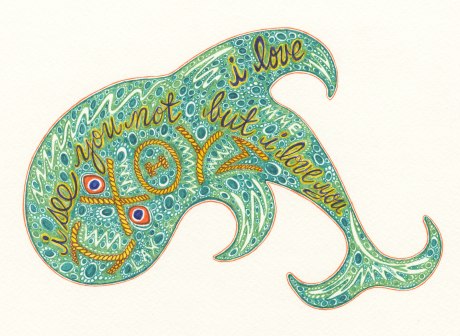
ICHTHYS: “i see you not but i love you i love” words from Robert Lax (1915-2000) from “In the Beginning was Love: Contemplative Words of Robert Lax,” edited with an introduction by S. T. Georgiou (2015), design by Meredith Eliassen, 2016.
Who is this Lady Luck?
September 22, 2016
My mother has been telling me about the “lady friend” of Lucky the Lizard for several months now… and she always refers to her as Lady Luck. This past weekend she finally described Lady to me in a way that I could picture her. Though the description changes with Lady’s mood and backdrop from her having gray and black stripes to Pokka dots remains the same… I am not yet convinced that she is part of Lucky’s posse, because she is reportedly pissed whenever he goes on his travels… whatever.
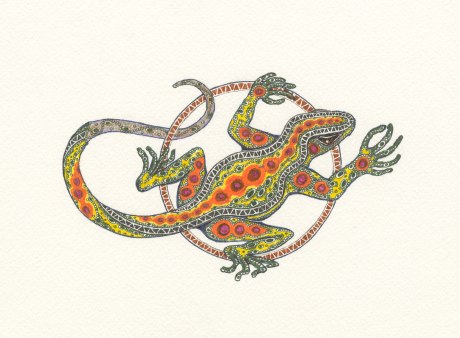
Lady Luck, a lizard in Sedona, Arizona, as seen by Meredith Eliassen, 2016.
The one constant in descriptions of Lady’s tail… you see… is that she lost it and it grew back gray. Nobody knows the story, and she won’t tell. Maybe a hawk stole it, or a lightening bolt hit her, or she was not fast enough in exiting my parents’ place and one of the poodles took a bite out of her (though they are both gentlemen, really…) Whatever her story might be, her tail grew back, you see, and life goes on…
As this description filled my thought, a true picture emerged of Lady Luck as a survivor in the desert, as the lizard that captured Lucky’s heart when he first saw her in the light of morning dawn as she perched on the Red Rock. Not only was her tail regrown but she was transformed into a critter, more strong, more beautiful, and energized.
Natural childhood? or marketed childhood…
September 21, 2016

“Brother Buzz” design by Meredith Eliassen, 2016.
The Latham Foundation to promote Humane Education was established in 1918 to foster in children a better understanding of the importance of treating animals well. The character of Brother Buzz (an elf in the form of a bee) was created to appeal to children and teach them about animals. Brother Buzz appeared first in print form in 1927, then on radio in the 1930s during the Great Depression, and then local television as World War II veterans opened up the broadcasting industry. The Wonderful World of Brother Buzz (1952-1969) was the longest running locally produced children’s program in the San Francisco Bay Area and the first to feature a puppet promoting the humane treatment of animals.
American pediatrician Benjamin Spock (1903-1998) revolutionized child rearing and childhood with his book Common Sense Book of Baby and Child Care (1946) that promoted a kind of permissive parenting when it asserted to mothers, ”You know more than you think you know.” Spock brought about major social change in childhood as young mothers in the post-war years relied more upon his marketed advice than upon family advice. American psycho-historian Lloyd deMause in examining the overarching psychological motivations of childhood through history found that Spock was part of a movement that asserted that the child “knows better than the parent what it needs at each stage in life.” While this perhaps gave parents the opportunity for nostalgic visits to childhood through their children, and the opportunity for children to be more independent to express views, it also subverted traditional safety boundaries. It would also bring in huge profits for baby and children’s stores lasting from approximately 1948 until 1970 when the baby bust occurred.
Wait… wait… wait… act…
September 14, 2016

“wait * wait * wait * act * wait * — * the * rhythm * of * things * — * make * it * a * song * & * it * will * be * come * one * — * lis * ten * lov * ing * ly * to * the * mu * sic * slow * ly * joy * ous * ly * join * the * dance” inspired by the words of Robert Lax, dancing being designed by Meredith Eliassen, 2016.
The Ancients and Media Ecology
September 12, 2016
Child culture has to some extent always been an adult societal construct since children are dependent upon adults as this stage. Lydia Maria Child, 1802-1880 wrote in the preface of her The Mother’s Book (1832): “We are told that when Antipater demanded of the Lacedemonians fifty of their children as hostages, they replied that they would rather surrender fifty of the most eminent men in the state, whose principles were already formed, than children to whom the want of early instruction would be a loss altogether irreparable (vii).”
Marshall McLuhan (1911-1980) asserted that three inventions were vectors for successive social transformation: the written phonetic alphabet carried humans from tribal to literate society; the printing press carried humans from literate to print society; and the telegraph carried humans from print to today’s increasingly electronic society by progressively arousing different brain patterns over generations that are distinctive to each particular form of dominant communication.
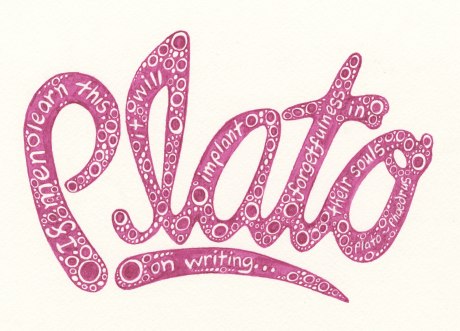
Plato… on writing, in “Phaedrus”: ‘If men learn this, it will implant forgetfulness in their souls… they will cease to exercise memory because they will rely on that which is written, calling things to remembrance no longer from within themselves, but by means of external marks.’ Design by Meredith Eliassen, 2016.
In the medieval world, there was no separate sphere for children; adults and the young had access to all common conversations that were part of the culture; a seven year old boy only differed from his father in his capacity to engage in love and war. The translation of sounds into letters and new visible symbolic objects radically altered the human consciousness: words could be read repeatedly and when individuals became literate, they could build upon recorded knowledge and advance thinking. When Aldus Manutius (1449-1515) began to mass-produce pocket-sized texts featuring italic type in 1502, this technology allowed humans to easily transport and share ideas. Media ecologists concur that with the print age, a consciousness of childhood as a distinct period of human development first emerged with a moral chiaroscuro of print media where the semantics of childhood was delineated by adult societal constructs of parenthood.
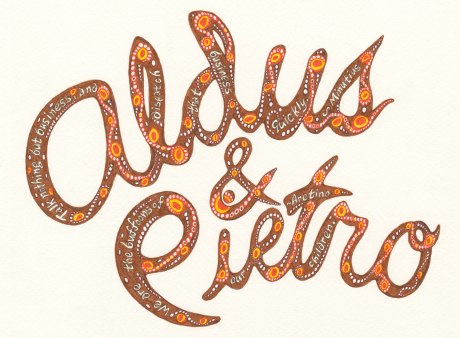
Aldus Manutius (1449-1515) established his printing house in Venice in about 1490. The Aldine Press was a corporate entity; the entrance placard conveyed the proprietor’s eithic: “Talk of nothing but business; and dispatch that business quickly.” Pietro Aretino (1492 -1556) was an Italian author, playwright, poet, satirist and blackmailer who wielded immense influence on contemporary art and politics and developed early pornographic literature. He wrote “We are the buffoons of our children.” Design by Meredith Eliassen, 2016.
Giovanni Francesco Straparola, approximately 1460-1557 (roughly translates to “The Babbler”) is credited with having introduced the genre of fairy tale, including “The Puss in Boots,” into contemporary European literature. He published a collection of popular stories incorporating practical jokes, romances, and fables in the style of the Decameron in Venice in 1550. It passed through sixteen editions in twenty years and was translated into French and German. The frame story is that Francesca Gonzaga, daughter of Ottaviano Sforza, Duke of Milan, escapes the commotions in that city and retires to the island of Murano, near Venice, where surrounded by a number of distinguished ladies and gentlemen, she passes the time in listening to stories related by the company. Thirteen nights are spent in this way, and seventy-four stories are told, when the approach of Lent cuts short the diversion. These stories are of the most varied form and origin and many are borrowed without acknowledgment from other writers including Morlini, Boccaccio, and others. Twenty-nine of the tales are from Straparola; they had never appeared before in European literature, but they were in no sense original to Straparola. His work had no influence on contemporary Italian literature (and was actually banned in areas), and was soon forgotten.
Learn more about media ecologists from the Media Ecologist Association.
Childhood at Risk? A Folklorist Investigates
September 10, 2016

“I can write my name but I can’t spell the letters.” Words by Joseph Simas, “Kinderpart,” 1989, design by Meredith Eliassen, 2016.
If a folkway is defined as a way of thinking or acting shared by members of a group as part of their common culture, then childhood is the means for accessing common culture. Children are vectors of imaginary landscapes within adult societal constructs. Children naturally explore, experiment, and create opportunities to test and expand boundaries within familial and community contexts. Original play allows children to holistically experience events that involve a certain degree of risk and failure to provide opportunities to learn and develop knowledge and skills needed to survive as adults engaged with society. For instance play jumping into and over puddles can test a child’s physical attributes as well as properties of the physical world. Likewise, childhood offers the potential to choose a simple vessel portal for imaginative play in order to explore its possibilities.
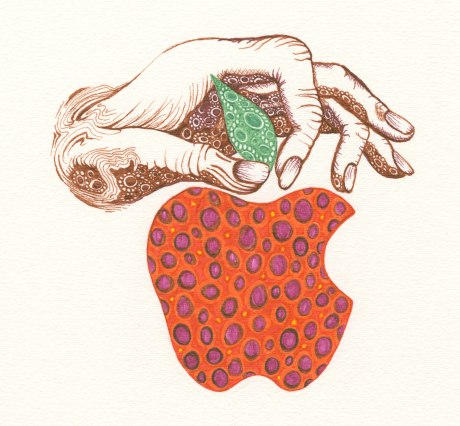
“Media as an extension of the human hand,” conceptual drawing by Meredith Eliassen, 2016
The cell phone can now be an interactive medium for child’s play and entertainment in an increasingly secular world. As folklorist, we can see with the lens of media ecology that this little device (like a play doll or ball of earlier days) has become an extension of the child or teenager’s arm and hand. Therefore, we can ask as with other media:
- Does this device structure what we can see and say and, therefore, do?
- Does this device assign to us roles to play? And then insist upon our playing them?
- Does this “smart” device explicitly specify what we are permitted to do and what we cannot do?
- Does this device offer half-concealed implicit and informal specifications that compel us assumption that what we are dealing with merely a machine and not a highly-corporate media environment?
When mass-produced toys create total-entertainment-experiences, society can loose ecosystems where holistic inner-imaginary landscapes flourish. Although folklorists will adapt to this technologist for studying First World childhood, we may need to head for the Cloud[s] to find our fodder for studying the real or ordinary lives of children. Media ecology surfaces roles that media compel us to play. Media ecology will continue to spotlight how emerging media structures the semantics of what we see and how media informs how we feel and act as we approach the gateway to the future with our eyes, ears, and hands wide open. In the coming weeks, I will explore the transitions of earlier media in this blog to identify areas that might be considered when asking the question: Is childhood at risk?
Here is a recent article from the Washington Post: And everyone saw it… by Jessica Contrera
To learn more about media ecologist go to the Media Ecologist Association.
Sarah Fielding & the Literary Fairy Tale
August 31, 2016
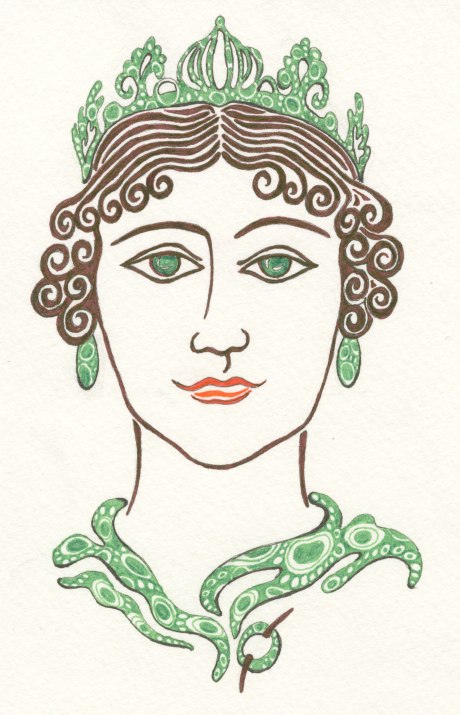
Design of “Princess Hebe” by Meredith Eliassen, 2016
Englishwoman Sarah Fielding (1710-68), the younger sister of author Henry Fielding, created an innovative work that included whimsical stories of fairies, giants, and animals that taught lessons about controlling vanity, envy and pride. Her novel, The Governess, or, The Little Female Academy (1749), taught didactic lessons to girls from eight to twelve years of age. The Governess has been called the first novel for children, but it was actually the first novel written for adolescent girls. Fielding’s logic appeared in genres familiar to females — the fable and fairy tale. The Governess became a textbook; its clean logic was perfect for teaching fundamental critical thinking to girls, its innovative feminine rhetoric remains seminal to understanding early fairy tales published in the United States between 1790 and 1820.
In her Dedication, Fielding referred to John Locke’s pedagogical theories when she asserted an inclination toward moral excellence might be gained with the suppression of passion. John Locke (1632-1704), one of the most influential Enlightenment thinkers, suggested children could be educated to conform with a shift from the physical coercion to more modern psychological maneuvering. Fielding adapted the traditional practice of a tutor (or governor) teaching sons into a suitable literary text designed to teach daughters: “The design of the following Sheets is to endeavour to cultivate and early Inclination to Benevolence, and a Love of Virtue, in the Minds of young Women by trying to shew them, that their True Interest is concerned in cherishing and improving those amiable Dispositions into Habits; and in keeping down all rough and boisterous Passions; and that from this alone they can propose to themselves to arrive at true Happiness, in any of the Stations of Life allotted to the Female Character.”
The Governess was the first novel to depict realistic juvenile characters in recognizable settings. Its frame story centers on daily activities in a boarding school for adolescent girls. The action of the novel begins when Mrs. Teachum’s students resort to violence over apples. The initial conflict creates the justification for imbedding tales that lead to character development. The governess, Mrs. Teachum, employs persuasion rather than force to instruct. Mrs. Teachum encourages the girls to read stories to each other, and then instructs her assistant to point out morals in the stories: “The misses all agreed, that certainly it was of no Use to read, without understanding what they read.” Fielding concluded, “This I have endeavoured to inculcate, by those Methods of Fable and Moral, which have been recommended by the wisest Writers, as the most effectual means of conveying useful Instruction.”
British essayist Joseph Addison asserted that fables flourished during periods “when Learning [was] at its greatest Height.” Readings provoke pupils to confess incidents that build upon themes of how passion, lying, cunning, and envy adversely affect chances for happiness. Fielding led a movement to utilize oral traditions including fables to teach girls good moral conduct. “The Story of Caelia and Chloe,” an exemplary tale, warned of the danger of using deceit and exerting will. Twin sisters, twenty-two years old, meet an intelligent lieutenant colonel named Sempronius. He cannot determine which sister to marry, so he goes to Chloe and explains to her that he loves Caelia and wants to marry her. Chloe dissuades Sempronius by lying about Caelia’s character. Chloe tells him that her sister is prone to horrible fits of rage, and that she would make him a poor wife. Confused by this poor report of Caelia’s character, Sempronius next goes to Caelia with the same message, telling her that he loves her sister and wants to marry her. Caelia, who has a sweet and loving temperament, is disappointed by this confession, because indeed, she loves Sempronius deeply. However, unable to speak badly of her sister, Caelia blesses the union. Sempronius leaves when he notices the difference in behavior between the two sisters. He returns to explain to Caelia how Chloe badmouthed her, but Caelia refuses believe him. Chloe becomes ill when she realizes that Sempronious has caught her in a lie. As Chloe’s lies weigh on her conscience, her “dis-ease” grows. Sempronius leaves with his regiment, and Caelia remains by her sister’s side to nursing her. Chloe grows worse under the weight of her guilt, until she confesses her transgression. Caelia blesses Chloe’s engagement to Sempronius, and peace is restored when the truth because both are equally provided for in the story’s resolution.
The Governess equates happiness with conformity and group cohesion. Mrs. Teachum instructs her assistant to choose fairy tales that illustrate how patience can present opportunities to prevail in adversity: “But neither this high-sounding Language, nor the supernatural Contrivances in this Story do I so thoroughly approve, as to recommend them much to your Reading; except, as I said before, great Care is taken to prevent your being carried away, by these high-flown Things, from that Simplicity of Taste and Manners which is my chief Study to inculcate.”
COMING IN SEPTEMBER… a discussion of media ecology in relation to childhood… stay tuned.
Angelou on the Semantics of Education
August 30, 2016

“Education is man’s most amazing tool… amazing toy, or effective tool, or it can be… man’s most effective weapon. Education” Maya Angelou “Blacks, Blues, Black!,” 1968. Design by Meredith Eliassen
“Blacks, Blues, Black!” (Episode 6: Education)
Conversely, Native Americans in California used baskets as if they are extensions of the human body; infants were immersed in water-holding baskets as they get immersed in culture. Basket makers are engineers who create amplified baskets from spiritualized raw natural materials; as children learned gendered tasks related to basket and net making, they learned cultural values. Here we perceive the concept of ecology as the study of environment and how its structure and content impact human beings. When the United States government attempted to eradicate the tribes in southern Oregon, they destroyed functional Native American baskets as a war tactic. In southern Oregon, during the Rogue River Indian War (1855-1856), vigilantes and army troops attacked Tututni villages employing a military tactic to undermine tribal stability by destroying all baskets and their contents that were use in every aspect of life, because without baskets, the tribes were unable to survive (See note).
In medieval European England, Biblical translator and reformer John Wycliffe (1338-1384) came to regard the scriptures as the only reliable guide to the Truth that came from God. Wycliffe maintained that all Christians should rely on the Bible rather than on the teachings of popes and clerics. He said that there was no scriptural justification for the papacy. In keeping with Wycliffe’s belief that scripture was the only authoritative reliable guide to living a good life, he became involved in efforts to translate the Bible into English as a means of empowering the common folk. Wycliffe asserted that not having English-language Bibles meant that it was not accessible to laypeople, therefore the common people were being deprived of God’s Word because it was written in the language of a foreign people.
Note: Stephen Dow Beckham, Requiem for a People: The Rogue Indians and the Frontiersmen (Norman: University of Oklahoma Press, 1971), 27.
A Toddler named Alma, on the sky…
August 29, 2016
British politician and orator William Gladstone (1809-1898) studied The Iliad and The Odyssey by the Greek writer Homer who was active during the eighth century BC, and came to the conclusion that Homer must have been colorblind. However more recently, scholars have come to believe that color perception must be evolving and that perhaps, the world saw in black and white until a human consciousness reached for the perception of additional colors over many generations; that our ancestors could see first black and white, followed by red, yellow, green and then blue.

Consider “boo” for blue… is the sky blue? Alma responds, “Blue, eh no, white, um no blue…” Design by Meredith, 2016.
My friend Ella turned me on to this program by Radio Lab…
Radio Lab: Why Isn’t the Sky Blue? http://www.radiolab.org/story/211213-sky-isnt-blue/ Radiolab is a show about curiosity. Where sound illuminates ideas, and the boundaries blur between science, philosophy, and human experience.
The program asserted that colors entered the human consciousness as they were manufactured, and the earliest manufactured blue pigment was created in ancient Egypt.

Some ancient beads from Egypt.
 MME Designs's Weblog